

What if the traditional advice to stay off your feet is actually the very thing slowing your recovery down? While resting a swollen ankle feels like the safest choice, staying stationary for too long often creates a “proprioceptive gap,” leaving your joint vulnerable to the recurring “giving way” sensation that many athletes and walkers in Johor Bahru fear. Finding the right ankle sprain physiotherapy jb is about more than just managing immediate pain; it’s about rebuilding the neural pathways that keep you stable on your feet.
We understand the frustration of being sidelined from your morning walks at Hutan Bandar or missing your weekly badminton sessions due to a lingering ache. You shouldn’t have to guess whether it’s time to move or time to rest. This article provides a professional roadmap to help you transition from acute injury to full agility. We’ll preview a comprehensive checklist that covers everything from initial assessment to corrective exercises, ensuring your recovery is both rapid and permanent.
Key Takeaways
- Learn to distinguish between micro-tears and complete ligament ruptures using the Grade 1 to 3 severity spectrum to inform your recovery timeline.
- Understand why professional ankle sprain physiotherapy jb is essential for closing the “Proprioception Gap” and preventing the long-term risks of Chronic Ankle Instability.
- Discover how specialized techniques like Hands-On Manual Therapy and Dry Needling restore joint glide and release protective muscle guarding.
- Follow a methodical, phased rehabilitation roadmap that transitions safely from initial protection to progressive loading and full agility.
- Identify the key credentials and clinical standards to look for when choosing an evidence-based specialist in the Johor Bahru area.
Understanding Your Injury: The Ankle Sprain Severity Checklist
An ankle sprain occurs when the joint is forced beyond its normal range of motion, typically causing the foot to turn inward. This sudden motion places excessive stress on the lateral ligaments, which act as the primary stabilizers of your joint. Understanding Ankle Sprains is the first step toward effective rehabilitation, as the specific grade of tissue damage dictates the pace of your recovery. While it’s common to hear that sprains heal on their own, an unmanaged injury often leads to long-term instability or chronic pain.
Self-Assessment: Grading Your Sprain
To understand the severity of your injury, clinicians use a three-tier grading system. Identifying where you fall on this spectrum helps determine the intensity of your ankle sprain physiotherapy jb program and sets realistic expectations for your return to activity.
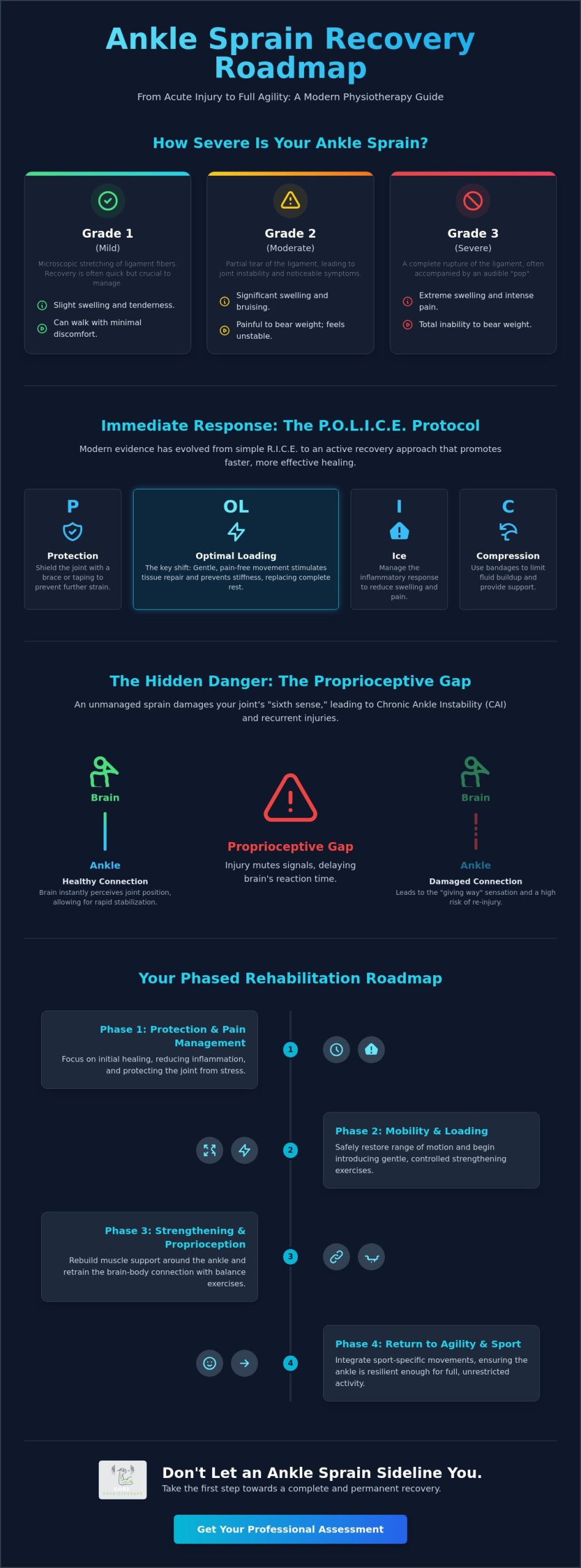
- Grade 1 (Mild): This involves microscopic stretching of the ligament fibers. You’ll notice slight swelling and tenderness, but you can usually walk with minimal discomfort. Recovery is typically fast, but ignoring it can lead to future vulnerability.
- Grade 2 (Moderate): A partial tear of the ligament occurs. This results in significant swelling, bruising, and a feeling of “looseness” in the joint. Bearing weight is typically painful, and the joint feels unstable during movement.
- Grade 3 (Severe): This represents a total rupture of the ligament. You might hear an audible “pop” at the time of injury. There is extreme swelling, intense pain, and a total inability to bear weight.
You should seek immediate clinical attention if you notice a visible deformity, localized bone tenderness, or if you cannot take four steps independently. These red flags may indicate a fracture or a more complex structural issue that requires diagnostic imaging before starting rehabilitation.
The Immediate Response Protocol
For years, the standard advice was R.I.C.E. (Rest, Ice, Compression, Elevation). However, modern evidence-based practice has shifted toward the P.O.L.I.C.E. principle. This protocol emphasizes active recovery over total immobilization, which is a cornerstone of effective ankle sprain physiotherapy jb.
Protection involves using a brace or supportive taping to shield the damaged tissue from further strain during the initial healing phase. Optimal Loading is the most significant change from traditional methods. Instead of complete rest, we encourage gentle, pain-free movement. This controlled activity stimulates tissue repair, maintains muscle activation, and prevents the joint from becoming excessively stiff. Finally, Ice and Compression are utilized to manage the inflammatory response effectively, reducing the pressure caused by fluid buildup so you can begin functional exercises sooner.
Why Root Cause Analysis is Critical for Ankle Sprain Physiotherapy in JB
Many people assume that once the swelling subsides and the bruising fades, the injury is healed. This is a common misconception that often leads to Chronic Ankle Instability (CAI). Effective ankle sprain physiotherapy jb must look beyond the surface of the skin to address the neurological and biomechanical shifts that occur after a trauma. When you “walk it off,” you might be training your body to compensate in ways that eventually lead to knee or hip pain. These compensations are often invisible to the untrained eye but have a profound impact on your long-term mobility.
Restoring the Brain-Body Connection
Proprioception is your sixth sense. It’s the ability of your brain to perceive where your foot is in space without you looking at it. This sense is powered by mechanoreceptors, which are tiny sensors within your ligaments. When a sprain occurs, these sensors are often damaged or muted. Without them, your brain cannot react fast enough to a curb or an uneven patch of grass. A Professional Movement Assessment in Johor Bahru is vital for identifying these neurological deficits. We focus on pinpointing exactly where the communication between your ankle and your brain has broken down.
Preventing the Cycle of Recurrent Sprains
The statistics are sobering. In a study of Malaysian Hockey League players, sprains and strains accounted for 63% of injuries, illustrating how frequent these setbacks are in active populations. This is often due to “Functional Instability.” While your ligaments might have physically healed, your muscles aren’t firing with the correct timing to protect the joint. Incorporating specific Ankle Rehabilitation Exercises into your daily routine is a positive start, but these must be tailored to your unique movement patterns to be truly effective.
Generic exercise sheets often fail because they don’t account for the kinetic chain. If your ankle remains stiff, your knee has to work harder to absorb impact during a walk. If your hip is weak, your ankle takes the brunt of every step you take. Our approach to ankle sprain physiotherapy jb involves a deep, root-cause analysis to ensure every link in your physical chain is supporting your recovery. If you’re tired of the cycle of re-injury, consider starting with a thorough Initial Assessment to build a foundation for lasting health. Identifying these root causes early prevents a simple twist from becoming a lifelong limitation.
The Physiotherapy Checklist: Evaluating Treatment Modalities in Johor
Selecting the right ankle sprain physiotherapy jb involves more than just finding a clinic with a treadmill. It requires a clinical environment where evidence-based modalities are applied with precision to match your specific stage of healing. While the early phases of recovery focus on protection, the middle and late stages must prioritize the restoration of structural integrity and functional movement. A comprehensive checklist should include interventions that address both the joint mechanics and the soft tissues that support them.
Hands-On Interventions for Immediate Relief
Hands-On Manual Therapy is a primary tool for restoring normal joint glide. Following a sprain, the talus bone often shifts slightly forward, creating a mechanical block that limits your ability to pull your toes toward your shin (dorsiflexion). Our clinicians use specific joint mobilization techniques to gently glide the joint back into its optimal position, which often results in an immediate reduction in that “pinched” feeling at the front of the ankle. We also apply myofascial release to the calf and peroneal muscles, which often tighten as a protective response to the injury.
Beyond mechanical alignment, manual therapy is highly effective at accelerating lymphatic drainage. By using rhythmic, targeted pressure, we help the body move stagnant inflammatory fluid away from the joint. This process is a vital part of professional sprained ankle diagnosis and treatment, as reducing swelling quickly allows for an earlier transition into weight-bearing exercises. It’s the difference between waiting weeks for the “puffiness” to go down and seeing visible improvement in just a few sessions.
Advanced Recovery with Dry Needling
Many patients are surprised to learn that their lingering ankle pain is actually being caused by trigger points in the lower leg. Dry Needling allows us to target these deep muscle knots that manual massage cannot reach. By inserting a fine, sterile needle into the peroneal or gastrocnemius muscles, we can release the “guarding” reflex that often persists long after the initial twist. This technique is particularly useful for those who feel their ankle is perpetually stiff or “stuck” despite doing their stretches.
Integrating this modality into a broader Pain Management Clinic in Johor Bahru approach helps reset the neuromuscular system. When a muscle is released via needling, the brain receives a “clear signal” from the joint once again, which directly improves your balance and reaction time. This isn’t just about pain relief; it’s about restoring the high-level agility needed for sports or walking on the uneven surfaces often found in local parks. When combined with Movement & Corrective Exercises, these modalities provide a robust foundation for a permanent recovery through ankle sprain physiotherapy jb.
Your Step-by-Step Rehabilitation Checklist: Phase 1 to Full Return
Recovering from a ligament injury requires a disciplined, phased approach. It’s not just about waiting for the calendar to turn; it’s about meeting specific functional milestones. This structured roadmap ensures you don’t skip vital steps that lead to long-term stability. Engaging in a specialized program for ankle sprain physiotherapy jb allows you to move through these phases with clinical guidance, ensuring each tissue layer is ready for the next level of stress. Each phase builds upon the last, moving you from simple protection to high-level performance.
Phase 1 & 2: Building the Foundation
The first four weeks are dedicated to calming the inflammatory response and reintroducing the joint to movement. During this time, your focus is on “quieting” the pain and preventing the scar tissue from becoming excessively stiff. You’ll know you’re ready to progress when you can check off these specific markers in your daily life:
- Can you walk without a limp? Gait normalization is the most critical milestone in the first fortnight. If you’re still favoring one side, your body is creating compensations.
- Is the morning stiffness reducing? A decrease in that “first-step-of-the-day” ache indicates the inflammatory cycle is successfully breaking.
- Can you perform isometric holds? Testing the muscles by pushing against a fixed object without moving the joint helps maintain strength during early healing.
Essential drills during this phase include ankle circles to maintain mobility, towel scrunches to engage the intrinsic foot muscles, and controlled isometric holds against a wall. These movements provide the necessary stimulus for repair without overstressing the healing lateral ligaments. Early loading, when done correctly, actually speeds up the collagen alignment in your ligaments.
Phase 3 & 4: Reclaiming Your Performance
Once the foundation is set, the focus shifts to high-level stability and power. This is where we address the “Proprioceptive Gap” mentioned earlier. You’re no longer just a patient; you’re an athlete in training. Whether your goal is returning to the badminton courts or enjoying a brisk walk through JB’s parks, these performance markers are non-negotiable for a safe return. Athletes looking to restore their competitive edge can benefit from a dedicated sports physio at Eco Palladium program that addresses the biomechanical foundations of movement alongside these functional milestones:
- Single-leg balance (30 seconds): This tests the neurological connection between your brain and your foot. You should be able to do this with your eyes closed for a true test of stability.
- Pain-free single-leg hop: This confirms that your ligaments and tendons can handle the force of impact loading and rapid deceleration.
- Symmetry in calf strength: Ensuring your injured side is as strong as your healthy side is vital for preventing future tears.
Advanced drills like perturbation training, where a therapist gently nudges you while you balance, help “wake up” your reaction time. Plyometric landings teach your body how to absorb force safely. For competitive athletes who want to go beyond basic recovery and unlock their full athletic potential, a structured sports performance physiotherapy in Johor program provides the elite-level framework needed to master the precise mechanics of movement under load. If you’re unsure if you’re ready for these high-impact movements, it’s time to book an Initial Assessment to get professional clearance. Moving too fast can lead to setbacks, but moving with a plan ensures you reclaim your vitality with confidence and peace of mind.
Choosing the Right Ankle Sprain Specialist in Johor Bahru
Selecting the right partner for your recovery is a decision that affects your mobility for years to come. While many clinics offer general rehabilitation, finding specialized ankle sprain physiotherapy jb requires looking for a provider that prioritizes evidence-based protocols over outdated methods. In Malaysia, all practicing physiotherapists must be registered under the Allied Health Professions Act 2016. Ensuring your clinician is registered with the Malaysian Allied Health Professions Council is the first step in verifying they meet the national standards for qualification and ethical practice.
What to Look for in a JB Physiotherapy Clinic
A clinical environment should feel like a partnership in your long-term health. When evaluating a clinic, your first question should be about their assessment process. A quick five-minute check isn’t enough to identify the subtle movement compensations that lead to re-injury. You need a comprehensive Initial Assessment that examines your balance, joint glide, and the strength of the entire kinetic chain. Look for a facility that focuses on one-on-one care rather than juggling multiple patients at once. This personalized attention ensures that your form during Movement & Corrective Exercises is perfect, which is essential for safely closing the “Proprioceptive Gap” we discussed earlier.
Accessibility also plays a vital role in your success. Ligament remodeling is a biological process that requires consistency. Choosing a clinic with a supportive environment and a convenient location makes it easier to stay committed to your program during the challenging middle phases of recovery. If the space feels institutional or rushed, it can hinder the steady, optimistic demeanor needed for a successful rehabilitation journey.
Why Core Physiotherapy is the Choice for JB Residents
At Core Physiotherapy PLT, we approach ankle rehabilitation with a focus on root-cause analysis. Our clinic, conveniently located near Eco Palladium, serves as a dedicated space for those who refuse to let a “simple twist” turn into a lifelong limitation. We don’t believe in superficial fixes. Instead, we integrate Hands-On Manual Therapy to restore joint mechanics with targeted Dry Needling to release the protective muscle guarding that often stalls progress. This combination allows our patients to move into active loading much sooner than traditional rest-based approaches would allow.
Our programs are specifically tailored to the unique lifestyle needs of Johor Bahru residents, from the weekend badminton player to the professional who enjoys long walks in Hutan Bandar. We treat you as an individual, not a diagnosis. By combining clinical precision with a deeply empathetic approach, we help you navigate the transition from pain to performance. If you’re ready to move past the fear of re-injury and reclaim your agility, our team is here to act as your knowledgeable, disciplined guide. Your journey to a stronger, more stable ankle starts with a commitment to evidence-based care and a clear roadmap to recovery.
Step Into Your Strongest Future
Recovering from an ankle injury is a journey that requires more than just patience; it demands a structured, evidence-based plan. By moving through the methodical phases of protection, mobility, and high-level agility, you can ensure that a temporary twist doesn’t lead to a lifetime of chronic instability. Addressing the neurological “proprioceptive gap” is the final, vital step in reclaiming your confidence on the badminton court or during your weekend walks through Johor’s parks.
At Core Physiotherapy PLT, our expert therapists specialize in root-cause movement analysis to identify exactly why your injury occurred and how to prevent its return. We utilize clinical protocols designed for a faster return-to-sport, ensuring every ligament and muscle is prepared for the demands of your lifestyle. Conveniently located for JB and Eco Palladium residents, we provide a supportive, one-on-one environment for your ankle sprain physiotherapy jb journey.
Don’t let a lingering ache dictate your activity levels. Book Your Initial Ankle Assessment at Core Physiotherapy JB today and start your professional roadmap toward full agility. We’re ready to partner with you in restoring your health and vitality with quiet confidence and lasting results.
Frequently Asked Questions
How many physiotherapy sessions will I need for a standard ankle sprain in JB?
The number of sessions required depends on the severity of your ligament damage and your specific recovery goals. For a mild Grade 1 sprain, you might only need two to four sessions to restore full function. More complex Grade 2 or 3 injuries typically require six to twelve sessions to address tissue healing and neuromuscular retraining. Your ankle sprain physiotherapy jb plan will be adjusted based on how quickly you meet your functional milestones.
Can I continue to walk or exercise while undergoing ankle physiotherapy?
You are encouraged to remain active, provided the movement is pain-free and doesn’t stress the healing ligaments. Following the “Optimal Loading” principle, we often suggest low-impact activities like swimming or stationary cycling during the early phases of recovery. Total immobilization is rarely recommended as it can lead to joint stiffness and muscle atrophy. We will guide you on exactly which movements are safe for your current stage of healing.
What is the typical cost of ankle sprain physiotherapy in Johor Bahru?
Costs for physical therapy in the Johor Bahru region vary based on the clinic’s location and the specific modalities used during your session. While some facilities charge per treatment, others offer structured packages for comprehensive rehabilitation. It’s best to check with your provider regarding their specific rates and whether they offer bundled sessions for long-term recovery plans. Most professional clinics maintain transparent pricing for their initial assessments and follow-up care.
Is dry needling safe for a recently sprained ankle?
Dry needling is a safe and effective tool once the initial acute inflammatory phase has subsided. It is particularly useful for releasing the protective muscle guarding that occurs in the calf and peroneal muscles after a twist. By resetting these overactive muscle fibers, we can reduce referred pain and improve your joint’s range of motion. This modality is always applied with clinical precision to ensure it supports your overall recovery goals.
How do I know if my ankle sprain requires surgery instead of physiotherapy?
Most ankle sprains are managed successfully through non-surgical rehabilitation and corrective exercise. Surgery is typically reserved for cases involving associated fractures or severe Grade 3 ruptures that result in persistent, chronic instability despite months of dedicated physical therapy. A thorough clinical assessment is the best way to determine if your injury requires a surgical consultation or if a structured ankle sprain physiotherapy jb program is the appropriate path.
Will my insurance cover physiotherapy for an ankle sprain in Malaysia?
Many private health insurance policies in Malaysia provide coverage for physiotherapy, though the specific terms vary significantly between providers. Some insurers require a formal referral from a general practitioner or specialist before they will process a claim. It’s advisable to contact your insurance agent to verify your coverage limits and any documentation requirements. We can provide the necessary clinical reports and receipts to assist you with your claims process.
What happens if I leave my ankle sprain untreated for too long?
Neglecting a sprain often leads to Chronic Ankle Instability and a permanent “proprioceptive gap” in your balance. When the ligaments and nerves don’t heal correctly, you become significantly more likely to suffer recurrent twists. Over time, these unresolved mechanical issues can cause compensatory pain in your knees, hips, and lower back. Early intervention ensures that your joint regains its full structural integrity and neurological responsiveness.