
What if the persistent ache in your lower back isn’t actually a back problem, but a clever compensation for the way your ankle or hip moves? Many people in Malaysia struggle with recurring neck or joint pain that seems to vanish after a massage, only to return with a vengeance the next morning. If you’ve found yourself frustrated by temporary fixes or confused about which gym exercises are truly safe for your body, you aren’t alone. Seeking a professional movement assessment in Johor Bahru is the first step toward moving away from surface-level treatments and toward a deeper understanding of your physical health.
At Core Physiotherapy PLT, we believe that movement is a language, and a clinical assessment translates your pain into a precise recovery blueprint. You deserve a clear explanation of why your body is reacting this way and a personalized plan that avoids surgical intervention. By working with a registered physiotherapist under the Malaysian Allied Health Professions Council, you gain the confidence to return to sports and daily life safely. This article will show you how identifying the root cause of your discomfort provides the roadmap you need for long-term vitality and lasting relief.
Key Takeaways
- Understand how a clinical movement assessment identifies the specific functional patterns causing your pain rather than just treating superficial symptoms.
- Learn why a professional movement assessment in Johor Bahru is essential for uncovering “energy leaks” and biomechanical imbalances that lead to chronic injury.
- Discover the limitations of passive treatments like massage and how active, assessment-led therapy provides a clearer roadmap for long-term recovery.
- Gain clarity on the clinical evaluation process, ranging from the initial history interview to functional drills and specific strength testing.
- See how personalized assessment data is used to design a corrective exercise program and manual therapy plan tailored to your unique physical needs.
What is a Clinical Movement Assessment and Why Does It Matter?
A movement assessment is a systematic, clinical observation of your functional patterns. It goes far beyond a simple physical exam. While many traditional checks focus on static posture, such as how you stand or sit, a dynamic movement screen analyzes your body in motion. This process identifies how your joints and muscles coordinate to perform specific tasks. Understanding “how” you move is often much more critical than focusing solely on “where” it hurts. By observing your body’s unique mechanics, we can pinpoint the “silent” compensations you’ve developed over time. These subtle shifts in movement often act as the hidden drivers of future injuries, even if they aren’t causing pain today.
Choosing a professional movement assessment in Johor Bahru allows you to see your body through a clinical lens. It’s a proactive approach to health. Instead of waiting for a joint to fail or a muscle to tear, we look for the underlying dysfunction before it becomes a chronic limitation. This methodical approach, also championed by holistic wellness studios like Livelovelife Chiropractic, ensures that your recovery isn’t just about temporary relief, but about building a foundation for long-term physical improvement and vitality.
The Difference Between Assessment and Diagnosis
Medical doctors often provide a diagnosis, which identifies a specific condition like a “slipped disc” or “meniscus tear” using tools like an MRI. While a diagnosis is important, it doesn’t always explain the root cause. An MRI might show structural changes, but it won’t show the movement fault that placed excessive stress on that tissue in the first place. At Core Physiotherapy PLT, our initial assessment focuses on the biomechanical “why.” In the modern rehabilitation landscape of Johor Bahru, this shift toward functional assessment is vital. We look beyond the scan to understand the movement dysfunction that led to your discomfort, ensuring we treat the source rather than just the symptom.
Common Signs You Need a Professional Evaluation
Many people live with low-level discomfort, assuming it’s a normal part of aging or an active lifestyle. However, certain signs indicate that your body is struggling to compensate for a deeper issue. You should consider a movement assessment in Johor Bahru if you notice:
- Recurring Pain: Discomfort that vanishes after a massage or a few days of rest, only to return the moment you resume your normal activities.
- Persistent Tightness: Feeling “stiff” in your hamstrings, hips, or neck despite regular stretching, foam rolling, or yoga sessions.
- Performance Plateaus: An inability to increase your gym weights or improve your sports performance because of nagging joint aches.
- Movement Fear: Feeling confused or hesitant about which exercises are truly “safe” for your specific injury history.
Addressing these signs through a clinical lens provides the clarity you need to move forward. It replaces guesswork with a personalized plan designed to return you to the activities you love without the fear of re-injury.
The Science of Root Cause: How We Analyze Your Bio-mechanics
The human body functions as a complex, integrated system rather than a collection of isolated parts. When one area lacks the necessary mobility or stability, the rest of the system must adapt to keep you moving. This is why a clinical movement-based pain assessment is so critical. It allows us to look beyond the localized site of discomfort to see how your entire body distributes force. During a professional movement assessment in Johor Bahru, we utilize evidence-based tests to quantify your movement quality. We look for “energy leaks,” which occur when force is lost through unstable joints or inefficient patterns, forcing other tissues to work harder than they were designed to. Over time, these leaks lead to the wear and tear we recognize as chronic pain.
Your brain is incredibly efficient at completing tasks, even if it means sacrificing long-term joint health. If a specific movement causes pain, your central nervous system “rewires” your motor patterns to find a path of least resistance. While this avoids immediate sharp pain, it creates a new set of biomechanical problems. Our goal is to identify these neurological workarounds and restore your body’s natural, efficient pathways. Understanding your unique bio-mechanics through an initial assessment provides the data-driven clarity needed to stop this cycle of compensation.
The Kinematic Chain: Everything is Connected
The kinematic chain describes how force travels through your joints in a linked sequence. For instance, a stiff ankle that cannot flex properly during a walk or run will often force the lower back to over-extend to compensate for the lost range of motion. In this scenario, the back isn’t the problem; it’s the victim of the ankle’s limitation. By assessing the whole body from the feet to the neck, we ensure that we aren’t just chasing the symptom, but addressing the mechanical driver of the issue. This same whole-body perspective is essential when addressing spinal conditions, and understanding how movement-based approaches support scoliosis management in Johor Bahru illustrates how a curved spine can create far-reaching compensations throughout the entire kinematic chain.
Understanding the top of the spine is particularly crucial, as misalignments there can affect the entire body’s balance. To explore how specialized chiropractic methods address these foundational issues, you can discover Precision Spinal Care and learn about their focus on gentle NUCCA treatments as a resource for structural health.
Identifying Compensatory Movement Patterns
Compensations are essentially your body’s “Plan B” for movement. They often feel completely normal to you because your brain has habituated to them over months or years. However, these patterns are clinically inefficient and place excessive load on structures like ligaments and tendons. Professional therapists are trained to spot these subtle shifts, such as a slight hip hike or a shoulder shrug during a simple squat or reach. Recognizing these “Plan B” movements is the first step in retraining your body to move with its intended precision and ease.
Movement Assessment vs. Traditional Symptom-Based Treatment
Traditional treatments often focus on the site of pain, utilizing “passive” modalities like heat packs, general massage, or medication to provide immediate relief. While these methods can reduce discomfort temporarily, they frequently fail to address why the pain started. This approach often leads to a cycle of chronic pain where symptoms are masked but the underlying mechanical fault remains. In contrast, an active, assessment-led approach prioritizes long-term function. By choosing a professional movement assessment in Johor Bahru, you shift the focus from merely “feeling better” to “moving better.” This transition is vital for anyone looking to return to high-impact activities without the constant fear of a relapse. If you find yourself caught in this cycle, learning more about a dedicated pain management clinic in Johor Bahru can help you understand how evidence-based recovery differs from symptom masking.
Investing in a root-cause analysis is also a matter of cost-effectiveness. While the initial price of physical therapy in the Johor Bahru District typically starts from RM100, the long-term savings are substantial. Identifying a biomechanical issue early prevents the need for years of recurring medication, expensive imaging, or invasive surgical procedures. It provides a definitive roadmap, replacing the “wait and see” mentality with a proactive strategy for physical improvement and sustained health. To understand why discomfort so often returns despite treatment, exploring the principles behind root cause pain analysis in JB reveals how a methodical, evidence-based assessment can uncover the true biomechanical source of your distress.
The Limitations of Temporary Relief
Hands-on manual therapy and dry needling are highly effective tools, but their true value is unlocked when guided by a clinical assessment. Without a clear understanding of your movement faults, these treatments only offer a “reset” for your muscles. If the underlying cause, such as a stability deficit or a joint restriction, isn’t corrected, your body will simply return to its painful state. Breaking the “Pain-Rest-Pain” cycle requires the clinical insight gained from observing your body in motion, ensuring that every therapeutic intervention serves a specific purpose in your recovery journey.
Why ‘Generic’ Workouts Often Fail Post-Injury
It’s tempting to follow “one-size-fits-all” rehab protocols found online, but these generic routines often ignore your unique compensations. A “safe” exercise for one person might be detrimental to another if their movement mechanics are different. A customized movement assessment in Johor Bahru ensures that your gym or sports routine supports your specific recovery needs. There’s a significant psychological benefit to this clarity. When you understand exactly what’s wrong with your movement, you can train with confidence, knowing that your efforts are building a stronger, more resilient body rather than aggravating an old injury.
What to Expect During Your Movement Assessment in Johor Bahru
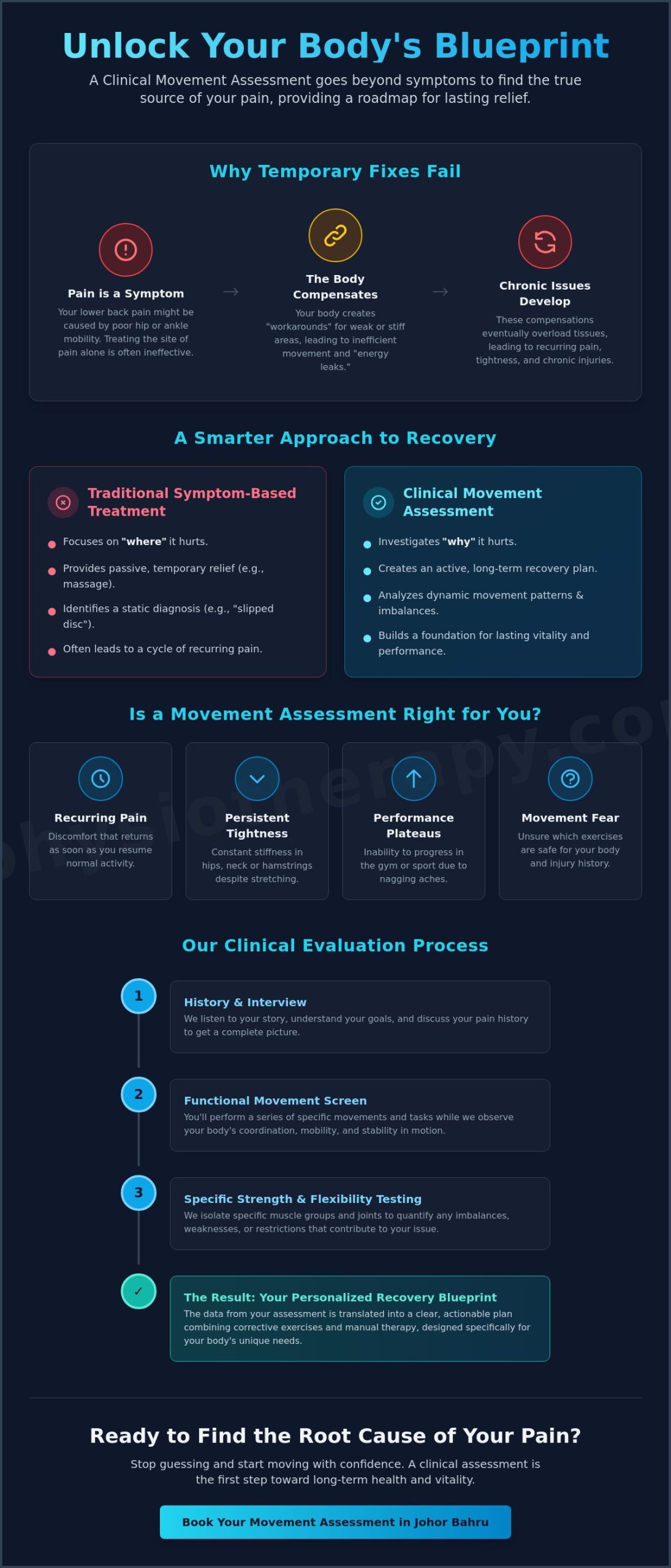
Entering a clinic for a movement assessment in Johor Bahru is a collaborative experience designed to bridge the gap between clinical data and your personal recovery goals. Unlike a standard medical checkup that might feel rushed, this process is methodical and thorough. It begins with a detailed initial interview where we explore your injury history, daily habits, and the specific activities you wish to reclaim. We don’t just want to know where it hurts; we want to understand how your pain limits your life, whether that is playing a round of golf at Horizon Hills or simply lifting your child without hesitation.
Following the interview, the physical evaluation begins. This involves a series of range of motion tests, strength measurements, and functional drills. We observe how you move through space, looking for the compensations discussed in previous sections. The session concludes with a “Report of Findings.” This is a transparent conversation where your therapist explains the results of the tests, identifies the mechanical drivers of your pain, and outlines a clear path forward. You can book your initial assessment to begin this journey toward a more resilient body.
Preparing for Your Session
To get the most out of your evaluation, proper preparation is essential. We recommend wearing flexible, athletic clothing that allows for a full range of motion. Tight or restrictive garments can mask subtle movement faults that are crucial for an accurate diagnosis. If you have previous medical reports, X-rays, or MRI scans, please bring them along. While we focus on movement, these documents provide valuable context to your structural health. Mentally, be ready to discuss your lifestyle in detail. Small habits, such as how you sit at your desk or your preferred sleeping position, often provide the final piece of the biomechanical puzzle. For professionals who spend long hours at a workstation, pairing your movement evaluation with a dedicated ergonomic assessment in Johor Bahru can reveal how your desk setup may be reinforcing the very compensations we identify in the clinic.
The Assessment Journey: Step-by-Step
- Step 1: Subjective History and Lifestyle Audit. We discuss your symptoms, past injuries, and what a “successful” recovery looks like to you.
- Step 2: Objective Movement Screening. You’ll perform fundamental patterns like squatting, lunging, and reaching so we can observe your joint coordination in real-time.
- Step 3: Specific Orthopedic and Neurological Testing. We isolate individual muscles and joints to check for underlying weakness or nerve involvement.
- Step 4: Collaborative Goal Setting. We translate the data into a personalized recovery plan that fits your schedule and physical demands.
For those visiting our clinic in the Eco Palladium area, we suggest arriving 10 minutes early to find parking and settle in. The vibrant environment of this JB district offers a modern backdrop for your rehabilitation, making your health journey feel like a proactive lifestyle choice rather than a clinical chore. Our goal is to ensure you leave the first session with total clarity about your condition and a renewed sense of optimism for your recovery.
Transforming Results into Recovery at Core Physiotherapy
Once the clinical data from your movement assessment in Johor Bahru is gathered, the focus shifts toward precise application. We don’t believe in generic protocols or short-term “cracking” sounds that provide only fleeting relief. Instead, we use your unique biomechanical profile to select the most effective interventions from our clinical toolkit. This evidence-based approach ensures that every session of Hands-On Manual Therapy or Dry Needling serves a specific purpose: resolving the movement faults identified during your evaluation. By focusing on the root cause, we help Johor Bahru residents move past the frustration of recurring injuries and toward a life of sustained physical vitality.
Our commitment to your long-term health means moving away from a passive patient role and toward an active partnership. We use the findings from your movement assessment in Johor Bahru to create a roadmap that is both logical and progressive. You won’t just leave with a list of exercises; you’ll leave with a deep understanding of why those specific movements are necessary for your recovery. This clarity builds trust and ensures that your path to improvement is steady, deliberate, and grounded in modern movement science.
Personalized Corrective Exercise Programs
True recovery happens when you’re empowered to manage your health outside the clinic walls. We design Corrective Exercises that target your specific “energy leaks” and muscle imbalances. The goal isn’t just to complete a certain number of repetitions, but to perform each movement with the correct “intent.” We teach you how to feel the right muscles working and how to maintain joint stability under load. This neurological retraining is what prevents old, painful patterns from returning.
We monitor your progress closely, adjusting the complexity of your program as your movement quality improves. As you get stronger, we transition your exercises to mimic the demands of your daily life or sport. This methodical progression ensures that you can return to the gym, the football pitch, or the golf course with total confidence in your body’s ability to perform safely and efficiently.
Integrated Therapy: Manual Skills Meet Movement Science
While manual skills are essential, they’re most effective when integrated with movement retraining. We use Hands-On Manual Therapy to “unlock” restricted joints and reduce muscle guarding, creating a “window of opportunity” for better movement. If a joint is stuck, you can’t move it correctly; if you can’t move it correctly, you can’t strengthen it. By combining manual techniques with targeted movement, we ensure that the gains you make in the clinic are translated into lasting functional improvements.
This synergy is particularly powerful when using Dry Needling to release deep-seated tension. By calming hyperactive muscles, we can more easily introduce the Corrective Exercises needed to stabilize the area. Your journey to pain-free living starts with this first step toward understanding your body. We’re here to act as your knowledgeable guide, helping you move with the health, vitality, and freedom you deserve.
Step into a Pain-Free Future with Clinical Clarity
Identifying the root cause of your discomfort is the essential bridge between temporary relief and a lifetime of functional movement. By understanding the intricate connections within your body’s kinematic chain, you can finally move past the cycle of recurring pain and symptom masking. A professional movement assessment johor bahru provides the precise clinical data needed to replace guesswork with a personalized recovery roadmap. Whether you’re aiming to return to high-level sports or simply want to enjoy daily activities without stiffness, your long-term health depends on addressing how you move, not just where you feel pain.
Our dedicated team at Core Physiotherapy PLT is ready to act as your guide. We combine expert root cause analysis with personalized corrective exercise plans to ensure your physical improvements are sustainable and meaningful. Conveniently located in Eco Palladium, Johor Bahru, we provide the specialized environment you need to reclaim your vitality and physical freedom. Book Your Comprehensive Movement Assessment at Core Physiotherapy Today. Your journey toward a resilient, pain-free life begins with this single, informed step.
Frequently Asked Questions
What exactly happens during a movement assessment?
You undergo a systematic evaluation where a physiotherapist observes your functional movement patterns in real-time. This process includes performing specific drills such as squats, lunges, and reaching tasks to identify biomechanical imbalances. We analyze how your joints coordinate and where compensations occur. This data-driven approach allows us to pinpoint the specific mechanical faults driving your discomfort rather than just looking at the site of pain.
How long does a professional movement assessment take?
A comprehensive assessment typically lasts between 45 to 60 minutes. This duration ensures enough time for a thorough subjective history interview, objective physical testing, and a detailed discussion of the findings. We prioritize a methodical approach to ensure every nuance of your movement is captured. This thoroughness is essential for creating an accurate and personalized recovery roadmap that addresses your unique physical needs and lifestyle goals.
Do I need a doctor’s referral to get an assessment in Johor Bahru?
No, you don’t need a doctor’s referral to book a movement assessment johor bahru. Physiotherapists in Malaysia are first-contact practitioners, meaning you can seek our expertise directly for musculoskeletal issues. Our practitioners are registered under the Allied Health Professions Act 774, ensuring you receive care that meets national standards. If we identify issues requiring medical intervention, we’ll guide you toward the appropriate specialist for further investigation.
Can a movement assessment help with chronic pain I’ve had for years?
Yes, a clinical evaluation is often the key to resolving chronic pain that has persisted for years. Long-term discomfort usually involves deep-seated compensatory patterns that the brain has habituated to over time. By identifying these “Plan B” movements, we can begin the process of neurological retraining. This clinical insight helps break the cycle of chronic pain by addressing the underlying mechanical drivers that surface-level treatments often miss.
What should I wear to my physiotherapy assessment session?
You should wear flexible, athletic clothing that allows for an unobstructed view of your joints and muscles. Items like gym shorts, leggings, and a fitted t-shirt or tank top are ideal. This visibility is crucial for the therapist to spot subtle shifts in your biomechanics, such as a hip hike or shoulder shrug. Comfortable footwear is also recommended, as we may analyze your movement patterns while you’re standing or walking.
Is a movement assessment only for athletes and sports players?
No, this assessment is beneficial for anyone experiencing physical discomfort, regardless of their activity level. While athletes use it to optimize performance, office workers often need it to address postural strain and recurring neck or back pain. Movement is a fundamental part of daily life. Whether you want to lift your children safely or walk through Eco Palladium without ache, understanding your movement quality is the first step toward long-term vitality.
How often should I have my movement patterns re-assessed?
Re-assessment frequency depends on your specific goals, but we generally recommend a check-in every 4 to 6 weeks during active rehabilitation. This allows us to monitor your progress and adjust your corrective exercise program as your movement quality improves. For those in a maintenance phase, a semi-annual review of your movement assessment johor bahru results can help identify new compensations before they lead to injury, ensuring your health remains a proactive priority.
Will I get exercises to do at home after the assessment?
Yes, you’ll receive a personalized corrective exercise program designed to address the specific faults identified during your evaluation. These home-based exercises are essential for reinforcing the improvements made during clinical sessions. We ensure you understand the correct intent and technique for each movement, empowering you to take an active role in your recovery. Consistent practice at home is what builds the lasting resilience needed for a pain-free lifestyle.