

What if the standard advice to simply rest and ice your injury is actually the reason your ankle still feels unstable months later? Many athletes in Johor Bahru experience a frustrating cycle where an initial injury seems to heal, yet the joint feels untrustworthy during a game of football or badminton. Research indicates that the recurrence of chronic ankle instability after an initial sprain can be as high as 30% among young athletes. Choosing the right ankle sprain physiotherapy jb is the first step in breaking this cycle by moving beyond surface-level symptoms to address the true mechanics of your movement.
We understand the hesitation that comes with a recurring “giving way” sensation and the confusion surrounding whether to move or stay still. You deserve a recovery plan that prioritizes long-term stability over a quick, temporary fix. In this guide, we’ll explain how a root-cause approach using manual therapy and corrective exercises can restore your proprioception and strength. You’ll discover a structured path from initial assessment to full athletic reintegration, ensuring your return to sport is both safe and permanent.
Key Takeaways
- Learn to identify the severity of your injury and why the ATFL is the most vulnerable ligament during high-impact sports like badminton or futsal.
- Understand the vital role of proprioception, your body’s internal GPS, in preventing the “giving way” sensation that often leads to chronic instability.
- Discover how professional ankle sprain physiotherapy jb combines hands-on manual therapy with corrective exercises to restore joint mobility more effectively than generic home routines.
- Explore a structured 4-phase roadmap that transitions your recovery from initial pain management to full return-to-sport readiness.
- Find out why a comprehensive assessment of your hip and knee is essential to ensuring your ankle isn’t overcompensating for underlying biomechanical issues.
Beyond the Initial Twist: Understanding Ankle Sprains in Johor Bahru
An ankle sprain occurs when the ligaments supporting the joint are stretched or torn beyond their normal range. In the majority of cases, this involves the Anterior Talofibular Ligament (ATFL) on the outer side of the ankle. While many view a “twisted ankle” as a minor inconvenience, Understanding Ankle Sprains requires looking at the structural integrity of the joint. Without proper intervention, a simple stretch can lead to micro-tears that compromise your long-term mobility. In our community, these injuries are particularly prevalent due to the high-intensity nature of local sports like futsal and badminton, where sudden lateral pivots put immense strain on the ATFL.
For residents of Johor Bahru, recovery often faces a unique challenge known as the “Singapore Commuter Factor.” Many of our clients walk long distances across the Causeway or through the CIQ complex daily. This repetitive, weight-bearing stress on a healing ligament can delay recovery and lead to the formation of disorganized scar tissue. Relying on a “wait and see” approach often results in a stiff, weak joint that is prone to re-injury. Seeking professional ankle sprain physiotherapy jb early ensures that your recovery accounts for these daily lifestyle demands rather than just resting at home.
Common Causes: From Futsal Courts to Eco Palladium Jogging Paths
The local environment plays a significant role in how these injuries occur. We frequently see patients who have sustained injuries while navigating the uneven surfaces of trail runs or even during a routine evening jog at Eco Palladium. Sudden changes in direction on synthetic futsal pitches or the high-impact landings typical of badminton matches are primary triggers for ligament damage.
The humid Malaysian climate also contributes to the risk. High humidity can lead to moisture buildup inside sports shoes, reducing foot stability and increasing the likelihood of a slip. When combined with the physical fatigue that sets in after long working hours, your muscles become less efficient at protecting the joint. This makes the ankle vulnerable to the sharp, inward rolls that cause a classic inversion sprain.
The Risk of Chronic Ankle Instability (CAI)
One of the most significant dangers of an untreated sprain is the development of Chronic Ankle Instability (CAI). This condition is characterized by a persistent “giving way” sensation, where the ankle feels untrustworthy even on flat ground. Research indicates that approximately 20% to 30% of individuals who suffer an initial inversion sprain go on to develop long-term instability issues without structured rehabilitation.
Early warning signs that your injury requires professional ankle sprain physiotherapy jb include:
- A feeling of “looseness” or wobbling when walking on uneven grass.
- Recurrent swelling that returns after you attempt to play sports.
- Noticeable weakness when trying to stand on one leg.
- A clicking or catching sensation inside the joint during movement.
Addressing these symptoms through a clinical initial assessment is vital. Our goal is to ensure your ligaments heal with the necessary tension and strength to support your active lifestyle in Johor Bahru.
The Clinical Science of Ligament Healing and Proprioception
Recovering from an injury involves more than just waiting for the pain to subside. The Clinical Science of Ligament Healing demonstrates that while tissues physically knit back together, the functional stability of the joint depends on much more than just biological repair. In fact, physical healing is only about 50% of the journey. The remaining half involves retraining the nervous system to protect the joint during dynamic movements. Without this secondary focus, the ankle remains vulnerable to the next roll or twist on the court.
Grading Your Injury: When to Seek Immediate Help
Understanding the severity of your sprain helps determine the appropriate level of intervention. Clinicians categorize these injuries into three distinct grades based on the extent of ligament damage:
- Grade I: These involve microscopic tears in the ligament. You’ll experience mild swelling and tenderness, but you can usually bear weight. These cases often respond well to early, guided movement.
- Grade II: This signifies a partial tear. You’ll likely see significant bruising and find it difficult to walk without pain. Professional ankle sprain physiotherapy jb is essential here to ensure the ligament heals at the correct length.
- Grade III: This is a complete rupture of the ligament. You’ll experience severe swelling and an inability to put any weight on the foot. This grade requires intensive clinical rehabilitation and, in some cases, a specialist referral to rule out fractures.
If you’re unsure where your injury falls, scheduling an initial assessment can provide the clinical clarity needed to start the right recovery path.
The “Hidden” Injury: Loss of Balance and Neuromuscular Control
When you twist your ankle, you don’t just damage the tissue; you disrupt the communication lines between your joint and your brain. Ligaments are packed with sensory receptors that tell your brain where your foot is in space. A sprain essentially “shuts off” these signals, leaving your brain blind to the ankle’s position. This is why strength alone isn’t enough to prevent re-injury during a fast-paced futsal match. Your muscles might be strong, but if they don’t fire at the exact millisecond you land, the joint will collapse again.
Proprioception is the body’s essential inner sense that allows you to perceive the position and movement of your joints without looking at them.
Restoring this “GPS” system is a core pillar of effective ankle sprain physiotherapy jb. By challenging your balance through progressive exercises, we help your nervous system regain control. This neuromuscular retraining ensures that your body can react instinctively to uneven surfaces, keeping you stable and confident as you return to your favorite activities.
Manual Therapy vs. Generic Exercise: The Multi-Modal Approach
Many individuals attempting to manage their recovery at home often turn to generic “YouTube exercises” for guidance. While movement is essential, a one-size-fits-all video cannot account for the specific limitations of your joint or the quality of your tissue healing. Effective ankle sprain physiotherapy jb relies on a multi-modal strategy that combines Hands-On Manual Therapy with tailored Movement & Corrective Exercises. This clinical approach ensures that we aren’t just strengthening a stiff joint, but actually restoring the natural mechanics required for fluid, pain-free movement.
Soft tissue work is another vital component of this professional process. After the initial inflammation subsides, the body often develops disorganized scar tissue around the site of the ligament tear. Our therapists use specific manual techniques to ensure these fibers align correctly, preventing the long-term stiffness that often follows a Grade II or Grade III sprain. By addressing these structural issues early, we help you avoid the common “blocking” sensation that many athletes feel when trying to return to high-impact sports like football or netball.
The Role of Joint Mobilization in Restoring Mobility
Following the initial swelling phase, it’s common for the ankle joint to feel “stuck.” This is often due to a restriction in dorsiflexion, which is the ability to move your foot upward toward your shin. When you walk, run, or squat, the talus bone must glide backward within the ankle mortise. If this glide is restricted, you’ll feel a sharp pinch or a hard stop at the front of the ankle during activity.
Our therapists use specialized joint mobilization techniques to manually facilitate this posterior glide of the talus. By applying precise, hands-on pressure, we can restore the joint’s natural range of motion far more effectively than passive stretching alone. This restoration is the key to performing a deep squat or accelerating during a badminton match without feeling limited by joint stiffness. It’s about moving beyond the injury to regain your full athletic potential.
Dry Needling for Compensatory Muscle Tension
When you suffer a sprain, your body’s natural defense mechanism is to “guard” the area. This results in the surrounding muscles, particularly the calf and peroneals, becoming hyper-tense to prevent further injury. While this protective tension is helpful in the first 48 hours, it can quickly become a hindrance, creating painful trigger points that limit your progress and cause secondary discomfort.
We utilize dry needling eco palladium as a specialized tool to reset these hyper-irritable muscle fibers. By targeting specific trigger points in the calf and lateral leg, we can release deep-seated tension that manual massage alone might not reach. This service, available at our Eco Palladium clinic, allows the muscles to relax and function optimally again. It’s a precise intervention that bridges the gap between pain management and functional recovery, ensuring your muscles support your joint rather than restricting its movement. This multi-modal approach is what distinguishes professional ankle sprain physiotherapy jb from simple home-based rest.
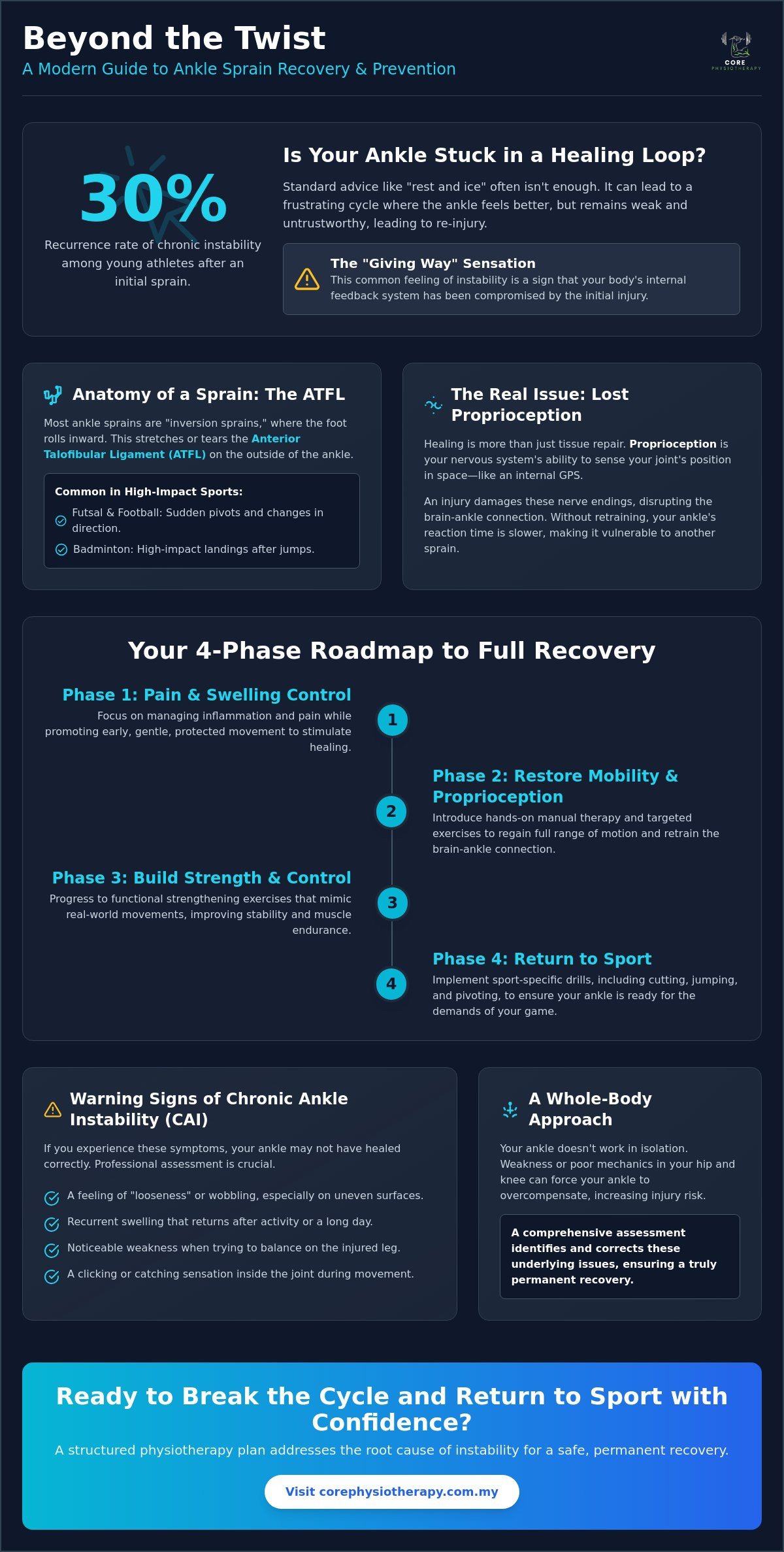
The 4-Phase Roadmap to Full Recovery and Return-to-Sport
Recovery from a ligament injury is a deliberate progression rather than a single moment of healing. To achieve a successful return to your active lifestyle, you must move through a structured roadmap that respects the biological timeline of tissue repair. Professional ankle sprain physiotherapy jb focuses on guiding you through these stages, ensuring that each phase builds a foundation for the next. This methodical approach prevents the common mistake of rushing back to high-impact activities before the joint is truly ready.
Phase 1 & 2: Moving from Protection to Mobility
In the immediate aftermath of an injury, our focus is on the PEACE & LOVE protocol. This modern framework prioritizes Protection, Elevation, and Compression while emphasizing the need for Education and Optimism. We move away from complete immobilization because total rest is often counterproductive to ligament health. Instead, we introduce early, pain-free movement patterns to maintain circulation and prevent excessive joint stiffness. This gentle loading encourages the new ligament fibers to align correctly from the very start.
The transition from acute swelling to active rehab occurs when the joint can tolerate gradual weight-bearing without a significant increase in discomfort. During Phase 2, we utilize Movement & Corrective Exercises to restore your natural gait. We focus on regaining the range of motion you may have lost, particularly dorsiflexion. By focusing on vascularisation through light aerobic activity, we ensure the healing tissues receive the nutrient-rich blood flow they need to strengthen.
Phase 3 & 4: Building an “Indestructible” Ankle
Once your mobility has returned, we shift our focus to functional stability. Phase 3 is where we rebuild your “inner GPS” using wobble boards, foam pads, and single-leg drills. These exercises challenge your nervous system to react quickly to unstable surfaces, which is vital for navigating the uneven pavements or grass fields found throughout Johor Bahru. We don’t just want a “healed” ankle; we want one that is resilient enough to handle unexpected trips or slips without re-injuring the ATFL.
Phase 4 is the final bridge to your return-to-sport goals. This stage involves high-impact plyometrics, such as jumping, landing, and lateral cutting drills. These movements mimic the demands of a fast-paced badminton match or a futsal game. You’ll know you’re 100% ready to return to your local JB sports club when your injured side achieves at least 90% of the strength and balance of your uninjured side during clinical testing.
If you’re tired of the “wait and see” approach and want a clear path back to the sports you love, the first step is a professional evaluation. Contact us today to schedule your initial assessment and start your personalized recovery roadmap.
Why Core Physiotherapy JB is Your Partner in Ankle Health
Choosing the right clinic for ankle sprain physiotherapy jb involves finding a team that looks beyond the localized pain of a twisted joint. At Core Physiotherapy PLT, we believe that true recovery requires a deep understanding of your body’s unique biomechanics. We don’t settle for temporary relief or superficial fixes. Instead, we utilize evidence-based practices to ensure your rehabilitation is grounded in clinical science and modern therapeutic techniques. Our goal is to empower you with the strength and stability needed for long-term athletic longevity, ensuring you can return to your passions without fear.
Our commitment to professional excellence means we prioritize a patient-centered approach. We act as a dedicated guide throughout your journey, moving from the initial identification of a physical challenge to the successful integration of movement back into your lifestyle. This methodical progression ensures that every intervention is purposeful. By focusing on the possibility of physical improvement, we build a relationship based on trust and optimistic outcomes, helping you achieve a level of health that lasts far beyond your final session.
Root Cause Analysis: Looking Beyond the Ankle
A recurring sprain is often a symptom of a larger mechanical issue elsewhere in the kinetic chain. For instance, a weak gluteus medius in the hip can lead to poor control of the leg during landing, forcing the ankle to absorb excessive force. By conducting a Professional Movement Assessment in Johor Bahru, our therapists can identify these hidden links. We assess the alignment of your knee and the strength of your hip to ensure your ankle isn’t overcompensating for deficiencies elsewhere. This holistic perspective is what prevents the cycle of re-injury and keeps you on the field for years to come.
Your Journey Starts at Eco Palladium
Our clinic at Eco Palladium provides a modern, professional space where your recovery is managed with dedicated precision. We understand the specific demands of the local lifestyle, whether you’re a weekend warrior on the badminton court or a professional navigating the daily cross-border commute. Every rehabilitation plan we create is strictly personalized. We integrate Hands-On Manual Therapy to resolve joint stiffness with Movement & Corrective Exercises to reinforce new patterns of stability. This dual approach ensures we address both the structural damage and the functional weaknesses that contributed to your injury. For those whose ankle issues are compounded by the physical demands of a desk-bound career and daily Causeway crossing, our physiotherapy for office workers jb program addresses the full spectrum of postural and musculoskeletal challenges that can affect your recovery.
You don’t have to accept recurring instability as an unavoidable part of your athletic journey. Booking your Initial Assessment for ankle sprain physiotherapy jb is the vital first step toward breaking the cycle of re-injury. Our team acts as a dedicated partner in your health, providing the expert clinical guidance and steady encouragement necessary for a successful outcome. We’re committed to helping you move with confidence again. Let’s work together to transform your physical health from a point of frustration into a foundation of vitality and strength.
Secure Your Path to Lasting Athletic Stability
Rebuilding confidence in your movement requires more than just time; it demands a structured, clinical approach that respects the complexity of ligament healing. We’ve discussed how a root-cause strategy, which assesses the hip and knee alongside the joint itself, is vital for preventing chronic instability. By prioritizing the restoration of your body’s “inner GPS” through specialized ankle sprain physiotherapy jb, you ensure that your return to sports like badminton or football is both safe and permanent.
Our expert therapists at Eco Palladium specialize in evidence-based sports rehabilitation, combining hands-on manual therapy with advanced techniques like dry needling eco palladium to address compensatory tension. This multi-modal care is designed to fit your unique lifestyle, moving you beyond a temporary fix toward long-term physical improvement. We’re committed to providing the steady support and clinical expertise you need to move with vitality once again.
Book Your Comprehensive Ankle Assessment at Core Physiotherapy JB
You don’t have to navigate your recovery journey alone. We’re ready to act as your dedicated partner, ensuring every step you take brings you closer to a full and confident return to the activities you love.
Frequently Asked Questions
How long does it take to recover from an ankle sprain with physiotherapy?
Recovery timelines vary significantly based on the severity of the ligament damage. A mild Grade I sprain might require only 1 to 2 weeks of focused rehabilitation, while a severe Grade III rupture can take several months to reach full athletic readiness. Our therapists use specific clinical markers to track your progress and ensure you’re meeting recovery milestones safely and effectively.
Is it better to rest or move my ankle after a sprain?
Early, controlled movement is generally superior to prolonged rest for promoting ligament health and tissue alignment. While protection is necessary in the first 48 hours, beginning gentle, pain-free mobility exercises helps maintain circulation and prevents joint stiffness. This active approach facilitates faster functional recovery compared to complete immobilization, which can often lead to muscle atrophy and secondary weakness.
Can physiotherapy help with an old ankle injury that still feels weak?
Physiotherapy is highly effective for addressing old injuries that have resulted in chronic instability or a persistent “giving way” sensation. We focus on retraining your proprioception and strengthening the surrounding muscles to compensate for past ligament laxity. By identifying underlying biomechanical issues, ankle sprain physiotherapy jb can restore the confidence you need to return to high-impact activities safely.
What is the difference between dry needling and sports massage for ankle pain?
Dry needling is a clinical intervention designed to reset hyper-irritable trigger points within the muscle using fine needles, whereas sports massage focuses on broad soft tissue relaxation. While massage can provide temporary relief, dry needling is specifically utilized at our clinic to release deep-seated compensatory tension in the calf and peroneals. This precise approach allows for a faster return to optimal muscle function and movement.
Do I need an X-ray before coming for physiotherapy in JB?
You don’t necessarily need an X-ray before visiting us for an Initial Assessment. Our therapists use clinical screening tools, such as the Ottawa Ankle Rules, to determine if a fracture is likely and if imaging is required. If your symptoms suggest a more serious bone injury, we’ll advise you on the appropriate medical referral to ensure your safety and correct diagnosis.
Can I continue working in Singapore while undergoing ankle rehab?
You can certainly continue your daily commute to Singapore while undergoing rehabilitation. We design your treatment plan to account for the physical stresses of cross-border travel, such as long periods of walking or standing at the CIQ. By integrating specific Movement & Corrective Exercises into your routine, we ensure your recovery progresses steadily without requiring you to pause your professional responsibilities. Many of our cross-border commuters also benefit from our dedicated physiotherapy for office workers jb program, which specifically targets the neck, shoulder, and lower back tension that accumulates from prolonged sitting and non-ergonomic work environments.
How many sessions of physiotherapy will I need for a Grade II sprain?
A Grade II sprain typically requires between 6 to 10 sessions of ankle sprain physiotherapy jb to achieve full functional restoration. The exact number depends on your individual healing rate and your specific return-to-sport goals. Each session is structured to move you through the phases of recovery, transitioning from initial pain management to advanced balance and agility training.
What should I wear to my first ankle assessment at Core Physiotherapy?
We recommend wearing comfortable sports attire, such as a pair of shorts and a t-shirt, for your first assessment. It’s important that our therapists can easily observe your ankle, knee, and hip mechanics during various movement tests. Bringing the footwear you most commonly use for sports or work also provides valuable insight into your foot positioning and support needs during the clinical evaluation.