
What if the “knots” in your shoulders aren’t actually tight muscles that need to be rubbed harder, but a protective response from your nervous system? If you’re searching for chronic muscle tension relief jb, you’ve likely experienced the frustration of the massage-pain-massage cycle. You spend an hour on a massage table only to find that the familiar tightness and tension headaches return within days. This happens because most traditional treatments focus on the surface symptom rather than the underlying neurological habit that keeps the muscle guarded.
It’s incredibly draining to live with persistent discomfort that affects your focus at work and your quality of life at home. You shouldn’t have to accept constant stiffness as your new normal. This guide will explain why standard relaxation techniques often fail to provide a permanent fix for deep-seated tension. You’ll discover how a clinical, evidence-based approach through physiotherapy can finally break the cycle of chronic pain and help you achieve the long-term mobility and comfort you deserve.
Key Takeaways
- Understand why your brain uses muscle “guarding” as a protective mechanism and why this prevents standard massages from providing lasting results.
- Learn about the “energy crisis” in your muscle fibers and how fascia restrictions lock your body into painful, recurring patterns.
- Discover how targeted dry needling and manual therapy offer a clinical path toward chronic muscle tension relief jb by reaching deep trigger points that surface-level treatments miss.
- Explore the three-step clinical framework for recovery, starting with a comprehensive initial assessment to identify the root cause of your discomfort.
- Find out how evidence-based movement and corrective exercises can help you maintain long-term mobility and break the cycle of persistent “knots” for good.
Beyond the Massage: Understanding Chronic Muscle Tension
Chronic muscle tension is fundamentally different from the soreness you feel after a heavy workout at the gym. While acute tightness usually resolves with a few days of rest, chronic tension is a persistent state where your muscle fibers remain semi-contracted indefinitely. Even when you are lying in bed or sitting at your desk, your body refuses to let go. For those seeking chronic muscle tension relief jb, it’s vital to recognize that this isn’t just a physical “stiffness” issue. It’s a complex interaction between your musculoskeletal system and your brain.
Many residents in Johor Bahru face a specific set of stressors that contribute to this condition. The daily cross-border commute to Singapore is a primary culprit. Spending three to four hours every day in a static, seated position on the Causeway or Second Link forces the body to adapt to a restricted posture. Over time, your nervous system initiates a “guarding” mechanism. If your brain perceives a weakness in your posture or a potential injury in your spine, it sends constant signals to the surrounding muscles to stay tight. This acts as a biological splint, protecting a perceived vulnerability. You cannot simply “relax” this tension away because your brain believes the tightness is necessary for your safety.
The Myth of the “Permanent Knot”
Most people describe their tension as “knots” that need to be crushed or broken. However, these aren’t physical tangles in your tissue. In reality, they are Myofascial trigger points, which are localized muscle spindles trapped in a state of intense, microscopic spasm. While a deep tissue massage might feel good in the moment, physical pressure alone rarely provides a permanent fix. To achieve lasting chronic muscle tension relief jb, we must focus on neurological desensitisation. This involves using clinical techniques to signal the nervous system that the “threat” has passed, allowing the muscle to finally exit its guarded state. Understanding the clinical science behind muscle trigger point release jb can help you make more informed decisions about your treatment options.
Signs Your Tension Needs Clinical Intervention
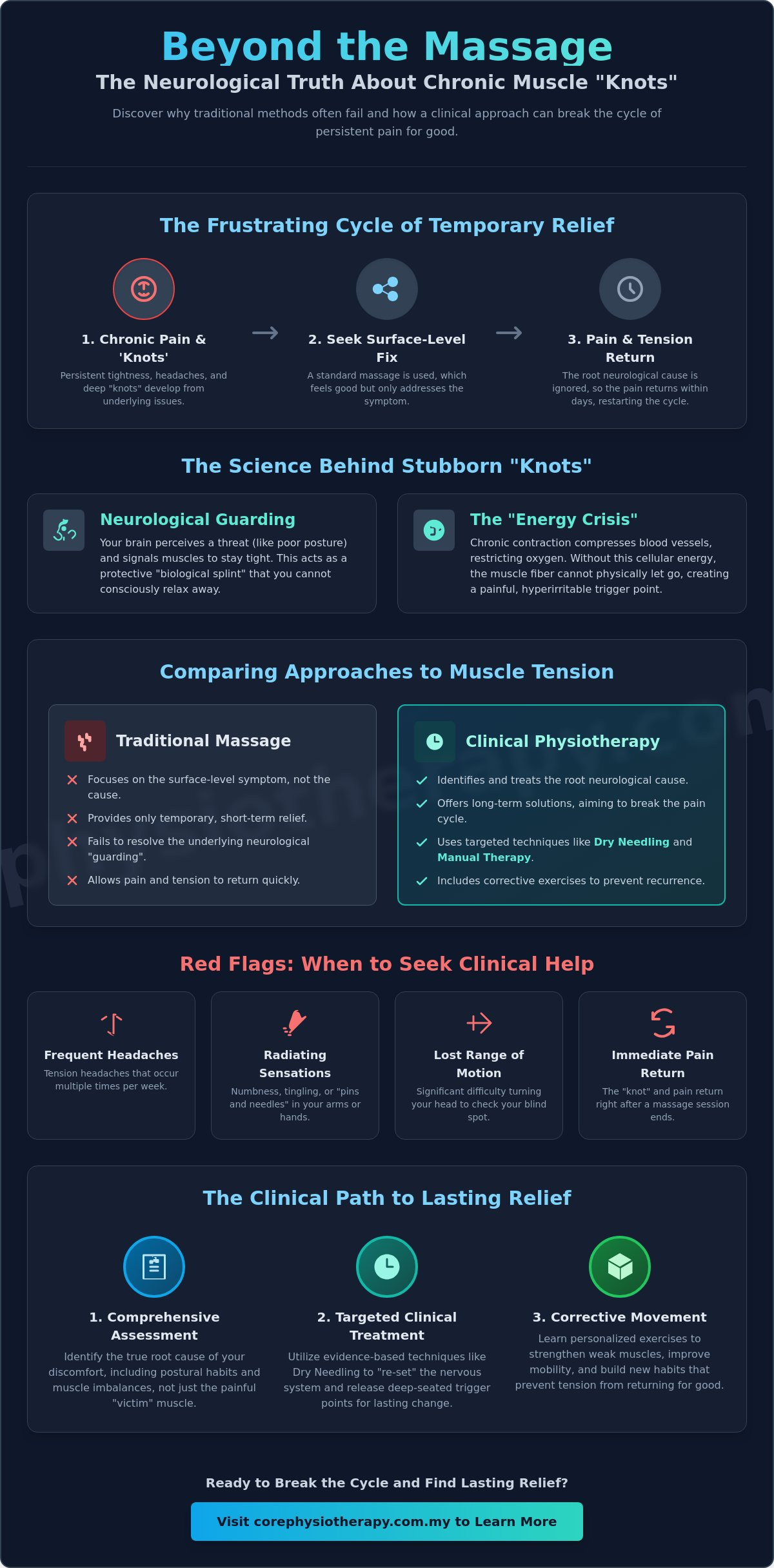
It can be difficult to know when to move past the spa and seek professional physiotherapy. While a general massage is excellent for wellness, it isn’t a medical treatment for myofascial pain syndrome. You should consider a clinical assessment if you notice these red flags:
- Tension headaches that occur multiple times a week and affect your work productivity.
- Radiating numbness, tingling, or a “pins and needles” sensation in your extremities.
- A significant loss in your range of motion, such as difficulty turning your head to check traffic.
- Pain that returns immediately after a standard massage session ends.
When muscle fatigue transitions into a chronic pattern of restriction, the solution must be as sophisticated as the problem. Moving beyond superficial rubbing toward root-cause analysis is the only way to reclaim your mobility and comfort.
The Science of “Knots”: Why Muscles Stay Tense
To achieve lasting chronic muscle tension relief jb, we must look deeper than the surface of the skin. When a muscle remains in a state of chronic contraction, it enters what clinicians call an “energy crisis.” This persistent squeezing of the muscle fibers actually compresses local blood vessels, leading to a state of ischemia, or restricted blood flow. Without adequate oxygen and nutrients, the muscle lacks the cellular energy required to physically let go. This creates hyperirritable spots in muscle that feel like hard, painful lumps under the finger.
Fascia, the silver-white connective tissue that wraps around every muscle, plays a significant role in “locking” these patterns in place. Think of fascia like a tight-fitting suit. When you are under constant strain, the fascia thickens and becomes less pliable. It begins to adhere to the underlying muscle, effectively gluing it into a restricted position. In the modern office environments of Eco Palladium, many professionals find themselves stuck in these rigid postures for eight hours a day. This repetitive strain doesn’t just make you feel stiff; it fundamentally alters how your tissues glide and move.
Often, the muscle that feels the tightest is not the actual source of the problem. It’s frequently a “victim” muscle that is overworking to compensate for a weak or inhibited neighbor. For example, your upper traps might be screaming in pain because your deep neck flexors or mid-back muscles aren’t doing their job. Identifying these imbalances through a professional initial assessment is the first step toward a solution that lasts longer than a single afternoon. A deeper understanding of how professional muscle trigger point release jb addresses these neuromuscular imbalances can clarify why targeted clinical intervention outperforms general massage for persistent pain.
The Brain-Body Feedback Loop
Your nervous system acts as the “software” that runs your physical “hardware.” When you experience high levels of stress or emotional load, your brain often defaults to a state of physical guarding. This is why you might notice your shoulders creeping toward your ears during a difficult meeting or a tight deadline. Eventually, the brain forgets how to turn these muscles off. This creates a self-perpetuating cycle: the pain causes more tension, and the tension causes more pain, trapping you in a state of constant discomfort.
Compensatory Patterns in Daily JB Life
Daily life in Johor Bahru presents unique challenges to our musculoskeletal health. “Tech Neck” is a common phenomenon among commuters who spend hours looking down at their phones while stuck in Causeway traffic jams. This position places an immense chronic load on the cervical spine. Similarly, sedentary desk work often leads to chronically short hip flexors, which eventually pulls on the lower back and creates secondary tension. Many people try to fix this by aggressively stretching the tight area. However, if the brain perceives the muscle is already overstretched or vulnerable, a vigorous stretch can actually trigger a protective reflex, making the guarding even worse. True relief requires a more precise, clinical intervention.
Dry Needling vs. Traditional Massage for Tension Relief
While a traditional massage provides a soothing experience, it often struggles to reach the deeper layers of tissue where persistent pain originates. For those pursuing chronic muscle tension relief jb, understanding the difference between superficial pressure and targeted clinical intervention is essential. Traditional massage primarily affects the skin and the most accessible muscle layers. In contrast, Dry Needling utilizes thin, filiform needles to penetrate directly into the Myofascial trigger points we discussed earlier. This allows us to reach deep-seated tension that even the strongest manual pressure cannot influence.
The hallmark of an effective dry needling session is the “Local Twitch Response.” This is an involuntary contraction of the muscle fibers in response to the needle. Think of this twitch as a physical reset button for your muscles. It confirms that the needle has reached the specific site of the physiological “energy crisis,” forcing the cramped fibers to finally let go. It’s a highly regulated and evidence-based practice. The Malaysian Ministry of Health recognizes dry needling as a safe treatment when performed by trained healthcare professionals, ensuring you receive a clinical standard of care rather than a temporary lifestyle fix. This same precision makes dry needling for jaw pain jb an effective option for patients whose chronic tension extends into the jaw and TMJ region, where myofascial trigger points are equally responsible for persistent discomfort.
How Dry Needling “Resets” the Nervous System
Beyond the physical release, dry needling initiates critical biochemical changes within the tissue. When a needle enters a trigger point, it helps clear out the acidic environment and inflammatory markers that accumulate during chronic guarding. This process triggers an immediate increase in local blood flow and oxygenation, providing the nutrients the muscle needs to remain relaxed. While a spa massage focuses on a “relaxing” sensory experience, dry needling provides a “therapeutic” release. It addresses the neurological software error that keeps your muscles in a state of constant alarm.
When to Choose Manual Therapy Over Needling
Dry needling is a powerful tool, but it’s rarely used in isolation. We often combine it with Hands-On Manual Therapy to achieve the best results. While needling addresses the muscle fibers, manual therapy is essential for restoring joint mobility and improving the way your tissues glide against one another. If a joint in your neck or back is restricted, your muscles will continue to guard that area regardless of how many trigger points are released.
At Core Physiotherapy PLT, we view dry needling as one component of a comprehensive recovery plan. It’s a highly effective way to reduce pain and desensitise the nervous system, but it works best when integrated with movement retraining. True chronic muscle tension relief jb requires a multi-faceted approach that addresses the muscle, the joint, and the brain’s protective habits simultaneously. By using the right tool for the right tissue, we can move you toward long-term comfort more efficiently.
Reversing the Cycle: 3 Steps to Long-Term Relief in Johor Bahru
Achieving chronic muscle tension relief jb requires more than just a temporary reduction in pain. It demands a structured transition from passive treatment to active recovery. If you only focus on releasing a tight muscle without addressing why it became tight in the first place, the tension will inevitably return. At Core Physiotherapy PLT, we utilize a three-step clinical framework designed to break this cycle. This journey moves from an intensive initial assessment to targeted intervention, and finally, to movement retraining that secures your long-term physical health.
Clinical Assessment: Finding Your Root Cause
Every successful recovery begins with a detailed Initial Assessment. We don’t just look at where it hurts. We look at how you move. Our clinicians use specific movement screens to identify imbalances that often go unnoticed during a standard spa visit. For instance, your persistent neck tension might actually be a compensation for poor hip mobility or a lack of stability in your mid-back. By identifying these silent contributors, we can create a plan that targets the source rather than just the symptom. Relying on self-treatment or generic advice often leads to further frustration. A professional diagnosis ensures that every minute of your therapy is spent on the right tissues.
Corrective Exercises: The “Insurance” for Your Body
Once we have reduced your pain through Manual Therapy and Dry Needling, the focus shifts to Step 3: Corrective Exercises. Think of these movements as insurance for your body. A corrective exercise is not just a general workout. It is a specific movement prescribed to fix an identified dysfunction. When your core and postural muscles are strong and stable, they take the burden off your tension muscles, such as the trapezius or lower back.
This phase is where you move from being a passive patient to an active participant in your own health. Relief without retraining is only a temporary pause in a recurring problem. By building functional strength, you teach your nervous system that it no longer needs to use guarding as a safety mechanism. This is the only way to ensure that the knots stay away for good. If you are ready to stop managing symptoms and start fixing the cause, you can schedule your clinical assessment today at Core Physiotherapy PLT to begin your personalized path to recovery.
Our approach is steady and deliberate. We prioritize clarity and logical progression, ensuring you understand exactly how each exercise contributes to your overall well-being. This methodical rhythm reflects the progressive nature of physical rehabilitation. We are here to guide you through every step, providing the expertise and support needed to regain your vitality and move without restriction.
Professional Muscle Tension Management at Core Physiotherapy JB
Core Physiotherapy PLT stands as a specialized clinical center for those seeking genuine chronic muscle tension relief jb. Located in the modern and serene environment of Eco Palladium, our clinic is designed to be a supportive space for recovery and physical improvement. We recognize that chronic tension is a complex neurological and physical challenge. It requires more than a standard relaxation session. Our commitment is to provide evidence-based solutions that prioritize long-term health over superficial, short-term fixes.
Every individual who walks through our doors receives a personalized treatment plan. We don’t believe in one-size-fits-all protocols because your tension is unique to your lifestyle, posture, and history. Whether you are a professional navigating the daily commute to Singapore or an athlete recovering from repetitive strain, Core Physiotherapy PLT tailors our approach to your specific needs. We focus on a steady and deliberate progression, ensuring you understand each phase of your rehabilitation journey.
The Core Physiotherapy PLT Difference
Our clinical philosophy centers on root-cause analysis. While many centers focus solely on the area of pain, we investigate the underlying imbalances that allow tension to persist. Our expertise encompasses the specialized techniques discussed earlier, such as clinical dry needling and high-level manual therapy. The team is dedicated to restoring your mobility and quality of life by acting as your partner in health, moving you through a structured journey from initial pain reduction to full lifestyle integration.
Start Your Journey to Movement Freedom
Beginning your recovery is a straightforward process. It starts with a comprehensive initial assessment, where we map out your physical challenges and define your goals. This clinical deep-dive allows us to identify the “why” behind your “knots” and set a clear path for intervention. You won’t find generic routines here. Instead, you’ll find a disciplined, professional framework aimed at permanent improvement.
Book Your Assessment at Core Physiotherapy Eco Palladium
Reclaim Your Movement Freedom Today
Breaking the cycle of persistent tightness requires a shift from temporary fixes to a structured, clinical approach. You now understand that chronic tension isn’t just a physical knot; it’s a protective response from your nervous system that needs a professional reset. By combining evidence-based root cause analysis with targeted interventions like dry needling and manual therapy, we can effectively desensitise this guarding mechanism. However, the final step to enduring health lies in personalized corrective exercise programs that address your specific movement imbalances.
Our expert therapists in Eco Palladium are dedicated to providing the comprehensive care needed for chronic muscle tension relief jb. We move beyond the surface to ensure your recovery is both deep and durable. If you’re ready to stop managing symptoms and start building a resilient, pain-free body, we invite you to take the next step in your health journey.
Schedule Your Initial Assessment at Core Physiotherapy JB to begin your personalized path toward lasting comfort. Your journey to physical vitality and effortless movement starts with a single, professional evaluation. We’re here to guide you every step of the way as you rediscover the joy of moving without restriction.
Frequently Asked Questions
Is dry needling painful for chronic muscle tension?
Most patients experience a deep, dull ache or a brief “twitch” sensation rather than sharp pain during the procedure. This “Local Twitch Response” is a positive sign that the needle has successfully reached the trigger point to initiate a release. While the sensation is unique, it’s generally well-tolerated and often described as a “productive” feeling that leads to immediate desensitisation of the muscle.
How many sessions of physiotherapy do I need for chronic tension relief?
A typical treatment plan for chronic muscle tension relief jb consists of 6 to 12 sessions over a period of 4 to 8 weeks. The exact duration depends on the severity of your symptoms and how long the tension has been present. We move methodically through phases of assessment, intervention, and lifestyle integration to ensure your recovery is both thorough and lasting.
Can I come for physiotherapy if I don’t have a specific injury?
Yes, you don’t need a traumatic injury to seek professional care. Many patients visit us for lifestyle-driven issues such as postural guarding, “Tech Neck,” or general stiffness from long commutes. Our goal is to optimize your physical function and prevent minor discomfort from developing into a chronic condition. We focus on root-cause analysis to improve your overall quality of movement.
What is the difference between physiotherapy and a deep tissue massage?
Physiotherapy is a clinical healthcare discipline focused on diagnosing and treating the underlying cause of musculoskeletal pain. While a deep tissue massage provides temporary relaxation of the surface muscles, physiotherapy utilizes evidence-based techniques like dry needling and corrective exercises. This approach aims for long-term functional improvement and neurological “resetting” rather than just a short-term “feel-good” fix.
Will my muscle tension return after I finish my treatment plan?
Our clinical framework is designed to prevent the return of tension by addressing the source of the problem. By completing your personalized movement and corrective exercises, you build the necessary strength to support your posture and joints. This active participation acts as “insurance” for your body, ensuring that the results achieved in the clinic are maintained in your daily life.
Is dry needling the same as acupuncture?
No, dry needling is a modern Western medical intervention based on anatomical and neurophysiological principles. While both techniques use thin needles, dry needling specifically targets myofascial trigger points to achieve chronic muscle tension relief jb. Acupuncture is rooted in Traditional Chinese Medicine and focuses on the flow of energy along specific meridians to treat a variety of internal conditions.
Do I need a doctor’s referral to visit Core Physiotherapy in JB?
In Malaysia, you have direct access to physiotherapy and don’t require a doctor’s referral to begin treatment. This allows you to start your recovery process as soon as you notice persistent tension. It’s advisable to check with your specific insurance provider, as some private medical cards or corporate plans may still require a referral letter to process your reimbursement claims.
What should I wear to my first assessment for muscle tension?
You should wear comfortable, flexible clothing that allows our therapists to easily examine the affected area. For neck and shoulder tension, a tank top or loose t-shirt is most appropriate. For lower back or hip issues, please bring a pair of shorts. Having a clear view of your movement patterns during the initial assessment is essential for an accurate clinical diagnosis and effective treatment plan.