
What if the “knot” you keep trying to rub away isn’t actually the source of your pain, but merely a symptom of a deeper neuromuscular imbalance? You’ve likely spent months dealing with referred pain that travels to your head or limbs, feeling your range of motion slowly decline during your workday or weekend sports. It’s frustrating when the “quick fix” fails to address the underlying issue. Seeking professional muscle trigger point release jb shouldn’t feel like a guessing game of temporary fixes; it requires a clinical understanding of how your body actually heals.
We understand the physical toll that chronic tension takes on your daily life and your long-term well-being. This guide explores the clinical science behind the “energy crisis” within your muscle fibers and how targeted intervention can finally break the cycle of recurring pain. You’ll discover the essential differences between professional clinical release and standard spa treatments. We will also preview how evidence-based manual therapy and corrective exercises can restore your mobility, helping you move with confidence and lasting comfort.
Key Takeaways
- Understand the “Energy Crisis” hypothesis and why your muscle knots persist despite temporary relief from traditional massage.
- Learn how professional muscle trigger point release jb identifies specific taut bands to restore healthy blood flow; this clinical approach helps eliminate referred pain at the source.
- Differentiate between the broad strokes of a spa treatment and the pinpoint accuracy required for clinical myofascial release.
- Discover the role of movement re-education in strengthening weak muscles to ensure your mobility gains remain permanent.
- Explore the step-by-step journey from an initial movement assessment to targeted manual therapy and long-term recovery.
Understanding Muscle Trigger Points: Why Your “Knots” Won’t Go Away
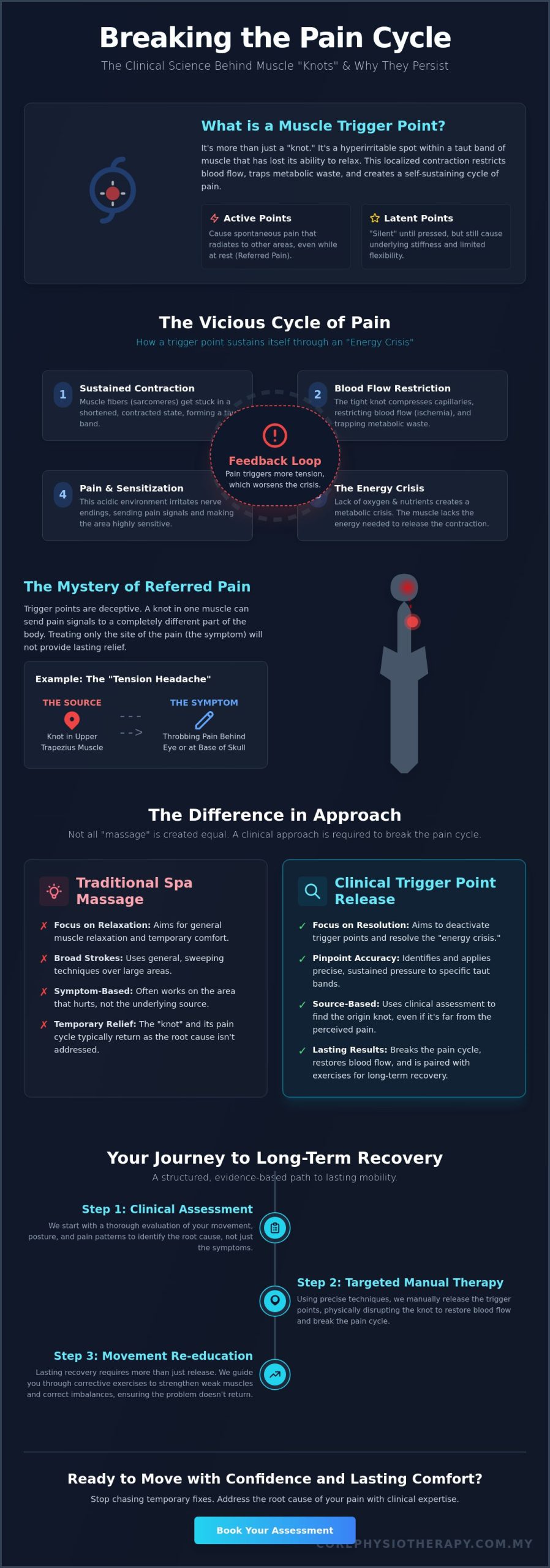
Myofascial trigger points are hyperirritable spots located within a taut band of skeletal muscle. When you feel a “knot,” you’re actually feeling a palpable nodule that has lost its ability to relax. It’s a localized contraction that persists even when you’re resting. This isn’t just a simple muscle cramp; it’s a structural change that requires a specific clinical approach like muscle trigger point release jb to resolve effectively. These nodules restrict blood flow and trap metabolic waste, creating a cycle of pain that your body cannot break on its own.
Clinicians distinguish between active and latent trigger points to determine the severity of your condition. Active trigger points cause spontaneous pain that radiates to other areas, even when you’re still. Latent trigger points are “silent” and only hurt when pressure is applied, yet they still cause stiffness and limit your flexibility. If left untreated, these points can evolve into myofascial pain syndrome. This chronic condition keeps your nervous system in a state of high alert, making your muscles feel constantly fatigued and sensitive to the touch.
The Mystery of Referred Pain: Why Your Shoulder Hurts Your Head
One of the most confusing aspects of trigger points is referred pain. This occurs when a knot in one muscle sends a pain signal to a completely different part of the body. For instance, a trigger point in your upper trapezius muscle often manifests as a throbbing tension headache behind your eye or at the base of your skull. If you only treat the site of the headache with medication or temple massages, you’re ignoring the actual source of the problem. Lasting relief only comes when the therapist identifies the “origin knot” and releases the tension there. This “referred pain map” is a vital tool we use during clinical assessments to ensure we’re treating the cause, not just the symptom.
Signs You Need Professional Trigger Point Release
Recognizing when your muscle tension has progressed beyond a simple ache is crucial for long-term recovery. Seeking professional muscle trigger point release jb is recommended if you notice specific physical changes that disrupt your daily routine. You should consider a clinical assessment if you experience:
- Persistent dull aching: Pain that remains constant for days and doesn’t improve with standard rest or hot showers.
- Localized muscle weakness: Finding it difficult to lift objects or maintain posture, even though you haven’t suffered an acute injury.
- Visible postural shifts: Noticing that one shoulder sits higher than the other or your head leans forward as your body tries to compensate for the tightness.
Addressing these signs early prevents the development of more complex movement compensations. By targeting the root cause, we can help you regain mobility and prevent the recurrence of chronic knots. We focus on a methodical approach that moves beyond temporary comfort toward genuine physical improvement.
The Physiology of Pain: How Trigger Points Form and Persist
The sarcomere is the smallest functional unit of a muscle fiber, responsible for the contraction and relaxation that allows us to move. When a trigger point forms, these sarcomeres become stuck in a shortened, perpetually contracted state. This persistent contraction compresses nearby capillaries, leading to a state of ischemia, or restricted blood flow. This lack of circulation means that the metabolic byproducts of muscle activity, such as lactic acid, cannot be flushed out effectively. Instead, they accumulate and irritate the surrounding nerve endings, causing that familiar deep ache.
Without adequate blood flow, the muscle is deprived of oxygen and essential nutrients. This creates a metabolic “energy crisis” where the muscle lacks the energy required to actually release the contraction. Current research on the mechanisms of myofascial pain suggests that this localized environment becomes increasingly acidic, which further sensitizes pain receptors. This creates a self-sustaining feedback loop: the pain triggers more muscle guarding, which increases tension and further restricts blood flow. Breaking this cycle requires precise mechanical intervention. This is why professional muscle trigger point release jb focuses on physically disrupting the knot to allow fresh blood to return to the tissue.
Johor Bahru Lifestyle Factors: Commutes and Posture
Many residents in Johor Bahru face unique physical stressors that contribute to these painful nodules. Commuting across the Causeway to Singapore often involves hours of static posture in a car or bus. This “Causeway Cramp” affects the psoas and neck muscles significantly as they struggle to stabilize the body during long waits. Similarly, the modern desk culture seen in professional hubs like Eco Palladium contributes to the prevalence of “Tech Neck.” These are forms of repetitive micro-trauma where muscles are held in shortened positions for too long. Over time, the body attempts to protect the area by forming these permanent muscle nodules.
The Role of Stress and the Nervous System
Emotional stress isn’t just a mental state; it has a direct physiological impact on your musculoskeletal system. It activates the sympathetic nervous system, which keeps your muscles in a state of “guarding” or constant readiness. For many, this manifests as chronic jaw clenching or shoulders that stay perpetually raised toward the ears. Once a trigger point is firmly established, “just relaxing” or taking a weekend off isn’t enough to resolve the issue. The physiological “lock” at the sarcomere level remains until it is clinically addressed. A targeted initial assessment can help identify which specific lifestyle factors or stressors are fueling your recurring pain cycle.
Clinical Trigger Point Release vs. Traditional Massage in Johor Bahru
While many people in Johor Bahru seek out traditional massages for relaxation, there’s a significant difference between a spa treatment and a clinical intervention. A standard massage typically employs broad, rhythmic strokes designed to soothe the nervous system and improve general circulation. While this feels pleasant, it often fails to reach the deep, hyperirritable nodules that characterize a true trigger point. Clinical muscle trigger point release jb, however, utilizes pinpoint accuracy to address the specific sarcomeres that have become stuck in a contracted state. The goal isn’t just temporary comfort; it’s the restoration of the muscle’s natural length and function.
It’s a common misconception that “harder is better” when it comes to resolving knots. In fact, aggressive deep tissue massage can sometimes aggravate an active trigger point if the therapist doesn’t follow a clinical guide to trigger point diagnosis. If the pressure is too intense or applied incorrectly, the body may perceive it as a threat. This triggers a protective guarding response, causing the muscle to tighten even further. A clinical approach begins with a thorough assessment to identify whether the point is active or latent, ensuring the manual therapy is applied with the correct intensity to encourage release rather than resistance.
The Power of Dry Needling for Deep Release
At Core Physiotherapy PLT, we often utilize dry needling as a highly effective tool for reaching trigger points that are too deep for manual palpation alone. During this process, a fine, sterile needle is inserted directly into the taut band of muscle. This often elicits a “Local Twitch Response,” an involuntary contraction that acts like a reset button for the neuromuscular junction. This twitch is a clear clinical sign that the trigger point is deactivating. It’s important to distinguish this from acupuncture; while the tools may look similar, dry needling is rooted in Western anatomical science and neurophysiology rather than traditional meridian theory. If you’re weighing your options, our detailed guide on dry needling vs acupuncture Johor Bahru explains the evidence-based differences between these two distinct practices to help you make an informed decision. This same precise approach is also used in dry needling for jaw pain jb, where trigger points in the masseter and surrounding muscles contribute to TMJ dysfunction and chronic tension headaches.
Manual Therapy: Hands-On Precision
For those who prefer a non-invasive approach, hands-on manual therapy remains a cornerstone of clinical care. We employ techniques like ischemic compression, where sustained, localized pressure is applied to the knot. This temporarily restricts blood flow, and upon release, fresh oxygenated blood “flushes” the area to nourish the starved tissue. We also integrate myofascial release to address the connective tissue layers that wrap around your muscles. A professional therapist carefully gauges the pressure throughout the session, ensuring it’s firm enough to facilitate a release but gentle enough to keep your nervous system in a relaxed, healing state.
What to Expect During a Professional Release Session in JB
Your journey toward lasting relief begins long before any manual pressure is applied. We prioritize a structured approach that ensures every intervention is purposeful and safe. By understanding your specific physical challenges, we can tailor the treatment to your unique needs. This methodical process helps us move beyond superficial symptoms to address the true mechanics of your discomfort.
The Clinical Assessment: Finding the Root Cause
We often start by observing your posture and gait to understand how your body moves as a whole. A chronic knot in your shoulder might actually be a compensation for a pelvic tilt or a weak core. By identifying these muscle imbalances, we prevent the “knots” from simply returning a few days after treatment. We look for localized muscle weakness and compensatory patterns that might be overloading specific areas. Assessment is the foundation of all successful therapy at Core Physiotherapy PLT.
Once the assessment is complete, the therapist uses skilled palpation to locate the precise taut bands within the muscle. This is where muscle trigger point release jb becomes a highly individualized experience. We don’t just “rub” the area; we feel for the specific nodules that are causing your referred pain. Depending on the depth and sensitivity of the trigger point, we may utilize hands-on manual therapy to encourage ischemic compression or dry needling for a more direct neuromuscular reset. The release itself is often followed by immediate post-care, including gentle stretching to maintain the newly gained muscle length.
Post-Treatment Sensations and Recovery
It’s normal to feel a sense of “good soreness” for 24 to 48 hours following a session. This sensation is similar to the feeling after a productive workout and indicates that the muscle tissue is beginning to remodel and heal. We recommend staying well-hydrated during this time to help your body flush out the metabolic waste that was trapped within the contracted knot. You’ll likely notice an improved range of motion and a reduction in referred pain shortly after this initial recovery period.
To ensure these results are permanent, we transition from the release phase into active recovery. This involves prescribed corrective exercises designed to strengthen the “weak” muscles that allowed the trigger point to form in the first place. This integration of movement and manual therapy is what creates a path toward long-term health. If you’re ready to identify the source of your tension, you can schedule your initial assessment with our clinical team today.
Long-Term Recovery: Why Movement Re-education is Key
Achieving immediate relief through the clinical techniques discussed earlier is a significant milestone, but it’s only the first step in a comprehensive recovery journey. The clinical objective is to move beyond temporary comfort toward a state of permanent physical resilience. Trigger point release effectively opens a “neuromuscular window” where your muscles are more receptive to new input. If we fail to address the movement habits that originally caused the tension, the body will naturally revert to its previous state of guarding. Preventing recurrence requires a shift from passive relief to active stability.
Movement and corrective exercises play a vital role in this process by retraining the specific muscles that have become inhibited. Often, a chronic knot is simply a muscle overworking to compensate for a neighbor that isn’t providing enough support. By integrating these targeted drills into your routine, we help restore balance to your musculoskeletal system. This neural re-education ensures that your progress is sustainable, teaching your body how to move efficiently without falling back into painful, protective patterns.
Breaking the Cycle of Recurrence
Managing your health in a busy environment like Johor requires practical strategies for daily life. We provide specific ergonomic guidance to help you optimize your workspace, whether you’re working from home or commuting frequently across the Causeway. Small adjustments to your seat height or monitor position can significantly reduce the static load on your tissues. We also advocate for “movement snacks,” which are brief periods of activity designed to break up long hours of sitting. These habits, combined with professional muscle trigger point release jb, create a powerful defense against recurring tension.
Your Path to Movement Freedom at Eco Palladium
At our clinic in Eco Palladium, we believe in a partnership-based approach to healthcare. We don’t just provide a service; we act as a dedicated guide on your path to physical improvement. Our focus remains strictly on evidence-based methods and personalized care plans that respect your individual goals. We invite you to experience a thorough clinical evaluation that looks at the root cause of your discomfort. Taking this proactive step is the most effective way to reclaim your mobility and live without the burden of chronic pain. Book your initial assessment at Core Physiotherapy PLT today and begin your journey toward lasting musculoskeletal health.
Empowering Your Recovery Through Targeted Clinical Care
Understanding the physiological “energy crisis” within your muscle fibers is the first step toward breaking the cycle of chronic tension. By identifying the distinction between active and latent nodules and mapping the true source of your referred pain, we can apply precise interventions that restore your body’s natural function. Clinical success relies on this thorough root-cause analysis rather than superficial, temporary treatments. We focus on returning your sarcomeres to their optimal length to ensure your mobility is restored safely and effectively.
Our expert therapists utilize evidence-based dry needling and hands-on manual therapy techniques to deactivate hyperirritable spots and encourage healthy blood flow. When you choose professional muscle trigger point release jb, you’re investing in a structured path that prioritizes both immediate relief and long-term movement re-education. We’re conveniently located at Eco Palladium, Johor Bahru, ready to act as your dedicated partner in musculoskeletal health. Every step of our process is designed to build your confidence in your body’s ability to heal and thrive.
Schedule Your Professional Movement Assessment in JB
We look forward to helping you move with freedom and quiet confidence once again. Your journey toward a pain-free lifestyle starts with a single, proactive decision to prioritize your long-term well-being.
Frequently Asked Questions
Is trigger point release painful?
You may feel a localized ache or “good pain” as the therapist applies pressure to the hyperirritable nodule. The sensation is often described as a deep pressure that reproduces your familiar symptoms. While the process can be intense, it should always remain within your tolerance level. Our therapists maintain constant communication to ensure the pressure is effective without causing unnecessary guarding or distress.
How many sessions of trigger point release will I need?
The number of sessions varies depending on the chronicity of your condition and your overall movement health. Most patients experience noticeable improvement within one to three sessions of muscle trigger point release jb. However, chronic conditions that have persisted for months may require a more structured plan of six or more visits. We focus on achieving a measurable change in your range of motion during every session.
Can I do my own trigger point release at home with a tennis ball?
Using a tennis ball or foam roller can help manage daily tension and maintain the progress made during your clinical sessions. However, it’s difficult to achieve the pinpoint accuracy required to deactivate complex trigger points on your own. Applying too much pressure to the wrong area can sometimes aggravate the nerve or cause more inflammation. We recommend a professional assessment first to ensure your home techniques are safe.
What is the difference between dry needling and trigger point massage?
Dry needling is a clinical tool that allows us to target deep-seated nodules that manual palpation cannot easily reach. It often triggers a “Local Twitch Response” that resets the muscle’s electrical activity. Manual trigger point massage, or ischemic compression, utilizes the therapist’s hands to flush the area with fresh blood. Both methods are effective, and we often combine them based on your specific clinical needs and preferences. For a deeper understanding of how dry needling compares to other needle-based therapies, our clinical comparison of dry needling vs acupuncture in Johor Bahru provides a thorough evidence-based breakdown to guide your decision.
Will my pain return after the trigger point is released?
Pain may return if the underlying movement imbalances and lifestyle factors aren’t addressed. A successful release provides immediate relief, but the knot may reform if your body continues to move in a way that overloads that specific muscle. This is why we emphasize movement re-education and corrective exercises alongside manual therapy. By strengthening the “weak” muscles, we create a stable environment that prevents the trigger point from returning.
Is trigger point release suitable for chronic migraines?
Many chronic migraines are fueled by referred pain from trigger points in the upper trapezius, levator scapulae, and sternocleidomastoid muscles. When these nodules are deactivated, the frequency and intensity of headaches often decrease significantly. Our clinical approach involves mapping these referral patterns to ensure we’re treating the actual source of your head pain rather than just the symptoms at the temples or forehead.
What should I avoid after a trigger point release session?
Avoid high-intensity workouts and static, cramped postures for at least 24 hours after your treatment. It’s best to skip heavy lifting or strenuous sports to allow the treated muscle to settle and heal. You should also avoid sitting in a static position for long periods, such as during a long commute. Instead, focus on light movement and adequate hydration to help your body process the metabolic waste released.
How do I know if my pain is from a trigger point or a slipped disc?
A clinical assessment is the only way to accurately differentiate between muscular trigger points and disc-related issues. Both conditions can cause radiating pain, but trigger points usually cause a dull ache, while a slipped disc often involves sharp, electric sensations or numbness. During your initial session, we perform specific orthopedic tests to determine the source. Identifying the correct cause is essential for choosing the right treatment path.