
That persistent, stubborn knot in your shoulder might feel like it requires a miracle to resolve, but the most effective solution isn’t about balancing energy; it’s about precise mechanical release. You’ve likely spent hours seeking relief through deep tissue massages, only to find the tension returns within days. It’s exhausting to live with chronic discomfort while feeling confused about which therapy actually works. When researching dry needling vs acupuncture johor bahru, many patients feel overwhelmed by conflicting advice or a natural hesitation toward needles.
We understand that your goal is to move without restriction and return to the activities you love. This clinical comparison guide clarifies the evidence-based differences between these two distinct practices, helping you determine which approach aligns with your recovery goals in 2026. You’ll discover the science behind trigger point release, learn how to manage any anxiety regarding treatment, and see how clinical needling fits into a long-term plan for physical vitality. Let’s move beyond temporary fixes and focus on the root cause of your muscle dysfunction.
Key Takeaways
- Understand how dry needling utilizes sterile needles to target deep-seated trigger points, offering a mechanical solution without the use of medication.
- Distinguish the clinical differences in dry needling vs acupuncture johor bahru, comparing Western anatomical assessments with traditional philosophical approaches.
- Learn why this technique provides a more precise and efficient release of chronic muscle knots than traditional deep tissue massage.
- Identify how specific conditions, such as “tech neck” or sports-related strains, respond to these targeted physiological interventions.
- Discover the value of integrating needling into a broader rehabilitation plan that includes professional movement assessments and corrective exercises.
What is Dry Needling? The Clinical Science of Trigger Point Release
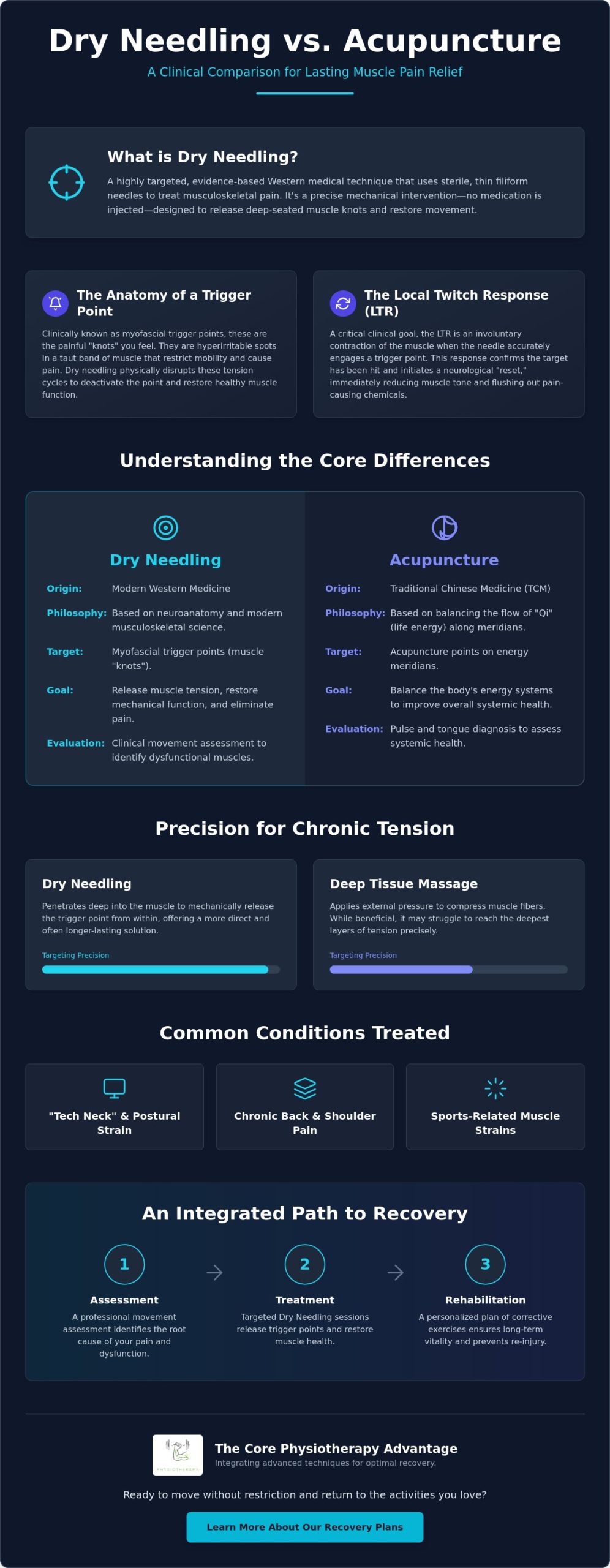
Dry needling is a highly targeted, evidence-based intervention designed to address musculoskeletal dysfunction. It uses sterile, thin filiform needles to penetrate the skin and reach specific muscle tissues. When patients evaluate What is Dry Needling?, they often discover it’s a precise Western medical technique focused on anatomical structures. Unlike “wet” needling, which involves injecting anesthetics, corticosteroids, or other substances, dry needling is strictly mechanical. There is no medication involved. The needle itself acts as the primary tool to stimulate underlying tissues and resolve restricted movement patterns. This approach is particularly effective for managing complex neuromusculoskeletal pain, especially when patients are comparing dry needling vs acupuncture johor bahru to find the fastest path to relief.
The Anatomy of a Trigger Point
The painful “knots” you feel in your neck or back are clinically recognized as myofascial trigger points. These are hyperirritable spots located within a taut band of skeletal muscle fibers. Active trigger points are the source of the spontaneous, familiar pain that interrupts your day. Conversely, latent trigger points may not cause immediate pain but are responsible for restricted mobility and muscle weakness. Utilizing muscle trigger point release jb allows us to physically disrupt these tension cycles. By inserting a needle directly into the center of the taut band, we can deactivate these points. This process facilitates the restoration of the muscle to its natural, healthy length and improves overall movement efficiency.
The Local Twitch Response (LTR)
A defining characteristic of clinical dry needling is the Local Twitch Response. This is a brief, involuntary contraction of the muscle fibers being treated. While the sensation can be unexpected, the LTR is a vital clinical indicator. It confirms that the needle has accurately engaged the hyperirritable zone of the trigger point. Achieving this twitch is a primary therapeutic goal because it triggers a neurological “reset.” This reset immediately lowers muscle tone and flushes out the accumulated chemicals that cause pain. When assessing dry needling vs acupuncture johor bahru, it’s clear that dry needling prioritizes this rapid physiological change. It’s a disciplined, methodical way to reduce sensitivity and regain control over your physical well-being.
Dry Needling vs. Acupuncture: Understanding the Core Differences
While both therapies utilize thin, sterile needles to facilitate healing, they operate on entirely different clinical frameworks. When you explore dry needling vs acupuncture johor bahru, the first distinction lies in their origins. Acupuncture is a cornerstone of Traditional Chinese Medicine (TCM) with a history spanning thousands of years. It focuses on the flow of “Qi” or life energy through specific meridians to balance internal systems. In contrast, dry needling is a modern Western medical intervention. It relies on contemporary neuroanatomy and musculoskeletal research to treat localized physical dysfunction. The evaluation process also differs. An acupuncturist may use pulse or tongue diagnosis to assess systemic health. A physiotherapist performs a clinical movement assessment to identify the exact muscle groups causing your pain.
Western Medicine vs. Traditional Philosophy
Dry needling targets specific anatomical structures, primarily myofascial trigger points, to restore mechanical function. It’s a disciplined, evidence-based approach that continues to gain validation through rigorous clinical studies. As we move through 2026, the medical community increasingly recognizes dry needling as a primary tool for sports injury rehabilitation. It’s particularly effective for mechanical pain where a muscle has become “stuck” in a state of contraction. While Dry Needling vs. Acupuncture may look similar to the casual observer, the intent of dry needling is always physiological. We aim to alter the chemical environment of the muscle and improve blood flow to facilitate faster recovery.
Practitioner Qualifications in Malaysia
Safety and precision are paramount when choosing a provider in Johor Bahru. In Malaysia, acupuncture practitioners are typically registered under the Traditional and Complementary Medicine (T&CM) Act 2016, focusing on holistic wellness. Dry needling is performed by healthcare professionals, such as registered physiotherapists, who possess deep knowledge of human anatomy. This clinical training is vital because it ensures the needle is placed safely away from major nerves and blood vessels. When searching for a professional physiotherapist in JB, you should prioritize clinicians who view needling as one part of a comprehensive recovery plan. If you’re ready to address the root cause of your tension, our team is here to guide you through a personalized assessment to see if this targeted approach fits your needs.
Choosing the right therapy depends on your specific goals. If you’re managing systemic issues like digestion or sleep, acupuncture offers a holistic path. However, if you’re dealing with a specific sports injury or chronic muscle knots that won’t release, the anatomical focus of dry needling is often the superior choice for rapid results. Understanding these distinctions helps you make an informed decision for your long-term physical health.
Why Dry Needling Often Outperforms Deep Tissue Massage for Chronic Tension
Many patients in Johor Bahru seek out deep tissue massage to address persistent knots, often spending hours on the table with limited results. While massage is excellent for relaxation and superficial circulation, it often fails to reach the primary source of chronic pain. When comparing dry needling vs acupuncture johor bahru, it’s essential to understand that dry needling offers a level of anatomical precision that manual pressure simply cannot match. A therapist’s fingers have a relatively large surface area. This makes it difficult to isolate a single hyperirritable muscle fiber without compressing the surrounding healthy tissue. The needle, however, is microscopic in its focus.
The needle provides a distinct mechanical advantage. It bypasses the superficial layers to reach the core of a trigger point in seconds. While a massage therapist might spend ten minutes of sustained pressure trying to “melt” a knot, a sterile needle can achieve a full release almost instantly through the local twitch response. This efficiency doesn’t just save time; it reduces the overall trauma to the muscle. For those seeking chronic muscle tension relief jb, this targeted approach often provides a more sustainable solution than the temporary relief of traditional bodywork. It addresses the physiological “lock” within the muscle rather than just smoothing out the surface.
Reaching the Deepest Tissue Layers
Certain muscle groups, such as the piriformis in the hip or the multifidus along the spine, are buried beneath thick layers of fascia and larger muscle groups. Attempting to reach these deep-seated areas with elbows or thumbs often results in significant surface bruising and discomfort. The fine gauge of a dry needle allows it to slide between superficial fibers without damaging them. It targets the fibrotic, “stuck” tissue directly at the source. This ability to penetrate deep tissue without causing widespread inflammation is a key reason why clinical needling is a preferred choice for complex mechanical dysfunctions that massage cannot resolve.
Post-Treatment Recovery and Soreness
It’s common to experience a sensation similar to “delayed onset muscle soreness” after a session. This is a natural part of the healing process. Unlike the bruising sometimes associated with aggressive massage, needling soreness typically feels like you’ve completed a vigorous workout. For our patients in Johor Bahru, we recommend staying well-hydrated and engaging in light movement to flush out metabolic waste. Many individuals report an immediate improvement in their range of motion. This rapid gain in mobility is often what surprises people most when they first explore dry needling vs acupuncture johor bahru as a path to recovery. The goal isn’t just to feel better during the session, but to move better for weeks to follow.
Is Dry Needling Right for You? Common Conditions Treated in Johor Bahru
Living and working in Johor Bahru often involves physical stressors that accumulate over time. For many, this manifests as persistent stiffness that traditional stretching doesn’t touch. When considering dry needling vs acupuncture johor bahru, it’s helpful to look at how each addresses specific lifestyle-driven conditions. Dry needling is particularly effective for those experiencing “tech neck” or tension-related headaches caused by long hours at a desk or during the daily commute. By targeting the specific muscles that have tightened in response to poor posture, we can provide rapid relief where other methods fall short. Understanding the clinical applications of dry needling vs acupuncture johor bahru helps you choose the right path for your specific discomfort.
Beyond neck and shoulder tension, this technique is a powerful tool for more complex issues. We frequently treat individuals struggling with sciatica or persistent lower back pain that limits their daily activities. These conditions often stem from deep gluteal tension or spinal muscle imbalances that are difficult to reach with surface-level treatments. By using needling to target these deeper layers, we can alleviate nerve pressure and restore the mechanical balance of your pelvis and spine. Additionally, for those suffering from facial tension or clenching, dry needling for jaw pain jb offers a specialized clinical solution for TMJ dysfunction. This targeted approach helps relax the masseter and temporalis muscles, restoring comfort during eating and speaking.
Managing Migraines and Tension Headaches
Many chronic headaches actually originate from trigger points in the neck and upper back. These “referral patterns” mean that a knot in your shoulder can cause sharp pain behind your eyes or at the base of your skull. Releasing the upper trapezius and levator scapulae muscles often yields an immediate reduction in headache frequency. In 2026, our clinical focus remains on combining these sessions with posture correction to ensure your results last. If you’re tired of relying on temporary fixes, book an initial assessment to identify the root cause of your headaches and start a personalized recovery journey.
Sports Recovery and Performance
Athletes across Johor Bahru, from weekend runners to marathon participants, use dry needling as a cornerstone of their recovery. Intensive training leads to the accumulation of metabolic waste and micro-tension within muscle tissues. Needling helps “flush” these areas by improving local blood flow and restoring full range of motion. This isn’t just about treating injuries; it’s about optimizing performance. JB athletes often integrate needling into their monthly maintenance programs to stay ahead of repetitive strain and ensure they’re ready for their next competition. It’s a proactive way to maintain muscle health and prevent the small tweaks from becoming long-term setbacks.
The Core Physiotherapy Advantage: Integrating Needling into a Recovery Plan
At Core Physiotherapy PLT, we view dry needling as a powerful catalyst for change, but never as a standalone “quick fix” for pain. While the technique is remarkably effective at deactivating trigger points, lasting recovery requires a more comprehensive, disciplined strategy. When patients weigh the benefits of dry needling vs acupuncture johor bahru, they often seek immediate relief from discomfort. We provide that relief, but we also ensure it’s supported by a foundation of stability. By integrating needling with Hands-On Manual Therapy and personalized corrective exercises, we prevent the muscle from simply returning to its previously tightened state. Our commitment to evidence-based practices means every intervention is chosen for its ability to facilitate your long-term physical vitality.
Every successful rehabilitation journey at our clinic starts with a thorough movement assessment in Johor Bahru. We don’t just treat the symptom; we investigate the mechanical source. This clinical evaluation allows us to determine if your pain stems from a muscle imbalance, a joint restriction, or a compensatory pattern developed over years of “tech neck” or sports strain. This methodical approach ensures that our use of dry needling is both safe and strategically effective for your unique body.
Identifying the Root Cause of Your Tension
Releasing a stubborn knot is only half the battle. If your posture at your desk or a specific weakness in your kinetic chain continues to strain the muscle, the tension will inevitably return. We use dry needling to “open a window” of reduced pain and improved mobility. This window is the optimal time to introduce Movement & Corrective Exercises. By strengthening the muscles that support your joints during this period of reduced sensitivity, we help you build a body that is resilient to future injuries. Our personalized care plans evolve as your strength improves, moving you from pain management to peak performance.
What to Expect at Our Clinic in Johor Bahru
Located in the professional environment of Eco Palladium, our clinic is designed to be a supportive space for your recovery. We maintain the highest clinical standards. Every needle is single-use, sterile, and handled with the precision you expect from a specialized healthcare provider. Our physiotherapists act as your dedicated guides, explaining the physiological “why” behind every twitch and sensation. This transparency helps alleviate any anxiety and builds a partnership based on trust. When comparing dry needling vs acupuncture johor bahru, the clinical environment and anatomical expertise of your practitioner are the most critical factors for your safety. If you’re ready to stop managing pain and start mastering your movement, booking an initial assessment is the first step toward a life without restriction.
Take Control of Your Recovery and Move Without Restriction
Reclaiming your mobility begins with choosing the right tool for your specific physical challenges. We’ve explored how dry needling targets the mechanical root of muscle knots, offering a level of precision that transcends traditional massage. By understanding the clinical distinctions in dry needling vs acupuncture johor bahru, you can now make an informed decision that prioritizes evidence-based results and long-term musculoskeletal health. Relief isn’t just about temporary comfort; it’s about restoring the functional integrity of your body so you can return to the activities you love.
At Core Physiotherapy PLT, our Certified Clinical Physiotherapists utilize specialized trigger point release techniques to help you overcome persistent tension. We invite you to experience our patient-centered approach at our clinic, conveniently located at Eco Palladium, Johor Bahru. Don’t let chronic discomfort dictate your lifestyle or limit your potential any longer. Book Your Clinical Assessment at Core Physiotherapy JB today to begin your journey toward a stronger, more resilient body. We’re ready to partner with you in achieving the lasting relief and physical vitality you deserve.
Frequently Asked Questions
Is dry needling painful, and what does the ‘twitch’ feel like?
Most patients experience a brief, deep ache or a sudden “twitch” rather than sharp pain during the procedure. The twitch sensation is often described as a momentary muscle cramp or an internal “thump” that lasts only a second. It’s a positive sign that indicates the trigger point has been successfully engaged, leading to rapid muscle relaxation and reduced sensitivity.
How many sessions of dry needling will I need to see results?
Most individuals experience a noticeable reduction in tension and improved mobility after 1 to 3 sessions. The total number of visits depends on the chronicity of your condition and how your body responds to the initial intervention. We typically integrate these targeted sessions into a broader rehabilitation plan to ensure long-term stability and prevent the pain from returning.
Are there any side effects or risks associated with dry needling?
Minor muscle soreness is the most common side effect, typically lasting 24 to 48 hours after treatment. Some patients might experience small bruises or temporary fatigue. Because our physiotherapists use sterile, single-use needles and possess deep anatomical knowledge, the risk of serious complications is extremely low. We prioritize your safety and comfort throughout every stage of the clinical process.
Can I exercise immediately after a dry needling treatment?
We generally recommend waiting 24 hours before engaging in high-intensity exercise or heavy lifting. Light movement, such as walking or gentle active stretching, is encouraged because it helps maintain the new range of motion and flushes out metabolic waste. Listen to your body and prioritize recovery during the first day to maximize the benefits of the session.
Is dry needling covered by health insurance in Malaysia?
Coverage depends on your specific insurance provider and policy details. Many corporate or private health plans in Malaysia cover physiotherapy services, which often include dry needling when performed as part of a clinical treatment plan. It’s best to check with your insurer regarding reimbursement for “physiotherapy interventions” to understand your specific benefits and claim procedures.
What is the difference between dry needling and IMS (Intramuscular Stimulation)?
Dry needling is a broad term that includes various techniques, while IMS is a specific system that focuses on neuropathic muscle shortening. When evaluating dry needling vs acupuncture johor bahru, it’s helpful to know that IMS is a specialized form of dry needling used to treat chronic nerve-related muscle pain. Both methods rely on Western anatomical science rather than traditional energy meridians.
Can dry needling help with long-term sciatica or slipped disc pain?
Dry needling can effectively reduce the secondary muscle spasms and hypertonicity often associated with sciatica or disc issues. While it doesn’t “fix” the disc itself, it alleviates the intense tension in the gluteal and spinal muscles that contributes to nerve irritation. This creates a more supportive environment for your long-term rehabilitation and movement training.
Should I avoid dry needling if I am pregnant or on blood thinners?
You should always consult your doctor first, but these are considered relative precautions rather than absolute reasons to avoid treatment. We typically avoid certain areas during pregnancy to ensure safety. For those on blood thinners, the risk of bruising is slightly higher, so we adjust our technique and application to ensure a safe and effective experience for every patient.