
What if the very exercises you’re doing to protect your spine are actually contributing to your discomfort? It’s a common experience to feel a sharp twinge while sitting at your desk or a sense of “weakness” in your back that makes you hesitant to stay active. You want to get stronger, but the fear of a sudden flare-up often keeps you on the sidelines. We understand this cycle of frustration and the genuine desire for a solution that provides more than just temporary relief.
This clinical guide explores a more sophisticated approach to core strengthening for back pain jb, moving past traditional sit-ups toward true functional stabilization. You’ll learn the crucial distinction between your visible abdominal muscles and the deep spinal stabilizers, such as the multifidus, that actually protect your vertebrae. We’ll provide a methodical roadmap to lasting stability and explain how professional guidance can help you regain the freedom to move with confidence and long-term vitality.
Key Takeaways
- Understand the clinical difference between superficial abdominal muscles and the deep “inner unit” that truly stabilizes your spine.
- Explore the “Canister Concept” to learn how intra-abdominal pressure protects your back during daily activities and movement.
- Identify why traditional sit-ups may aggravate existing injuries and how specialized core strengthening for back pain jb offers a safer, more effective alternative.
- Discover foundational clinical drills, starting with diaphragmatic breathing, to reactivate dormant stabilizing muscles and reduce discomfort.
- Recognize the importance of an initial clinical assessment to ensure your stability roadmap is tailored to your unique physical needs and recovery goals.
Understanding Core Strengthening for Back Pain in JB: More Than Just Abs
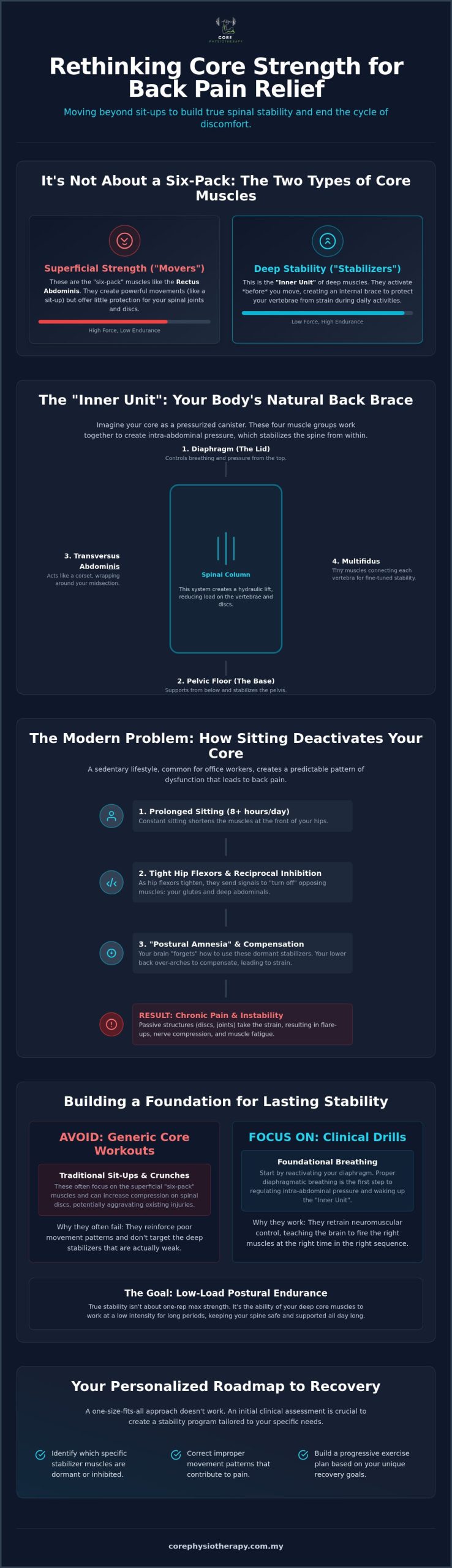
Many people believe that a “six-pack” is the ultimate sign of a healthy spine. In reality, the rectus abdominis, the visible muscle group often targeted in gyms, is frequently the least important muscle for managing chronic spinal discomfort. When we discuss core strengthening for back pain jb, we’re actually referring to core stability. This is the clinical ability of your deep musculature to support and protect the spine during every movement, from lifting a heavy box to simply standing up from a chair. It isn’t about brute force. It’s about creating a dynamic “internal brace” that ensures your lumbar spine receives active support rather than enduring passive strain on your ligaments and discs.
The difference between active support and passive strain is critical. When your core is weak or poorly coordinated, your spine relies on “passive” structures like bones and joints to stay upright. This leads to the sharp, localized pain many JB residents feel after a long day. True stability involves the “active” recruitment of deep muscles that wrap around your vertebrae to absorb shock and maintain alignment. Without this activation, even simple daily tasks can trigger a flare-up.
The Difference Between Strength and Stability
A common misconception is that a physically strong person automatically has a stable core. You might be able to perform heavy squats or deadlifts, yet still experience a “weak” back because the timing of your muscle firing is off. The Anatomy of Stability relies on neuromuscular control, where the brain tells specific muscles to activate just milliseconds before you move. Stability acts as your body’s internal scaffolding. While high-load gym movements focus on power, core stability focuses on low-load postural endurance. It’s the ability of your muscles to work at a low intensity for long periods, keeping your spine safe throughout the day.
Why JB Office Workers are at Risk
Residents in Johor Bahru face unique lifestyle challenges that contribute to spinal instability. Whether you’re spending 8 to 10 hours at a desk or navigating the long, static commute across the Causeway to Singapore, your body adapts to these positions. This often results in “postural amnesia,” a condition where the brain “forgets” how to efficiently engage the core stabilizers because they haven’t been challenged. This sedentary lifestyle creates a specific pattern of dysfunction:
- Tight Hip Flexors: Sitting shortens the muscles at the front of your hips, which pulls your pelvis forward.
- Reciprocal Inhibition: As hip flexors tighten, they “turn off” the glutes and deep abdominals.
- Increased Lumbar Arch: Your lower back compensates for this lack of support by arching excessively, leading to nerve compression and muscle fatigue.
Breaking this cycle requires more than just generic exercise. Seeking physiotherapy for office workers in JB allows for a targeted approach to reactivate these dormant stabilizers and restore the natural balance of your spine.
The Anatomy of Stability: How Your Deep Muscles Protect Your Spine
Visualizing your core as a single muscle is a common mistake. Instead, clinicians view it as a sophisticated “Inner Unit” that functions like a pressurized canister. This system consists of four primary components: the diaphragm at the top, the pelvic floor at the bottom, the transversus abdominis (TrA) at the front and sides, and the multifidus at the back. Together, these muscles create intra-abdominal pressure, which acts as a hydraulic support system for your vertebrae. This “Canister Concept” is the foundation of effective core strengthening for back pain jb, as it provides the internal tension necessary to prevent your spine from buckling under the weight of daily activities.
A critical, often overlooked player in this system is the multifidus. These are tiny, deep muscles that connect each individual spinal segment. Think of them as the “individual stabilizers” that manage the fine-tuning of your posture. In patients with chronic pain, the multifidus often undergoes atrophy or “shuts down” due to inhibitory pain signals. When this happens, your spine loses its segment-by-segment protection. Clinical research, including guidelines found in AAOS spine conditioning exercises, highlights that restoring the timing of these muscles is more important than building raw power. In a healthy body, these stabilizers fire a few milliseconds *before* you move your arms or legs. If this anticipatory firing is delayed, your spine remains vulnerable during movement.
The Transversus Abdominis: Your Natural Weightlifting Belt
The transversus abdominis is your deepest abdominal layer, wrapping around your midsection like a natural corset. Its primary job isn’t to move the trunk, but to compress the abdominal cavity and stabilize the lumbar spine. For years, patients were told to “hollow” their stomachs by sucking the navel toward the spine. We now understand that hollowing can actually reduce spinal stability by narrowing your base of support. Modern evidence-based therapy favors “bracing,” where you subtly stiffen the entire midsection as if preparing for a light poke. This technique engages all layers of the abdominal wall, providing a much sturdier “weightlifting belt” for your back.
The Role of the Pelvic Floor and Diaphragm
Breathing patterns are the absolute foundation of all core stability. If you’re a “chest breather,” you’re failing to utilize your diaphragm to create the necessary downward pressure in the canister. This lack of pressure leaves the lower back unsupported. Simultaneously, the pelvic floor must act as the sturdy base of this canister. If the pelvic floor is weak or overactive, the entire pressure system fails. Learning to breathe through your lower ribs allows the diaphragm and pelvic floor to work in tandem, creating a stable environment for your spine to heal. If you feel your spine “giving way” during simple tasks, an initial assessment can help identify which specific part of your stability canister requires the most attention.
Why Generic Core Workouts Often Fail (or Cause More Pain)
Walking into a local gym with the intention of fixing your back is an admirable step. However, without clinical guidance, many popular exercises can inadvertently cause more harm than good. Effective core strengthening for back pain jb requires a nuanced understanding of spinal mechanics rather than a “no pain, no gain” mentality. When we see patients who have tried to manage their pain independently, we often find they’ve been performing movements that actually increase the mechanical stress on their already sensitive spinal structures.
The Crunch Myth: Why Flexion Isn’t the Answer
Repetitive spinal flexion, such as the standard sit-up or crunch, generates significant compressive loads on the lumbar discs. For an individual already dealing with a slipped disc, these high-compression exercises can push disc material further against nerve roots, intensifying sharp pain. We prioritize “isometric” exercises where the spine remains neutral while the core resists movement. This approach builds the necessary endurance without the shear force associated with traditional abdominal work. Moving from hollowing to functional bracing ensures the spine remains supported in its most resilient position.
Identifying Compensatory Movement Patterns
When the deep stabilizers we discussed earlier are dormant, the body finds a workaround. These are known as compensatory patterns. You might notice your lower back arching excessively during a plank or your pelvis tucking under, often called a “butt wink,” during a squat. These subtle errors indicate that your large, superficial muscles are trying to do the job of the deep stabilizers. Over time, these patterns lead to the recurring flare-ups frequently discussed in pain management clinics in JB. Stability is a skill of coordination, not just a measure of strength.
It’s also vital to understand the fatigue factor. Deep stabilizing muscles are designed for endurance, not explosive power. When you push for “one more rep” with poor form, these stabilizers are the first to switch off, leaving your spine vulnerable to injury. This is why a professional movement assessment in Johor Bahru is an essential first step. Identifying your specific imbalances ensures that your core strengthening for back pain jb builds a foundation of safety rather than a cycle of irritation.
5 Clinical Drills to Improve Core Stability in JB
When implementing core strengthening for back pain jb, we prioritize the quality of movement over the quantity of repetitions. Performing five repetitions with perfect clinical form is significantly more beneficial than fifty repetitions with a compromised posture. These drills focus on neuromuscular control, teaching your brain how to engage the deep stabilizers we’ve discussed to protect your spine during movement. By following this progressive structure, you can build a resilient foundation that supports your daily life in Johor Bahru.
Phase 1: Activation and Breathing
The foundation of all stability is 360-degree diaphragmatic breathing. Many patients mistakenly breathe only into their upper chest, which fails to create the intra-abdominal pressure needed for the “canister effect.” Instead, focus on expanding your lower ribs in all directions, front, sides, and back, as you inhale. This expansion creates a stable base for the spine before any limb movement occurs.
Once you master the breath, you must find your neutral spine while lying on your back with knees bent. Neutral spine is the position where the back is neither arched nor flat. From this position, you can perform the Pelvic Tilt, a subtle movement that helps you find and maintain this “home base” for your vertebrae. In our Eco Palladium clinics, we use this as the starting point for every rehabilitation journey.
Phase 2: Progressive Loading
After establishing breath and neutral alignment, we introduce limb movements that challenge your stability. These drills are the core of personalized back pain exercises in Johor Bahru because they can be scaled to your specific recovery level. The progression usually follows this sequence:
- The Dead Bug: Lie on your back and slowly lower one leg at a time while keeping your spine perfectly still. As you improve, you can progress to lowering the opposite arm and leg simultaneously.
- The Bird-Dog: From a hands-and-knees position, extend one arm and the opposite leg. This integrates the posterior chain and specifically targets the multifidus muscles.
- The Modified Side Plank: Prop yourself up on your elbow and knees to build lateral stability. This strengthens the obliques and quadratus lumborum without the high compression of traditional planks.
A common mistake during these drills is trying to “glue” the lower back to the floor. This actually bypasses the deep stabilizers and relies on superficial muscles. Instead, maintain that tiny, natural space of your neutral spine. If you find your back arching or your breath catching, it’s a sign that the load is too high and you should regress to a simpler version. To ensure you’re performing these movements with the precision required for recovery, we recommend booking an initial assessment with our clinical team.
Personalized Core Strengthening at Core Physiotherapy JB
While the internet is filled with “one-size-fits-all” workout routines, applying a generic video to a specific injury can be counterproductive. A YouTube tutorial cannot see your specific compensatory patterns or understand the unique history of your spinal health. Effective core strengthening for back pain jb must be tailored to the individual. At our Eco Palladium clinic, we begin with a comprehensive clinical assessment to identify exactly which muscles are dormant and which are overworking to compensate. This data-driven approach ensures that your rehabilitation program is both safe and highly efficient.
During a session with our team, you’ll experience a methodical progression from pain relief to functional movement. We don’t just give you a list of exercises and leave you to it. We focus on the precision of your movement, providing real-time feedback to ensure your deep stabilizers are firing correctly. Our ultimate goal is your independence. We want to equip you with the knowledge and skills to manage your own spinal health, moving you away from a cycle of dependency on temporary fixes toward a life of long-term physical resilience.
Beyond the Exercises: Manual Therapy Integration
Sometimes, exercise alone isn’t enough to restart the stability system. If certain muscles are chronically tight or “locked,” they can physically block the activation of your core. This is where our integrated approach provides a significant advantage. We often utilize dry needling in Eco Palladium to release these stubborn trigger points and reset the nervous system. By combining hands-on manual therapy and joint mobilization with corrective exercise, we clear the path for your core to function as intended. We treat the root cause of your instability, ensuring that the symptoms don’t simply return a few weeks later.
Your Journey to Pain-Free Movement
The transition from clinical rehabilitation to high-performance living is a structured journey. Once we’ve established a stable foundation through specialized core strengthening for back pain jb, we begin to integrate more complex movements that mimic your daily life. Whether your goal is to return to competitive sports, manage a demanding job in Singapore, or simply play with your children without fear of a flare-up, we provide the roadmap to get you there. Restoring full spinal resilience often requires addressing the surrounding joints as well, and incorporating hip mobility exercises in JB alongside core work ensures that tight hip flexors and restricted joint movement no longer compromise your lumbar stability. We believe that recovery is not just about the absence of pain, but the presence of vitality and the freedom to move with confidence.
Your path to a stronger, more stable spine begins with a professional evaluation. Don’t let the fear of movement hold you back from the life you deserve. Our dedicated specialists are here to act as your partners in health, guiding you through every step of the rehabilitation process with clinical expertise and genuine empathy. Take the first step toward lasting relief and book your initial assessment at our Johor Bahru clinic today.
Take the First Step Toward Lasting Spinal Resilience
Building a resilient spine requires more than just raw strength; it demands the precise coordination of your deep stabilizing muscles. By shifting your focus from superficial abdominal training to evidence-based core strengthening for back pain jb, you address the root cause of your discomfort rather than just managing the symptoms. True stability is the result of proper breathing, correct timing, and a consistent commitment to quality movement over quantity.
Our expert therapists in Johor Bahru are dedicated to helping you regain your independence through specialized corrective exercise programs and evidence-based clinical assessments. Whether you’re returning to a demanding career or an active lifestyle, we provide the professional guidance needed to ensure your form is perfect and your progress is sustainable. Your journey to recovery doesn’t have to be a solo effort. Book Your Movement Assessment at Core Physiotherapy Eco Palladium today and discover how personalized care can transform your physical well-being. We’re ready to help you move with confidence and vitality once again.
Frequently Asked Questions
Is core strengthening safe if I have a slipped disc?
Yes, it’s safe and often essential when performed with correct clinical form. The goal is to build an “internal brace” that protects the disc from further irritation. We prioritize isometric exercises that keep the spine in a neutral position, avoiding the repetitive bending or twisting that can aggravate a disc injury. Starting with low-load activation drills ensures you gain stability without increasing spinal compression.
How long does it take to see results from core stability exercises?
Most patients begin to feel improved spinal control and reduced discomfort within 2 to 4 weeks of consistent practice. Initial progress is usually due to “neuromuscular tuning,” where your brain learns to fire the right muscles at the right time. Significant structural changes and long-term endurance typically develop over 8 to 12 weeks of progressive training. Consistency is more important than intensity during this early phase.
Can I do core exercises every day for my back pain?
You can perform low-intensity activation drills, such as diaphragmatic breathing and pelvic tilts, every day to maintain muscle “wakefulness.” However, more demanding exercises like the Bird-Dog or modified side planks should be done 3 to 4 times a week. Stability muscles need recovery time to avoid fatigue, which can lead to the compensatory patterns and poor form that often trigger flare-ups.
What is the best core exercise for someone with chronic lower back pain?
While there isn’t a single “best” movement for everyone, the Dead Bug is widely considered the safest starting point for core strengthening for back pain jb. It allows you to practice moving your limbs while keeping your spine perfectly stable against the floor. This drill effectively targets the transversus abdominis and teaches the coordination required for daily activities without placing excessive load on the lumbar joints.
Why does my back hurt more after doing planks or sit-ups?
Increased pain usually occurs because these exercises generate high compressive forces or allow the lower back to arch when the core muscles fatigue. Sit-ups place significant shear stress on the discs, while planks often lead to “sagging” in the lower back if the deep stabilizers aren’t strong enough. If you feel pain during these movements, it’s a sign that your body is using compensatory muscles instead of the deep core.
Do I need special equipment to improve my core stability in JB?
You don’t need specialized gym equipment to build a resilient core. Most clinical stability drills, such as the Bird-Dog or Pelvic Tilt, rely entirely on your own body weight and a flat surface. While tools like resistance bands or stability balls can be added later to increase the challenge, the foundation of recovery is built on mastering your own body’s alignment and muscle activation patterns.
How do I know if my core is actually weak or just tight?
A core can be both weak and tight simultaneously, as the body often “tightens” superficial muscles like the hip flexors to compensate for deep instability. This tightness is a protective “splinting” response from your nervous system. A clinical assessment is the only way to distinguish between a primary muscle restriction and secondary tightness caused by a lack of underlying spinal support. If restricted joint movement is contributing to your discomfort, exploring hip mobility exercises in JB alongside your core program can help address both the tightness and the underlying instability simultaneously.
Can core strengthening help with sciatica symptoms?
Yes, targeted core strengthening for back pain jb can reduce the mechanical pressure on the sciatic nerve by improving spinal alignment. When your deep stabilizers, particularly the multifidus, function correctly, they help maintain the space between your vertebrae. This reduces the likelihood of disc bulges or joint inflammation pinching the nerve roots, providing a long-term solution rather than just temporary symptom relief.