
What if your dedicated daily stretching routine is actually reinforcing the very stiffness you’re trying to escape? It’s a common frustration for many active individuals who experience a persistent pinching sensation during squats or a deep ache in the lower back that won’t go away. You shouldn’t have to settle for a limited range of motion or the constant feeling that your joints are “stuck” despite your best efforts.
In this clinical guide, we’ll introduce you to the most effective, evidence-based hip mobility exercises jb residents can use to reclaim fluid and functional movement. We’ll also explain how a professional initial assessment can identify the true structural or mechanical cause of your stiffness, moving beyond superficial relief toward a long-term solution. You’ll discover the specific drills that restore joint centration and learn how a methodical approach to rehabilitation can transform your daily comfort and athletic performance.
Key Takeaways
- Understand how daily habits, such as the long Johor Bahru-Singapore commute, contribute to hip stiffness and “gluteal amnesia.”
- Learn to distinguish between simple muscular tension and joint capsular restriction to address the true source of your discomfort.
- Discover why clinical hip mobility exercises jb, like the 90/90 Hip Switch, are more effective than generic stretching routines.
- Identify the limitations of “one-size-fits-all” online videos and the value of a professional initial assessment at Eco Palladium.
- Explore a methodical 3-step approach to restoring functional movement through targeted mobilization and corrective exercises.
Why Hip Mobility is the ‘Missing Link’ for Johor Bahru Residents
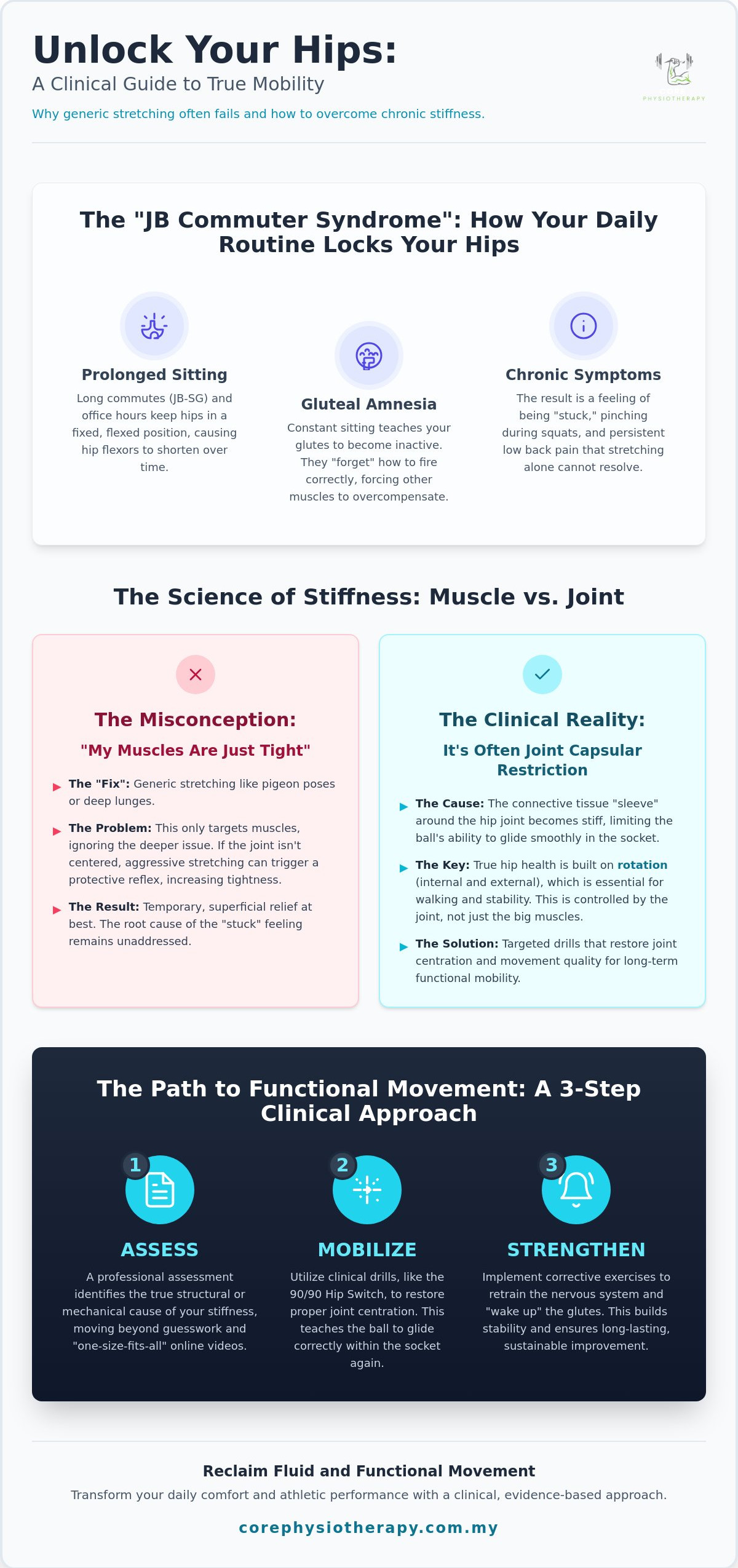
Many residents in Johor Bahru find themselves caught in a cycle of persistent stiffness that stretching alone cannot fix. This isn’t a failure of effort. It’s often a direct result of the unique environmental demands placed on our bodies. From the high-pressure offices at Eco Palladium to the grueling daily transit across the border, your hips are under constant mechanical stress. Prolonged sitting in these office environments often leads to “Gluteal Amnesia,” a clinical condition where the gluteal muscles lose their ability to fire correctly. When the hip joint loses its ability to move freely, the rest of the kinetic chain suffers, leading to the chronic lower back pain so many of us experience.
Generic “hip openers” found in many yoga classes or gym routines often fail to provide long-term relief because they focus on stretching the muscle without addressing joint centration. If the ball isn’t sitting correctly in the socket, stretching the surrounding tissue can actually cause more irritation. This is why a clinical perspective is necessary to bridge the gap between temporary flexibility and true functional mobility. By focusing on targeted hip mobility exercises jb, we can begin to reverse these adaptations and restore the joint’s natural capacity for movement.
The JB-SG Commuter Syndrome
The hours spent navigating the Causeway or sitting on a bus create a specific set of physical challenges. In this seated position, your hip joints are held in a fixed angle of flexion. This causes the psoas and iliacus muscles to stay in a shortened state for extended periods. Over time, the brain begins to accept this restricted range as the “new normal.” It’s a common mistake to finish a long commute and immediately drop into a deep pigeon stretch. Because the muscles are cold and the nervous system is in a state of high tension, aggressive stretching can trigger a protective stretch reflex. This actually increases guarding rather than releasing it. Effective hip mobility exercises jb must be introduced gradually to respect these physiological limits and safely retrain the nervous system.
When Stiffness Becomes a Clinical Issue
Stiffness becomes a clinical priority when it begins to alter how you walk, sit, or exercise. You might notice a sharp pinch in the front of your hip during a gym session or a dull ache that lingers long after you’ve left your desk. These symptoms often point to deeper issues than simple muscle tightness. To truly understand the problem, we must look at The Science of Hip Restriction, which involves the complex interaction of the joint capsule, ligaments, and surrounding musculature.
Micro-traumas from poor posture and prolonged sitting accumulate silently. Without a professional movement assessment johor bahru, it’s difficult to know if your restriction is a muscular imbalance or a structural joint issue. A clinical approach ensures we aren’t just treating the symptoms but are actively restoring the joint’s integrity. Using targeted corrective drills as part of a structured plan allows for sustainable improvement rather than temporary relief, helping you return to the activities you love with confidence.
The Science of Hip Restriction: More Than Just ‘Tight’ Muscles
The hip is a ball-and-socket joint, scientifically known as the femoroacetabular joint. It’s designed for multi-planar movement, allowing you to walk, squat, and rotate with ease. Many people assume stiffness is simply a matter of tight hamstrings or hip flexors. However, the restriction often lies deeper in the joint capsule, which is the connective tissue sleeve surrounding the joint. When this capsule becomes restricted, it limits the femoral head’s ability to glide within the socket, creating a sensation of tightness that no amount of muscle stretching can fully resolve. Just as joint capsular restriction drives stiffness in the hip, a similar process underlies conditions like adhesive capsulitis in the shoulder, where patients seeking frozen shoulder treatment jb residents trust often discover that stage-specific clinical intervention is essential for recovery.
Rotation is the true foundation of hip health. Internal and external rotation aren’t just movements for athletes; they’re essential for a normal walking gait and pelvic stability. The “Deep Six” rotators, a group of small muscles like the piriformis and obturators, act as the “rotator cuff” of the hip. They ensure the joint stays stable during movement. Without this stability, your larger muscles overcompensate, leading to the chronic tension many try to fix with generic hip mobility exercises jb. Understanding these mechanics is the first step toward a more effective recovery plan.
Bone-on-Bone vs. Soft Tissue Restriction
Sometimes, the restriction isn’t soft tissue at all. Femoroacetabular Impingement (FAI) occurs when the bone of the hip or the socket has an irregular shape, causing them to rub together. This often creates a sharp pinching sensation in the groin. Joint centration is the optimal alignment of the femoral head in the socket. If you push through a pinch, you risk damaging the labrum, which is the cartilage ring that deepens the socket. For older residents, this type of structural joint deterioration can also overlap with arthritis management johor bahru specialists address through evidence-based rehabilitation, where restoring joint centration is equally critical to reducing daily pain. If you’re unsure if your pain is structural, a professional initial assessment can help clarify the safest path forward for your body.
The Role of Internal Rotation in Squatting and Running
Internal rotation is often the first range of motion we lose. When you lack this capacity, your body finds it elsewhere, usually at the knee or the lower back. This compensation is why many runners in Johor Bahru complain of knee pain that actually stems from the hip. During gait, the pelvis relies on a “scissor effect” where one side rotates forward while the other moves back. If this rotation is blocked, your movement becomes inefficient and taxing. Learning Top 5 Corrective Hip Mobility Drills can help restore these essential mechanics. For those dealing with persistent issues, seeking comprehensive hip pain treatment johor bahru is the most reliable way to ensure you’re addressing the root cause rather than just stretching a symptom. Utilizing specific hip mobility exercises jb tailored to your unique anatomy can make the difference between a temporary fix and a permanent recovery.
Self-Correction vs. Professional Physiotherapy in Johor Bahru
Many individuals begin their journey toward better movement by searching for “top 10 stretches” on YouTube. While these videos offer accessible advice, they often lack the diagnostic precision required to address complex joint issues. A one-size-fits-all approach ignores your unique anatomy and injury history. For example, if you have an inherently hypermobile joint, aggressive stretching can lead to further instability and potential labral tears. In many cases, the sensation of “tightness” is actually a protective neurological response. Your brain creates tension to stabilize a joint that it perceives as weak or vulnerable. Applying generic hip mobility exercises jb to a joint that needs stability rather than flexibility can inadvertently worsen your condition.
A clinical assessment at our Eco Palladium clinic differs fundamentally from a standard gym screening. While a personal trainer might look at your range of motion during a squat, a physiotherapist analyzes how your nervous system controls that movement. We evaluate the quality of tissue resistance and the specific “end-feel” of the joint. This level of detail allows us to determine whether your restriction is truly muscular or if the underlying cause is a lack of motor control. Transitioning from generic routines to clinical interventions ensures your progress is both safe and sustainable.
Identifying the Root Cause
The hip doesn’t function in isolation. It’s a central hub in the kinetic chain. A restriction in the ankle or a lack of stability in the lumbar spine often forces the hip to work harder, leading to premature fatigue and stiffness. This is Why Hip Mobility is the ‘Missing Link’ for many who spend their days seated. Relying solely on passive stretching is only 20% of the solution. To see lasting change, we must move beyond the symptoms and perform a comprehensive root cause pain analysis jb. This ensures that every corrective drill you perform is targeted at the specific driver of your dysfunction, rather than just chasing the site of the pain.
The Value of Hands-On Intervention
Before jumping into active hip mobility exercises jb, it’s often necessary to prepare the tissues and the joint itself. Hands-on manual therapy allows us to perform specific joint mobilizations that “unlock” the capsule. This restores the glide and slide mechanics we discussed in the science of hip restriction. This clinical preparation makes your subsequent exercises far more effective by removing mechanical blocks.
In some instances, stubborn trigger points or chronic muscle guarding require more direct intervention. This is where dry needling eco palladium residents can benefit from comes into play. By using fine needles to release deep-seated tension, we can reset the muscle’s resting tone. This creates a window of opportunity where you can move without pain. Once the “noise” of the pain is reduced, we transition from passive care to active corrective exercises. We then integrate your new range of motion into daily movement patterns to ensure your recovery is permanent.
Top 5 Corrective Hip Mobility Drills for Daily Performance
Restoring range of motion requires more than passive stretching. It demands active engagement and neurological intent. These five clinical drills are designed to retrain your nervous system while respecting your joint mechanics. When performing these hip mobility exercises jb residents should prioritize the quality of each movement over the total number of repetitions. Slow, controlled transitions allow your brain to map new ranges of motion safely.
- The 90/90 Hip Switch: This drill is a gold standard for isolating internal and external rotation. By positioning both legs at 90 degree angles, you challenge the joint’s capacity to rotate without the lower back compensating.
- Controlled Articular Rotations (CARs): These involve moving the hip through its full, pain free circumference. Think of this as “mapping” the outer edges of the joint to maintain and eventually expand your current mobility.
- The Adductor Rock-Back: This movement targets the inner thigh muscles while synchronizing hip movement with pelvic floor function. It’s essential for anyone looking to improve their squat depth.
- Hip Aeroplanes: This “closed-chain” exercise requires your foot to remain planted. It builds the lateral stability needed to control your pelvis during the single-leg phases of walking and running.
- The Psoas March: This drill integrates core stability with active hip flexion. It teaches your body to lift the leg using the deep hip flexors rather than over-relying on the superficial muscles of the thigh.
Execution Cues for the 90/90 Position
Precision is vital in the 90/90 position. You must keep your spine neutral and avoid rounding your back to “reach” further into the stretch. If you find it impossible to sit upright, place your hands on the floor behind you for support or sit on a small cushion to elevate your pelvis. To maximize your mobility gains, use “irradiation.” This involves creating full-body tension by bracing your core and lightly squeezing your fists. This tension signals to the nervous system that the joint is stable and safe, allowing it to release deeper into the range of motion.
Integrating Mobility into Your JB Lifestyle
You don’t always need a gym to improve your joint health. Performing “desk-friendly” hip resets during a lunch break at Eco Palladium can significantly counteract the effects of a long morning commute. The 2-minute rule states that you must maintain a mobility position or drill for at least 120 seconds to trigger actual mechanical changes in the connective tissues. The best time for this work is often in the evening. Your body temperature is naturally higher then, which facilitates better neural adaptation and long-term progress.
If you find that these movements cause discomfort or if you’re unsure of your form, our team can help you refine your technique through a personalized Initial Assessment.
Restoring Functional Movement at Core Physiotherapy PLT
Our clinical philosophy centers on a structured 3-step approach designed to move you from restriction to resilience. We begin with a comprehensive assessment to map your current joint capacity. Once we identify the mechanical drivers of your stiffness, we utilize hands-on mobilization techniques to restore joint glide. Finally, we integrate these changes into your daily life through targeted movement patterns. This methodical progression ensures that the hip mobility exercises jb residents perform in our clinic translate into lasting, pain free movement during your daily activities.
We prioritize corrective exercises jb patients can rely on for structural integrity over generic gym workouts. While a standard exercise routine might focus on global muscle fatigue, our clinical drills target the specific imbalances identified during your initial assessment. This precision prevents the common “one step forward, two steps back” cycle often seen with self-guided mobility work. Our team of clinical experts at Eco Palladium is dedicated to providing the medical authority and supportive guidance you need to reclaim your physical potential.
Personalised Rehabilitation Plans
Every individual possesses a unique anatomical structure and movement history. We don’t believe in “cookie-cutter” solutions. Instead, we tailor back pain exercises johor bahru residents find effective by integrating them with their specific hip mechanics. We use movement screening technology and clinical biofeedback to ensure your form is perfect and your progress is measurable. Education is a cornerstone of our practice. We empower you with the knowledge to understand your body, ensuring that the improvements you make in our clinic are maintained for years to come.
Your First Visit to Our Eco Palladium Clinic
Preparing for your first session is simple. We recommend wearing comfortable, athletic clothing that allows for a full range of motion. Please bring any relevant medical reports or imaging if you have them. When you enter our Eco Palladium clinic, you’ll find a professional yet warm environment designed to put you at ease. Our focus is on creating a steady, deliberate path toward your recovery. We move at your pace, ensuring you feel confident and supported at every stage of your health journey. It’s time to stop managing stiffness and start restoring your movement.
Book Your Movement Assessment in Johor Bahru Today
Reclaim Your Freedom of Movement
Restoring your hip health is a journey that moves from understanding mechanics to implementing precise, clinical action. We’ve explored how identifying the root cause of your restriction is far more effective than generic stretching. By prioritizing joint centration and utilizing evidence-based hip mobility exercises jb, you can move away from persistent stiffness and toward a life of fluid, functional motion. Whether you’re navigating a long commute or training for your next athletic milestone, your joints deserve a specialized approach.
At our clinic in the heart of Eco Palladium, Johor Bahru, we combine evidence-based clinical assessments with specialized techniques like dry needling and manual therapy. This integrated model ensures you aren’t just managing symptoms but are actively solving the mechanical drivers of your pain. It’s time to stop letting hip immobility dictate your lifestyle and start your path toward physical improvement.
Book Your Professional Movement Assessment at Core Physiotherapy JB today. We’re here to guide you every step of the way with quiet confidence and dedicated care.
Frequently Asked Questions
How do I know if my hip pain is muscular or a joint issue?
Muscular pain typically feels like a dull ache or a pulling sensation that changes when you stretch the area. Joint issues often present as a sharp, deep “catch” or a pinching feeling during specific movements like rotating your leg inward. While self-checks provide clues, a clinical assessment is the only way to differentiate between soft tissue tension and joint capsular restriction with certainty.
Can hip mobility exercises help with my lower back pain?
Yes, because the hips and the lumbar spine are deeply interconnected within the kinetic chain. When your hips are restricted, your lower back often overcompensates by moving excessively to make up for the lost range. By performing targeted hip mobility exercises jb residents can use to restore joint function, you effectively offload the spine and reduce the mechanical stress that causes chronic back pain.
How often should I perform these hip drills to see results?
Consistency is the primary driver of neurological change in your movement patterns. We generally recommend performing these drills for 10 to 15 minutes daily to maintain your range of motion. While you might feel immediate relief after a single session, permanent changes to your connective tissue and motor control typically require several weeks of regular, disciplined practice.
Is it normal to feel a ‘pinching’ sensation during hip stretches?
A sharp pinching sensation is not a normal part of a productive stretch and often signals a mechanical impingement. This is different from the tension felt when a muscle is lengthening. If you experience a pinch in the front of your hip, you should stop the movement immediately. Pushing through this sensation can irritate the joint capsule or the labrum, making the restriction worse.
Do I need a doctor’s referral to visit Core Physiotherapy in JB?
You don’t need a referral from a doctor to book an initial assessment at our clinic. We are primary healthcare providers trained to diagnose and treat musculoskeletal conditions directly. However, it’s a good idea to check with your insurance provider first. Some medical plans in Malaysia may require a referral from a General Practitioner if you intend to claim the cost of your sessions.
Can I do these exercises if I have a history of labral tears?
Yes, but your approach must be highly specific and cautious. Mobility work for a labral tear focuses on joint centration and stability rather than pushing into extreme ranges of motion. We carefully tailor these hip mobility exercises jb to ensure you are building strength in safe zones. This specialized approach helps you improve function without placing unnecessary stress on the damaged cartilage.
What is the difference between flexibility and mobility?
Flexibility refers to the passive length of your muscles, while mobility is the active control you have over a joint’s range of motion. You can be flexible but still have poor mobility if you lack the strength to move into a position under control. True mobility is the combination of adequate tissue length and the neurological strength to use that range safely during daily activities.
How long does a typical physiotherapy session take at your clinic?
A standard session at our Eco Palladium clinic typically takes between 45 to 60 minutes. This duration allows us to be thorough in our approach, covering your progress assessment, hands-on manual therapy, and the refinement of your corrective exercises. We believe in a methodical pace that ensures you understand every part of your rehabilitation plan before you leave the clinic.