
What if the persistent stiffness in your shoulder isn’t just a minor strain, but a complex clinical condition that requires a precise, stage-specific roadmap to resolve? We understand how debilitating it is when reaching for a high shelf or simply getting dressed becomes an agonizing struggle. This intense pain often disrupts your sleep and leaves you feeling frustrated by a recovery timeline that seems to stretch on indefinitely. Finding effective frozen shoulder treatment jb residents can rely on is the critical first step toward reclaiming your daily independence and restoring your physical vitality.
It’s common to feel overwhelmed by the phases of adhesive capsulitis, but clarity is the foundation of a successful recovery. This guide will help you identify the right clinical approach to restore your mobility and transition from severe stiffness to fluid, pain-free movement. We’ll explore the vital role of a professional initial assessment and how evidence-based interventions like manual therapy and dry needling accelerate your progress. You’ll gain a clear, stage-specific recovery plan designed to achieve a significant reduction in pain and a full restoration of your range of motion.
Key Takeaways
- Identify the three distinct clinical stages of frozen shoulder to ensure your recovery plan aligns with your body’s current physiological needs.
- Evaluate the specific benefits of manual therapy and dry needling in addressing the root cause of joint capsule thickening and stiffness.
- Learn how to select the most effective frozen shoulder treatment jb offers by prioritizing evidence-based clinical practices over generic massage.
- Transition from passive pain management to active movement restoration with a stage-specific roadmap designed for long-term mobility.
- Understand why a professional initial assessment is the essential first step in differentiating adhesive capsulitis from other complex shoulder dysfunctions.
Understanding Frozen Shoulder: Why Specialized Physiotherapy in Johor Bahru is Essential
Adhesive capsulitis, commonly known as frozen shoulder, is more than just a stiff joint. It’s a clinical condition where the connective tissue surrounding the glenohumeral joint becomes thick, tight, and inflamed. This process, which you can explore further by Understanding Frozen Shoulder, restricts the humerus from moving freely within its socket. For those seeking effective frozen shoulder treatment jb, recognizing this underlying pathology is the first step toward a successful recovery. Unlike a simple muscle strain, this condition involves the deeper capsule of the joint, requiring a methodical approach to restore mobility.
In Johor Bahru, many individuals initially turn to traditional bone-setting or general wellness massages when they first notice stiffness. While these practices have deep cultural roots, they often lack the clinical precision required to manage a thickening capsule. Aggressive manipulation or “traditional” adjustments can sometimes exacerbate inflammation, leading to a longer recovery period. Transitioning to professional physiotherapy Johor Bahru provides a structured, evidence-based alternative that prioritizes long-term tissue health over temporary relief. Early intervention is the key to preventing a permanent loss of range of motion.
Common Symptoms and Daily Impact
The hallmark of frozen shoulder is its progressive and restrictive nature. Most patients describe a dull, aching pain that intensifies at night, making it nearly impossible to find a comfortable sleeping position. Simple daily tasks, like reaching for a seatbelt or fastening a garment behind the back, become sources of significant distress. This loss of function often carries a psychological toll, as the sudden inability to use one’s arm freely impacts both work and leisure. It’s a common mistake to believe that “resting it” will resolve the issue. In reality, prolonged inactivity often allows the capsule to tighten further, making frozen shoulder treatment jb essential to keep the joint as mobile as possible during the recovery phases.
The Clinical Advantage of Professional Assessment
A successful recovery begins with an accurate diagnosis. Because shoulder pain can stem from various issues, a professional movement assessment johor bahru is essential to rule out other conditions. We look for the specific patterns of restriction that define adhesive capsulitis, ensuring we don’t confuse it with a rotator cuff tear or subacromial bursitis. This thorough evaluation allows us to establish a clear baseline. By measuring your current range of motion and pain levels, we can create a recovery plan that is measurable, objective, and tailored to the unique stage of your condition, ensuring every exercise and manual technique serves a specific purpose in your journey back to health.
The 3 Stages of Frozen Shoulder: Tailoring Your Treatment Plan
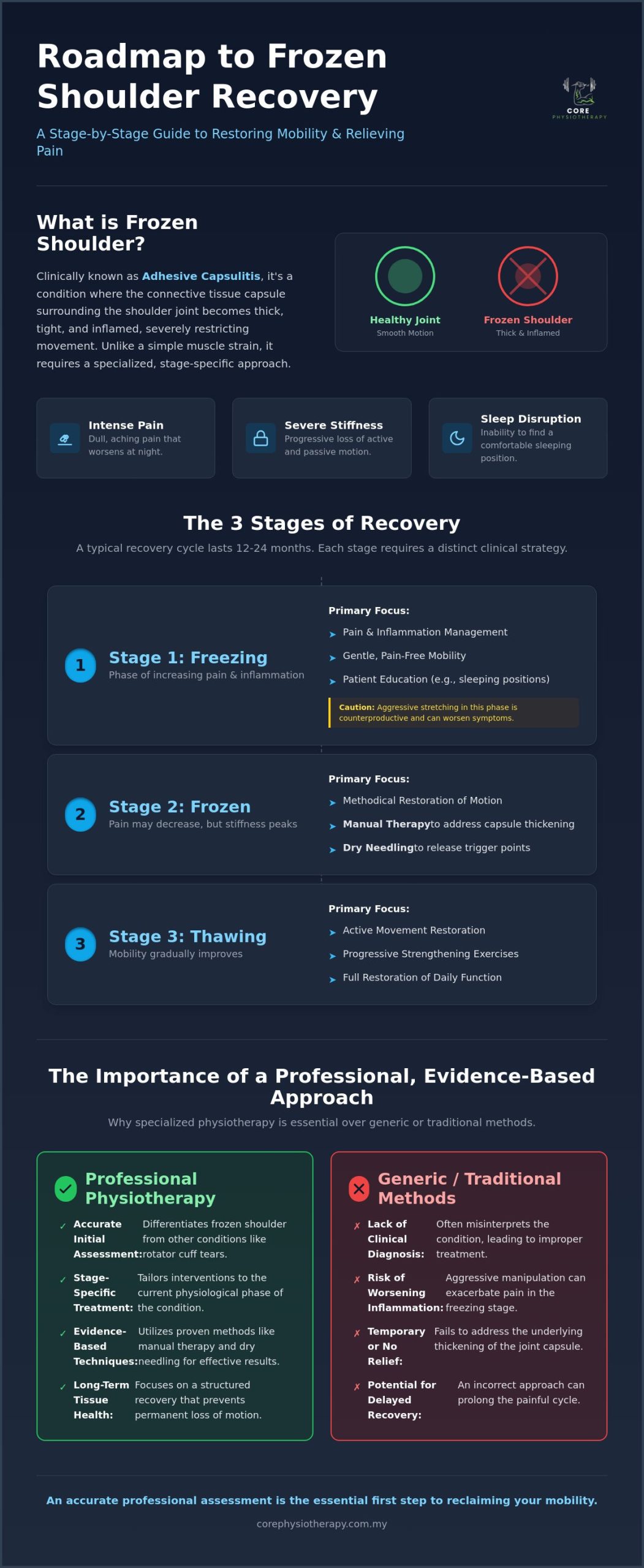
Frozen shoulder is a self-limiting condition, yet its cycle can last anywhere from 12 to 24 months. Understanding where you sit within this timeline is vital for a successful recovery. We categorize this journey into three distinct phases: Freezing, Frozen, and Thawing. Each phase requires a different clinical strategy. Attempting the wrong intervention at the wrong time isn’t just ineffective; it can actually heighten your pain. When seeking frozen shoulder treatment jb, you need a partner who understands these nuances to guide you through the long-term cycle with confidence.
Stage 1: Managing Inflammation and Pain
The ‘Freezing’ phase is characterized by intense, escalating pain and a gradual loss of motion. During this stage, the shoulder capsule is highly inflamed. Aggressive stretching is often counterproductive here because it can trigger further protective muscle guarding and increase inflammatory markers. Our focus shifts toward pain modulation and gentle, pain-free mobility. We often utilize dry needling eco palladium to release local trigger points and soothe the nervous system. We also provide education on specific sleeping positions, such as using supportive pillows to cradle the arm, which can significantly reduce night-time distress.
Stages 2 & 3: Restoring Joint Mechanics
As you transition into the ‘Frozen’ and ‘Thawing’ stages, the intense pain usually plateaus, but the stiffness becomes more profound. This is when we begin Evaluating Treatment Options that involve more intensive manual joint mobilization. We use precise, hands-on techniques to gently stretch the thickened capsule and improve the gliding of the joint. Once the range of motion begins to return, we introduce progressive loading and corrective exercises to regain the strength lost during the period of inactivity. The ‘thawing’ phase is accelerated by consistent clinical movement therapy that encourages the remodeling of the capsule tissue.
Navigating this two-year cycle alone can be daunting. Professional guidance ensures that your frozen shoulder treatment jb evolves as your body heals, preventing setbacks and ensuring a steady return to function. If you’re unsure which stage you’re currently in, scheduling a movement assessment is the most effective way to start your recovery with a clear, stage-specific plan.
Evaluating Treatment Options: Manual Therapy vs. Dry Needling
While many clinics rely on passive modalities like TENS or ultrasound, effective frozen shoulder treatment jb requires a more proactive clinical approach. Passive machines can temporarily soothe nerves, but they don’t address the mechanical thickening of the joint capsule. Clinical evidence suggests that hands-on manual therapy and targeted dry needling offer a more robust solution for restoring function. These techniques allow us to treat both the stiff joint and the muscles that have become tense from overcompensating. For a deeper look at clinical standards, the Mayo Clinic provides an excellent overview of Frozen shoulder diagnosis and treatment.
Integrating these diverse techniques into a single recovery plan is what defines a high-standard pain management clinic johor bahru. We don’t just treat the shoulder; we treat the person. By combining the mechanical benefits of manual therapy with the neurological relief of dry needling, we provide a comprehensive path toward pain-free movement. This synergy ensures that your frozen shoulder treatment jb addresses both the root cause and the secondary symptoms.
The Power of Manual Joint Mobilization
Unlike chiropractic adjustments that often focus on high-velocity “cracking,” clinical joint mobilization involves controlled, rhythmic glides. Our therapists apply specific pressure to the head of the humerus to create space within the tight capsule. This myofascial release is essential for breaking down the adhesions that limit your reach. You’ll often notice an immediate increase in comfort after a session, while the long-term gains in range of motion accumulate through consistent mobilization. It’s a methodical process of reclaiming the joint’s natural gliding mechanics without forcing the tissue beyond its current physiological limit.
Dry Needling for Secondary Muscle Tension
When one joint stops moving, others work harder. Patients often develop intense tension in the trapezius and levator scapulae muscles because they “hike” their shoulder to compensate for the lack of joint rotation. Dry needling is a game-changer for this compensatory pain. By inserting thin, sterile needles into these hyper-irritable trigger points, we can force the muscle to relax. This reduction in muscle guarding makes it much easier for you to perform your prescribed movement exercises. If it’s your first time, don’t worry. Most patients feel only a brief twitch response, followed by a significant release of deep-seated tension and a lighter feeling in the neck and upper back.
Choosing a Physiotherapy Clinic in JB: A Patient’s Checklist
Selecting a clinical partner for frozen shoulder treatment jb is a decision that directly impacts your recovery timeline. You aren’t just looking for a service provider; you’re looking for an expert guide who understands the complex, multi-stage nature of adhesive capsulitis. Many facilities offer generic massages or “quick fixes,” but these rarely address the underlying thickening of the joint capsule. A high-standard clinic should prioritize evidence-based practices and a deep, root-cause analysis of your specific movement patterns. This ensures that every session moves you closer to your goal of pain-free movement.
A comprehensive initial assessment is the most critical first step in this journey. This evaluation allows the therapist to differentiate adhesive capsulitis from other dysfunctions, such as rotator cuff tears or bursitis. Your therapist should also provide personalized corrective exercises jb tailored to your specific mobility gaps. Generic printouts often fail to account for individual muscle compensations. Furthermore, consider the location and accessibility of the facility. Clinics near Eco Palladium or Mount Austin offer modern environments and convenient access for JB residents, making it easier to maintain the consistency required for long-term rehabilitation.
Red Flags to Avoid During Your Search
Be cautious of clinics that promise a “cure” in just one or two sessions. A true frozen shoulder follows a physiological timeline that simply cannot be bypassed. You should also be wary of an over-reliance on passive machines like TENS or ultrasound without any hands-on manual therapy. While machines can manage symptoms, they don’t replace the clinical glides needed to restore joint space. Finally, avoid clinics that lack a documented progress tracking system, as objective measurements are vital for a successful outcome.
Questions to Ask Your Potential Therapist
Ask your therapist how they adapt their techniques for the freezing versus the thawing stages. A one-size-fits-all approach is often ineffective and can even be counterproductive. Inquire about their method for root-cause movement analysis to see if they look at how your neck and back are compensating for the shoulder stiffness. Lastly, confirm that they provide a structured home program. True recovery happens between clinical visits, so having a plan to follow at home is essential for the most effective frozen shoulder treatment jb.
If you’re ready to transition from debilitating stiffness to a life of movement, the first step is a professional evaluation. We invite you to schedule your initial assessment today to begin your personalized path to recovery.
The Core Physiotherapy Approach: Evidence-Based Recovery in Johor Bahru
Core Physiotherapy PLT’s approach to frozen shoulder treatment jb is built on a foundation of clinical excellence and patient-centered care. We believe that recovery shouldn’t be a matter of guesswork. Instead, we focus on a deep, root-cause analysis that looks beyond the shoulder joint itself. By examining how your scapula moves and how your posture influences joint mechanics, we create a recovery environment where long-term healing is the priority. Our philosophy integrates hands-on manual therapy with modern techniques to ensure your journey through the thawing phase is as efficient and comfortable as possible.
We understand that the 12 to 24 month recovery cycle of adhesive capsulitis requires more than just clinical skill; it requires empathy. Our therapists act as dedicated partners, guiding you through the frustrating moments of stiffness with quiet confidence and optimism. By combining joint mobilization to restore space with dry needling to soothe compensatory muscle tension, we provide a structured path toward physical vitality. This integrated method ensures that every aspect of your dysfunction is addressed simultaneously. Patients who also experience joint stiffness beyond the shoulder may benefit from exploring arthritis management johor bahru services, as the root-cause rehabilitation principles that guide our shoulder recovery protocols apply equally to other joints affected by chronic stiffness and inflammation.
Your First Session at Eco Palladium
When you visit our modern clinic at Eco Palladium, your journey begins with a comprehensive initial assessment. This isn’t a generic check-up. We perform a detailed movement analysis to establish your current baseline and identify specific areas of restriction. Together, we’ll set realistic, measurable goals for pain reduction and mobility restoration based on the current stage of your condition. We remain steadfast in our commitment to utilizing clinical science and evidence-based protocols rather than relying on superficial, short-term fixes.
Long-Term Health and Injury Prevention
As your range of motion returns, our focus shifts toward building functional strength. This transition is vital for remodeling the shoulder capsule and ensuring the joint can handle the demands of your daily life. We pay special attention to physiotherapy for office workers jb, as sedentary habits and poor ergonomics can often lead to the postural imbalances that complicate shoulder health. By integrating corrective exercises into your routine, we help you prevent future recurrence and maintain your hard-won mobility.
Recovery from a frozen shoulder is a marathon, not a sprint. While the stiffness may feel permanent right now, the right clinical support changes everything. With patience, discipline, and expert guidance, your shoulder can and will move freely again. We’re here to ensure that your frozen shoulder treatment jb leads to a future of unrestricted, pain-free movement and long-term well-being.
Reclaiming Your Mobility and Quality of Life
Recovering from adhesive capsulitis is a journey that requires clinical precision and personal patience. You’ve learned that effective recovery isn’t found in generic fixes, but in a stage-specific plan that evolves with your body’s healing process. By integrating evidence-based manual therapy techniques with specialized dry needling for targeted relief, we address both the structural stiffness of the joint capsule and the compensatory muscle tension. This comprehensive approach ensures you aren’t just managing symptoms, but actively restoring your natural range of motion through root-cause movement analysis for long-term results.
Finding the right frozen shoulder treatment jb can offer is the critical turning point in your recovery. Our expert therapists are ready to act as your dedicated guides, helping you transition from debilitating stiffness toward a life of physical freedom. It’s time to reclaim the ability to perform daily tasks with ease and sleep through the night without pain. Book Your Clinical Shoulder Assessment at Core Physiotherapy JB today to begin your personalized path to health. Your journey to a pain-free life is entirely possible, and we’re here to support you every step of the way.
Frequently Asked Questions
Is frozen shoulder treatment in JB covered by insurance?
Coverage for physiotherapy typically depends on your specific insurance policy and often requires a referral from a General Practitioner. Most major Malaysian medical insurance providers, including AIA, Prudential, and Great Eastern, cover outpatient physiotherapy under their medical benefits. We recommend verifying your outpatient limits and checking if your plan requires a doctor’s letter. SOCSO also provides full coverage for work-related injuries that lead to adhesive capsulitis.
How many sessions of physiotherapy will I need for a frozen shoulder?
Most patients require between 10 to 15 sessions to manage the chronic nature of adhesive capsulitis effectively. While acute muscle strains might resolve in just a few visits, the thickening of the joint capsule requires a longer, stage-specific approach. Your therapist will adjust the frequency of your visits based on whether you’re in the freezing, frozen, or thawing stage to ensure a steady and safe recovery.
Can I treat frozen shoulder at home without a professional?
While home exercises are a vital part of recovery, self-treating without professional guidance often leads to increased pain or prolonged stiffness. Attempting aggressive stretches during the inflammatory ‘freezing’ phase can actually worsen the condition. A clinical assessment ensures you’re performing the right movements at the right time. Professional manual therapy is often necessary to restore joint space that simple home exercises cannot reach.
Why is my shoulder pain worse at night?
Night-time pain is a hallmark symptom caused by increased inflammation and the lack of joint movement during sleep. When you lie down, gravity can cause the humeral head to shift against the tight, inflamed capsule, triggering an intense pain response. Additionally, the decrease in distracting daytime activities makes you more aware of the dull, persistent ache. Using supportive pillows to cradle the arm can help provide relief.
Is dry needling painful for frozen shoulder patients?
Most patients experience a brief, localized twitch sensation rather than intense pain during dry needling. We use thin, sterile needles to target hyper-irritable trigger points in the neck and shoulder muscles that have become tense from overcompensation. While you might feel a momentary ache as the muscle releases, the subsequent reduction in tension is significant. This technique is highly effective for reducing the deep-seated muscle guarding that limits your movement.
What happens if I leave my frozen shoulder untreated?
Leaving the condition untreated can result in a permanent loss of range of motion and chronic compensatory pain in the neck and back. While some cases eventually “thaw” on their own, the process can take years and the shoulder rarely returns to full function without intervention. Professional frozen shoulder treatment jb residents utilize ensures the capsule remodels correctly, preventing long-term disability and secondary joint issues.
Can frozen shoulder return after successful treatment?
It’s rare for adhesive capsulitis to recur in the same shoulder once it has fully resolved. However, about 10% to 15% of patients may develop the condition in the opposite shoulder later in life. Consistent adherence to the movement and corrective exercises we provide helps maintain joint health. This proactive approach reduces the risk of other shoulder dysfunctions that could mimic the symptoms of a recurrence.
How do I know if I have frozen shoulder or a rotator cuff injury?
The primary differentiator is that frozen shoulder limits both active and passive movement, whereas a rotator cuff injury often allows for passive movement. If you can’t lift your arm and a therapist also can’t move it for you, it’s likely adhesive capsulitis. Rotator cuff issues usually involve pain during specific movements but maintain a greater overall range. A professional movement assessment is the only way to confirm the root cause.