
What if the sharp, radiating pain making your daily commute across the Causeway unbearable isn’t a permanent sentence to the operating theater? Many residents believe that once a disc herniates, surgery is the only path back to a normal life. We understand the deep-seated anxiety this causes, especially when you’re struggling to sit through a workday or fearing the long-term impact on your career and mobility. It’s exhausting to manage constant discomfort while trying to maintain the fast-paced Johor Bahru lifestyle.
The good news is that clinical evidence supports a different path. This guide outlines a comprehensive roadmap for slipped disc treatment jb, focusing on how you can achieve a full recovery through non-invasive, evidence-based care. You’ll learn how identifying the root cause of your mechanical stress allows for a structured return to pain-free movement. We’ll preview the essential stages of rehabilitation, including professional clinical assessments, manual therapy, and corrective exercises, all designed to help you reclaim your health with confidence and clarity.
Key Takeaways
- Understand the clinical differences between bulging and herniated discs to better navigate your personal recovery journey.
- Learn why effective slipped disc treatment jb requires addressing underlying mechanical issues like poor hip mobility rather than just suppressing pain symptoms.
- Discover how professional manual therapy and dry needling work together to restore joint function and alleviate secondary muscle spasms.
- Follow a structured, two-phase recovery roadmap that moves from initial pain modulation to the full restoration of your range of motion.
- Identify the critical criteria for selecting a clinical specialist who prioritizes evidence-based protocols and long-term spinal health.
Understanding Slipped Disc: Why It Affects So Many in Johor Bahru
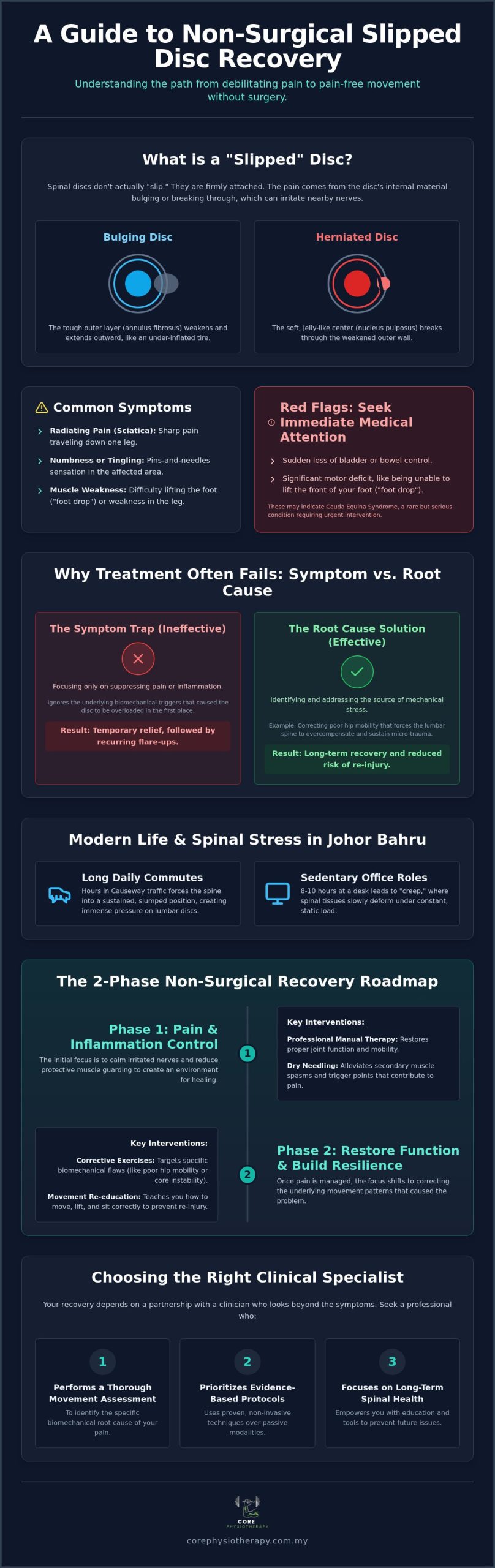
The term “slipped disc” is widely used in our community, yet it’s actually a bit of a medical misnomer. Your spinal discs are firmly attached to the vertebrae; they don’t simply slide out of place like a loose tile. Instead, what most people experience is either a bulging or herniated disc. A bulging disc occurs when the tough outer layer weakens and extends outward, while a herniation happens when the soft, jelly-like center, known as the nucleus pulposus, actually breaks through that outer ring. For those seeking slipped disc treatment jb, understanding this distinction is the first step toward an effective, evidence-based recovery.
When this internal material escapes or the disc bulges significantly, it often irritates nearby nerve roots. This irritation is what triggers the symptoms that disrupt your life. You might feel a sharp, radiating pain down one leg, commonly known as sciatica, or notice localized numbness and muscle weakness. For a comprehensive overview of spinal disc herniation, it’s helpful to view the disc not as a static object, but as a dynamic shock absorber that reacts to every mechanical stress you encounter during your day.
The Anatomy of a Disc Herniation
Your spinal discs consist of a tough exterior called the annulus fibrosus and a hydrated, gelatinous core. When mechanical pressure becomes uneven or excessive, the core can press against the outer wall. This doesn’t just cause physical pressure; it can also trigger a chemical inflammatory response that sensitizes the nerves. While most cases respond well to conservative slipped disc treatment jb, you must be aware of “red flags.” If you experience a sudden loss of bladder or bowel control, or a significant motor deficit like “foot drop,” where you cannot lift the front of your foot, seek immediate medical attention. These symptoms may indicate cauda equina syndrome, a rare but serious condition requiring urgent intervention.
Johor Bahru Lifestyle Factors
Residents in Johor Bahru face unique environmental stressors that contribute to spinal issues. The daily Singapore commute is a primary culprit. Spending hours in heavy Causeway traffic forces the spine into a sustained, slumped position, which places immense hydrostatic pressure on the lumbar discs. Similarly, many professionals working in modern office hubs like Eco Palladium spend eight to ten hours a day in sedentary desk roles. This lack of movement leads to “creep,” where the spinal tissues slowly deform under constant load. When you combine this sedentary baseline with repetitive lifting or sudden movements without proper mechanics, the disc’s structural integrity can eventually reach a breaking point. A study conducted between 2016 and 2017 found that lumbar disc herniation was present in 31.9% of patients with low back pain, highlighting how common this challenge has become in our modern environment.
The Root Cause: Why Slipped Disc Treatment in JB Often Fails
Many patients seeking slipped disc treatment jb find themselves in a frustrating cycle of temporary relief followed by sudden flare-ups. This usually happens because the focus remains on the symptom—the pain—rather than the underlying biomechanical triggers. When you only treat the inflammation or the muscle spasm, you’re ignoring the reason the disc was overloaded in the first place. For instance, poor hip mobility is a common silent contributor. If your hips can’t rotate or hinge properly, your lumbar spine is forced to compensate by moving excessively, leading to repetitive micro-trauma on the discs.
Your body is highly intelligent. When it senses a disc injury, it initiates “muscle guarding,” which is a protective contraction of the surrounding muscles to stabilize the area. While helpful in the short term, chronic guarding creates a rigid, painful environment that prevents natural healing and limits blood flow. A professional movement assessment johor bahru identifies these specific biomechanical triggers, allowing us to pinpoint exactly where your movement patterns are failing your spine.
Compensation Patterns and Spinal Loading
When you’re in pain, you naturally alter your gait to avoid discomfort. These compensation patterns often lead to core instability, as certain muscles switch off while others overwork. This is why generic stretches found online often make a slipped disc worse. They might target the wrong area or place even more tension on a sensitized nerve root. Recovering from a slipped disc requires a precise, individualized approach that restores balance to your entire kinetic chain, ensuring your spine isn’t bearing the weight of your whole body’s movement errors.
The Importance of a Clinical Assessment
A successful recovery depends on more than just an imaging report. While an MRI provides a static snapshot of your anatomy, it doesn’t explain how you move or where your neurological deficits lie. Our clinical approach integrates findings from established Herniated disk diagnosis and treatment guidelines with functional movement testing to set realistic benchmarks. We look for specific markers of progress, such as improved nerve conduction and restored joint mobility, rather than just the absence of pain. If you’re ready to look beyond the surface of your symptoms, a thorough initial assessment is the most reliable way to begin your recovery.
Non-Surgical Slipped Disc Treatment: Comparing Clinical Options
Choosing the right clinical path is essential for a successful recovery without invasive procedures. While surgery was once viewed as an inevitable outcome for many, modern clinical guidelines now recommend an initial 6 to 12 week trial of supervised physiotherapy. Evidence suggests that a high percentage of patients experience significant improvement through structured Non-surgical treatments. In Johor Bahru, we focus on a multi-modal approach that combines hands-on intervention with neurological de-sensitisation to ensure your slipped disc treatment jb addresses both the disc pathology and the resulting movement compensations.
Manual Joint Mobilization
Manual therapy is a specialized clinical tool used to restore mobility to the spinal segments that have become stiff or “locked” due to muscle guarding. Unlike a general massage that focuses on superficial relaxation, professional mobilization involves precise, low-velocity movements applied to specific vertebrae. These techniques help reduce the mechanical pressure on affected nerve roots by improving the space and fluid dynamics within the spinal canal. It’s often helpful to understand how manual joint mobilization jb aids in pelvic and spinal alignment, as a balanced pelvis provides the stable foundation your lumbar spine needs to heal without being subjected to uneven loading.
Dry Needling for Spinal Support
When a disc is injured, deep stabilizing muscles like the multifidus and quadratus lumborum (QL) often go into a state of chronic, painful contraction. These secondary muscle spasms can be just as debilitating as the disc injury itself, creating a “splinting” effect that limits your movement. Our specialized dry needling eco palladium sessions target these specific neuromuscular trigger points to force a release in the deep tissue. By resetting these muscle fibers, we can effectively manage sciatica symptoms and accelerate the reduction of inflammatory pain, providing a window of relief that allows you to progress into more active rehabilitation phases.
The final, and perhaps most critical, component of a clinical roadmap is movement and corrective exercises. These aren’t generic gym movements; they’re prescribed tasks designed to build spinal resilience and core stability. A single-method treatment, such as only using heat packs or only getting a massage, rarely provides lasting results because it doesn’t change how your body handles load. A multi-modal approach is superior because it first modulates the pain through manual therapy and dry needling, then secures those gains by teaching your body to move correctly again. This comprehensive strategy ensures that your slipped disc treatment jb doesn’t just fix a temporary problem, but builds a stronger, more resilient spine for the future.
The Core Physiotherapy Roadmap to Spinal Recovery
Recovery from a disc injury is rarely a linear event. It’s a methodical clinical journey that requires a shift from passive relief to active resilience. Our approach to slipped disc treatment jb follows a structured, four-phase roadmap designed to respect the biological healing timelines of spinal tissues while progressively restoring your physical capabilities. By moving through these stages, we ensure that you don’t just feel better temporarily, but actually build a spine that can handle the demands of your daily life.
Phase 1 & 2: Finding Immediate Relief
The initial stages of recovery focus on pain modulation and the de-sensitisation of the affected nerve. When a disc is in an acute state, the surrounding environment is often highly inflammatory. We use specific clinical positioning and hands-on manual techniques to gently open the spinal canal space, which helps reduce the direct mechanical pressure on the nerve root. This phase isn’t about “fixing” the disc instantly; it’s about creating a chemical and physical environment where healing can begin.
Education plays a vital role during this period. We guide you on “safe movement” strategies that allow you to perform essential daily tasks without triggering an acute flare-up. By understanding which positions alleviate pressure and which exacerbate it, you gain control over your symptoms. This clinical de-sensitisation is the necessary precursor to restoring your full range of motion through targeted manual intervention.
Phase 3 & 4: Long-Term Prevention
Once the initial inflammatory peak has subsided, the focus shifts toward building spinal stability. Disc healing is a biological process that requires progressive loading to succeed. This means we must carefully introduce weight and movement to the spine to stimulate tissue repair and strengthen the supporting musculature. We develop a personalized exercise program johor that targets your specific weaknesses, ensuring your core and hips provide the stability your lumbar spine needs.
The final stage is functional integration. For many of our patients, this involves specific physiotherapy for office workers jb to address the ergonomic strains of long hours at a desk or the repetitive stress of a Singapore commute. We simulate your real-world movements to ensure your body is ready for a full return to activity. This comprehensive slipped disc treatment jb ensures you have the strength and the knowledge to prevent future recurrences.
If you’re ready to stop managing symptoms and start a structured path to recovery, the first step is a professional clinical diagnosis. Schedule your initial assessment today to begin your personalized roadmap to spinal health.
Choosing a Slipped Disc Specialist in Johor Bahru
Selecting the right provider for slipped disc treatment jb is a decision that impacts your long-term mobility and quality of life. In a landscape filled with “miracle gadgets” and flashy decompression machines, it’s vital to remember that clinical expertise and reasoning are your most valuable assets. High-end equipment can’t replace a therapist’s ability to listen to your history, observe your movement patterns, and adapt a treatment plan based on your daily feedback. A dedicated pain management clinic johor bahru offers a level of clinical specialization that general wellness centers often lack, focusing on the complex relationship between your nervous system and spinal mechanics.
When you attend your initial assessment, don’t hesitate to ask specific questions to gauge the quality of care. You should feel confident asking your therapist how they determine the root cause of your pain, what specific neurological markers they’ll monitor, and what the expected timeline is for non-surgical improvement. Our clinic at Eco Palladium is designed to provide this level of transparency and professional rigor. Being located within the JB community allows for the consistent follow-up sessions that are so critical for a successful recovery, especially for those balancing a busy career with the demands of spinal rehabilitation.
Evidence-Based Practice vs. Short-Term Fixes
Many patients seek out a quick “crack” or high-velocity adjustment, hoping for instant relief. While manual therapy is a core part of our practice, aggressive manipulation is rarely the appropriate solution for an acute herniated disc. We prioritize evidence-based mobilization that respects the sensitivity of your nerve roots. This methodical approach is why professional assessment fees are an investment in your future; they ensure your therapist has the time to perform a thorough analysis rather than rushing into a generic treatment. We value a partnership where you’re an active participant in your recovery, helping us refine your program as your symptoms evolve.
Next Steps for Your Recovery
Consistency is the cornerstone of physical rehabilitation. Your recovery doesn’t just happen during your 45-minute clinical session; it happens through the small, daily choices you make about how you sit, move, and perform your prescribed exercises. To prepare for your first visit, bring any relevant MRI or X-ray reports and wear comfortable clothing that allows for a full movement assessment. We’ll work together to establish clear benchmarks for your progress, ensuring your slipped disc treatment jb remains focused on your goal of returning to a pain-free, active lifestyle. If you’re ready to move beyond temporary relief and address the mechanical triggers of your disc pain, Schedule your professional assessment at Core Physiotherapy today.
Reclaiming Your Active Lifestyle Through Clinical Recovery
Recovering from a disc injury is a biological process that demands patience, precision, and a structured clinical approach. By shifting your focus from temporary symptom relief to a comprehensive root-cause analysis, you can navigate the path to health without the need for invasive surgery. We’ve explored how integrating professional manual therapy with specialized dry needling and progressive corrective exercises provides the mechanical support your spine requires. This evidence-based strategy is specifically designed to help you overcome the physical stressors of the Johor Bahru lifestyle.
Our expertise in slipped disc treatment jb ensures that every phase of your rehabilitation is grounded in clinical reasoning and personalized care. At our Eco Palladium facility, we prioritize thorough assessments to create a roadmap that is unique to your body and your goals. You don’t have to let spinal pain dictate your future or limit your potential. Take the first step toward a more resilient, pain-free version of yourself today.
Book Your Clinical Slipped Disc Assessment at Eco Palladium and begin your journey toward lasting spinal health with a team that values your long-term well-being.
Frequently Asked Questions
Is surgery always necessary for a slipped disc in Malaysia?
Surgery is not the only option for recovery. Clinical guidelines in Malaysia suggest that most lumbar disc herniations respond well to 6 to 12 weeks of conservative, supervised physiotherapy. Surgical intervention is typically reserved for “red flag” cases involving progressive motor deficits or loss of bladder control. Most patients find that a structured non-surgical approach is sufficient for a full return to activity.
How many physiotherapy sessions are typically needed for a slipped disc?
The number of sessions depends on the severity of your symptoms and how your body responds to the initial phase of care. A typical roadmap for slipped disc treatment jb starts with two to three sessions per week during the acute pain modulation phase. As your stability improves, the frequency usually decreases to once a week or bi-weekly to focus on long-term prevention and functional integration.
Can I continue working in Singapore while undergoing treatment in JB?
You can often continue your commute, provided you implement specific ergonomic adjustments. We focus on teaching you how to manage the mechanical stress of long periods of sitting or standing during the Causeway transit. By using “safe movement” strategies and making small changes to your posture, you can support your recovery while maintaining your professional commitments in Singapore.
What is the difference between a slipped disc and general back pain?
General back pain often stems from muscle strains or joint stiffness without nerve involvement. A slipped disc specifically involves the displacement of disc material that irritates a nerve root. This often results in neurological symptoms like radiating leg pain, numbness, or tingling. A clinical assessment is necessary to distinguish between simple musculoskeletal tension and true disc-related nerve compression.
Can dry needling help with the leg pain caused by a slipped disc?
Dry needling is highly effective for managing the secondary muscle spasms that accompany a disc injury. When a nerve is irritated, the surrounding muscles often contract protectively, which can worsen leg pain. By targeting trigger points in the lower back and glutes, dry needling helps de-sensitise the area and reduce the intensity of sciatica symptoms, allowing for more comfortable movement.
Is it safe to exercise if I have been diagnosed with a herniated disc?
Exercise is not only safe but essential for recovery when performed correctly. The key is progressive loading that strengthens the core and stabilizes the spine without overstressing the injured disc. We design movements that avoid excessive spinal flexion in the early stages, focusing instead on building a “muscular corset” to protect your vertebrae during your daily activities.
How do I know if my slipped disc is getting better or worse?
A positive sign of improvement is “centralization,” where the pain moves from your leg back toward the center of your spine. If the pain travels further down your leg or if you notice increasing weakness, the condition may be peripheralizing. It’s important to monitor these neurological markers closely with your therapist to ensure your recovery plan is progressing as expected.
What should I avoid doing if I suspect I have a slipped disc?
Avoid prolonged periods of slouched sitting and heavy lifting without proper biomechanics. You should also be cautious with aggressive self-stretching, especially “toe-touch” stretches that place high tension on the hamstrings and the spinal cord. If you suspect an injury, it’s best to avoid high-impact activities until you’ve had a professional assessment to determine the stability of your spine.