
What if that “rusty” sensation in your joints is not an inevitable consequence of aging, but a mechanical signal that your body is ready for restoration? You likely know the frustration of waking up with joints that take an hour to loosen, or the hesitation that comes when you want to enjoy a weekend walk in a JB park. It feels as though your range of motion is shrinking, making hobbies like golf feel like a distant memory. This persistent tension is a sign that it’s time to seek professional physiotherapy for joint stiffness JB to regain your physical freedom.
We understand how these limitations impact your daily life, and we believe recovery is achievable through a methodical, patient-centered approach. This guide explains how evidence-based care transforms rigid movements into fluid motion through professional mobility restoration. You will learn how a clinical initial assessment identifies the root cause of your stiffness, creating a foundation for long-term health. We will also explore how manual therapy and corrective exercises offer a path to avoid surgery and restore your full range of motion, allowing you to move with confidence once again.
Key Takeaways
- Learn how mobility restoration moves beyond temporary relief to return your joints to their full, pain-free range of motion.
- Identify how sedentary desk work and cross-border commuting in Johor Bahru contribute to chronic joint restrictions.
- Understand why professional root-cause analysis is superior to generic massage for achieving long-term physical freedom.
- Discover the benefits of evidence-based physiotherapy for joint stiffness JB through a personalized four-step clinical journey.
- Explore how modern manual therapy and corrective exercises at Eco Palladium can help you avoid surgery and return to the activities you love.
What is Mobility Restoration and Why is it Essential for Stiff Joints?
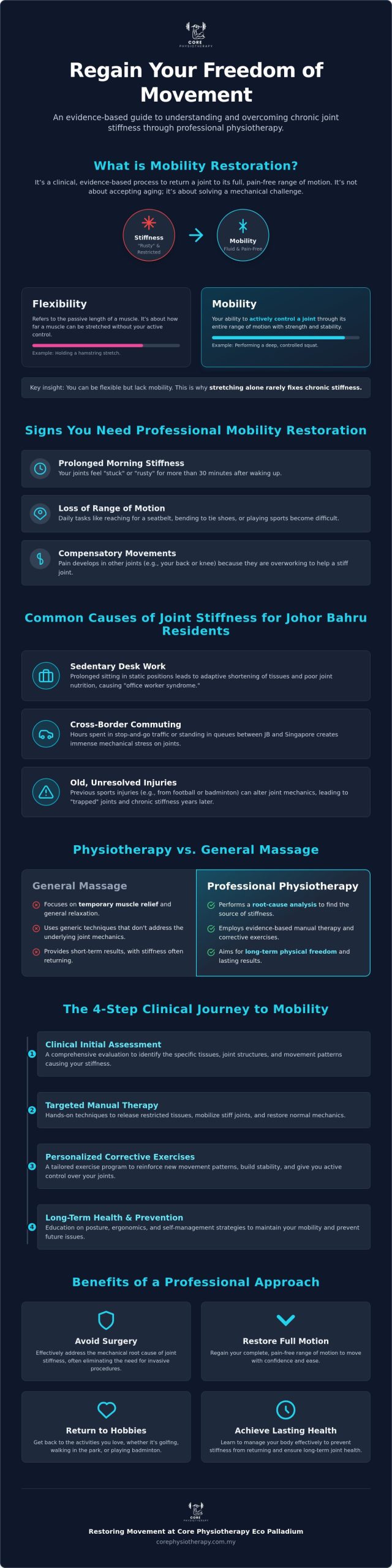
Mobility restoration is the clinical process of returning a joint to its full, pain-free range of motion. It is a structured, evidence-based approach that goes far beyond basic stretching or temporary relief. While many people believe that losing their range of motion is an unavoidable part of getting older, we view it as a mechanical challenge that can be solved. This process focuses on identifying the specific tissues or joint structures that are restricted and using targeted interventions to restore fluid movement.
When investigating What is joint stiffness?, it’s helpful to understand that stiffness is often a protective mechanism of the body that has become “stuck.” Your nervous system may tighten the muscles and tissues around a joint to protect it from perceived instability or potential injury. While this response is beneficial during an acute injury, it becomes a problem when the tightness persists long after the initial threat has passed. Professional physiotherapy for joint stiffness jb aims to reset this protective loop by addressing the underlying mechanical restrictions that keep you feeling “rusty.”
It is vital to distinguish between normal age-related changes and pathological stiffness that requires clinical intervention. You might feel slightly less supple than you were in your twenties, but you shouldn’t lose the ability to perform basic daily activities. When stiffness prevents you from moving naturally or causes discomfort that lingers throughout the day, it’s no longer just “aging.” It’s a sign that your joint mechanics need professional attention to prevent further degeneration and maintain your quality of life.
The Difference Between Flexibility and Mobility
People often use these terms interchangeably, but they represent very different physical states. Flexibility refers to the passive length of a muscle. Mobility, however, is your ability to actively control a joint through its entire range of motion. You can be flexible but still have poor mobility if your joints lack the necessary stability or neurological control. This is why stretching alone rarely fixes chronic joint stiffness. A comprehensive initial assessment identifies whether your limitation is a muscle length issue or a deeper joint restriction, ensuring you receive the correct treatment for your specific needs.
Signs You Need Professional Mobility Restoration
Recognizing the indicators of mechanical restriction early can help you avoid long-term complications. You should consider professional support if you experience any of the following:
- Morning stiffness that lasts more than 30 minutes before your joints feel “warmed up.”
- A noticeable loss of range of motion that affects daily tasks, such as reaching for a seatbelt or bending to tie your shoes.
- Compensatory movements, where other joints start hurting because they are working harder to “help” a stiff or restricted joint.
Addressing these signs through specialized physiotherapy for joint stiffness jb allows you to regain your physical freedom and return to the activities you enjoy without the constant shadow of restriction.
Common Causes of Joint Stiffness for Residents in Johor Bahru
Johor Bahru is a city characterized by its unique pace and specific lifestyle demands. For many residents, joint stiffness isn’t just a biological fluke; it’s often a direct result of daily habits and local environments. Understanding these causes is the first step toward effective physiotherapy for joint stiffness jb. When we identify the “why” behind your restriction, we can build a more precise path toward recovery.
Sedentary habits in JB offices contribute significantly to what we call “office worker syndrome.” When you sit at a desk for eight hours a day, your joints remain in static positions, leading to adaptive shortening of tissues. This lack of movement prevents the natural circulation of nutrients to your joints. Similarly, the daily cross-border commute between JB and Singapore places an immense physical toll on the body. Whether you’re navigating the long queues at the CIQ or enduring hours of stop-and-go traffic, these prolonged periods of standing or sitting create mechanical stress that manifests as persistent stiffness.
Old injuries also play a major role in how you move today. Many patients we see have “trapped” joints resulting from previous sports injuries, often from years of playing football or competitive badminton. These injuries may have healed superficially, but the underlying joint mechanics often remain altered. We also consider degenerative changes like osteoarthritis. It’s helpful to view this through a clinical overview of joint stiffness, which recognizes that while wear and tear is natural, it doesn’t have to result in a loss of mobility. With the right clinical intervention, you can manage these changes effectively and maintain an active lifestyle.
The Role of Synovial Fluid and Cartilage
Your joints rely on a sophisticated lubrication system to function smoothly. Synovial fluid is the “engine oil” for your joints. It reduces friction and provides essential nutrients to the cartilage. However, this fluid only circulates effectively when you move. Without regular movement, the fluid becomes more viscous and the cartilage doesn’t receive the nourishment it needs to stay healthy. This is why joints feel “stuck” after long periods of inactivity, such as a long drive or a full day at a computer.
Myofascial Restrictions and Stiffness
Stiffness isn’t always about the joint itself. Fascia, the connective tissue that wraps around every muscle and organ, can become tight and restricted. This myofascial tension can mimic joint stiffness by pulling on the structures around the bone. For instance, those experiencing lower body issues might benefit from understanding hip pain treatment johor bahru, which delves deeper into how myofascial release can unlock movement. Addressing these soft tissue restrictions is a core component of successful physiotherapy for joint stiffness jb. If you’re ready to identify the specific cause of your discomfort, scheduling a clinical assessment is the most effective way to start your recovery journey.
Physiotherapy vs. General Massage: Why Root-Cause Analysis Wins
Many people seek relief through generic massages or heat packs when they feel physically restricted. While these methods provide a soothing sensory experience, they often only mask symptoms for a few hours. The “rusty” sensation usually returns because the underlying mechanical restriction hasn’t been addressed. Our approach to physiotherapy for joint stiffness jb is built on a different philosophy. We prioritize identifying exactly why the restriction occurred in the first place rather than just treating the sensation of tightness.
A clinical assessment is the essential first step in this journey. It allows us to determine if your stiffness is rooted in the joint structures themselves or if it’s a result of muscular imbalances or neural tension. Without this clarity, any treatment is simply a guess. By performing a movement assessment johor bahru, we map your current movement patterns to find the specific “blockages” in your kinetic chain. This methodical process ensures that every intervention we perform is purposeful and targeted toward long-term mobility restoration.
Evidence-Based Treatments for Lasting Results
Once we understand the root cause, we utilize specialized techniques to restore function. Hands-on manual therapy is particularly effective for “unlocking” joint capsules that have become tight over time. Unlike the broad pressure of a massage, manual therapy involves precise, clinical mobilizations that improve the way joint surfaces glide against each other. For deep-seated muscle knots that contribute to joint tension, we often employ dry needling. This technique targets myofascial trigger points to reset muscle tone and provide dry needling eco palladium for those seeking targeted relief from chronic stiffness.
Science Over Short-Term Fixes
It’s common for individuals to try “cracking” their own joints to find a moment of ease. While this might release a temporary burst of endorphins, it doesn’t solve the mechanical issue. In fact, habitual self-cracking can lead to hypermobility in some areas while the actual stiff joint remains restricted. Clinical mobilization, performed by a professional, is designed to improve blood flow and joint nutrition through controlled, specific movements.
Ignoring persistent stiffness is a significant risk. It can lead to accelerated wear and tear as your body compensates for the lack of movement in one area by overworking another. Choosing professional physiotherapy for joint stiffness jb means investing in the structural integrity of your body. We focus on creating a sustainable solution that allows you to move with confidence, ensuring that your joints remain healthy and functional for years to come.
The 4-Step Journey to Mobility Restoration in JB
Reclaiming your physical freedom requires more than just willpower. It necessitates a structured, clinical roadmap that moves you from restriction to fluid movement. At Core Physiotherapy PLT, we guide our patients through a methodical four-step process. This journey is designed to ensure that your recovery is not only effective but also sustainable for the long term. By following this evidence-based path, physiotherapy for joint stiffness jb becomes a transformative experience rather than a temporary fix.
- Step 1: Comprehensive Clinical Assessment. We begin by mapping your current movement patterns to identify where your kinetic chain is failing. This isn’t just about where it hurts; it’s about uncovering why the joint became restricted in the first place.
- Step 2: Hands-on Manual Therapy. Once we’ve identified the blockages, we use skilled, manual techniques to address immediate joint and tissue restrictions. This phase focuses on physically “opening” the joint space.
- Step 3: Targeted Interventions. We may utilize dry needling or other specialized techniques to achieve a neuromuscular “reset.” This helps to calm overactive muscles that are guarding the stiff joint.
- Step 4: Personalized Corrective Exercises. The final step involves building a foundation of strength and control. We provide you with specific movements to maintain and build on the new mobility achieved in the clinic.
Manual Therapy and Joint Mobilization
The core of our clinical intervention lies in skilled, hands-on mobilization. Unlike a standard spa massage that focuses on general relaxation, professional mobilization involves specific, low-velocity movements applied directly to the joint surfaces. These techniques are designed to improve the glide and roll of the bones within the joint capsule. For those interested in the technical aspects of these treatments, our guide on soft tissue mobilization jb provides a deeper clinical reference. This specialized care is essential for breaking down adhesions and restoring the natural “give” that healthy joints require.
Corrective Exercises: Locking in the Progress
While the work we do in the clinic is vital, the “homework” you perform is what truly locks in your progress. Corrective drills are not just generic stretches; they are targeted movements that retrain your brain to use its newly available range of motion. Without this neurological integration, your body might default back to its old, stiff patterns. For example, simple chin tucks can help stabilize a stiff neck, while specific glute bridges can improve hip mobility. These exercises ensure that your recovery continues long after you leave our facility. If you are ready to begin this structured path toward movement, booking a professional assessment is the most effective first step in your physiotherapy for joint stiffness jb journey.
Restoring Movement at Core Physiotherapy Eco Palladium
Our clinic at Eco Palladium is a modern, supportive environment designed specifically for clinical rehabilitation and mobility restoration. We understand that the local lifestyle, from long hours in Johor Bahru offices to the daily cross-border commute, creates unique physical demands that often lead to chronic restriction. Our therapists specialize in identifying the root causes of these issues, ensuring that your path to physiotherapy for joint stiffness jb is grounded in clinical evidence rather than guesswork. We believe that every resident deserves access to high-quality care that prioritizes long-term function over temporary relief.
We reject the “cookie-cutter” approach often found in generic healthcare settings. Every treatment plan we develop is personalized to your specific anatomical needs and lifestyle goals. For residents in Mount Austin, Setia Indah, and the surrounding JB areas, our facility offers a professional sanctuary where recovery is the primary focus. We combine clinical expertise with a supportive atmosphere to help you regain the mobility you thought was lost to the passage of time. Our methodical approach ensures that we address the structural restrictions of the joint while also optimizing the surrounding soft tissues for fluid, natural movement.
A Patient-Centered Approach to Recovery
Building trust is the cornerstone of our practice. We believe that a successful recovery requires a dedicated partnership between the therapist and the patient. This journey starts with a thorough initial assessment, where we listen to your history and analyze your movement patterns with clinical precision. By moving away from superficial fixes, we help you transition from feeling “stiff and stuck” to being “active and optimized.” Our goal is to empower you with the knowledge and physical tools needed to maintain your joint health long after you leave our clinic.
Book Your Mobility Assessment in JB Today
You don’t have to accept joint stiffness as a permanent part of your life or an inevitable sign of aging. Whether you’re struggling to enjoy a round of golf or simply want to walk through the park without discomfort, professional intervention can make the difference. At Core Physiotherapy PLT, we make it easy to start your recovery. You don’t need a doctor’s referral to see us for an initial assessment, allowing you to take proactive control of your health immediately. Choosing physiotherapy for joint stiffness jb is about more than just relief; it’s about restoring your quality of life and your physical freedom.
Start your mobility restoration journey at Core Physiotherapy today and discover the difference that expert, clinical care can make for your movement.
Reclaim Your Physical Freedom and Fluidity
You now understand that persistent joint stiffness is a solvable mechanical challenge rather than an inevitable consequence of aging in Johor Bahru. By moving beyond temporary fixes like generic massage and embracing evidence-based root cause analysis, you can target the specific tissues that restrict your movement. Our structured clinical journey, involving expert manual therapy and dry needling, is designed to restore your natural range of motion and prevent future degeneration. It’s a path that prioritizes long-term function and helps you return to the activities you love with confidence.
Choosing professional physiotherapy for joint stiffness jb ensures that your recovery is guided by clinical expertise and a deep commitment to your well-being. We are located conveniently in Eco Palladium to support your transition from restriction to active living. Your journey toward fluid, pain-free movement starts with a single clinical step. We look forward to acting as your dedicated guide in restoring the quality of life you deserve.
Book Your Initial Mobility Assessment at Eco Palladium and start your restoration today.
Frequently Asked Questions
How many sessions of physiotherapy do I need for joint stiffness?
The number of sessions depends on the root cause of your restriction and how long the stiffness has been present. Most patients begin to feel a noticeable difference within three to five sessions. A full course of mobility restoration typically requires a structured plan to ensure the joint mechanics are fully optimized and the surrounding tissues are resilient enough to maintain the progress.
Is physiotherapy painful for someone with very stiff joints?
You may feel some mild discomfort or a “stretching” sensation during manual therapy as we work to unlock restricted tissues. However, the process shouldn’t be painful. We maintain constant communication during your session to ensure the intensity is appropriate for your current state. Our goal is to create a supportive environment where your body feels safe enough to release long-held tension.
Can I do mobility restoration exercises at home?
Yes, performing personalized corrective exercises at home is a critical component of your recovery. We provide specific drills designed to “lock in” the range of motion gained during your clinical sessions. These exercises retrain your nervous system to accept and use your new mobility, ensuring that you don’t default back into old, stiff patterns during your daily activities in JB.
Does joint stiffness always mean I have arthritis?
Joint stiffness isn’t always an indicator of arthritis. It’s often a mechanical signal that your tissues have become “stuck” due to sedentary habits, old injuries, or myofascial restrictions. While arthritis is one possible cause, many people find that professional physiotherapy for joint stiffness jb can resolve their symptoms by addressing the underlying mechanical blocks that have nothing to do with permanent joint disease.
How is physiotherapy better than a deep tissue massage for stiffness?
Physiotherapy focuses on root-cause analysis rather than just providing temporary sensory relief. While a deep tissue massage might feel good in the moment, it rarely addresses why a joint is restricted. We use clinical assessments to determine if the issue is joint-based or muscular. This allows us to use targeted manual therapy and dry needling to fix the actual mechanical problem for lasting results.
What should I wear to my first physiotherapy assessment in JB?
You should wear loose, comfortable athletic clothing that allows your therapist to easily access the area being treated. For example, shorts are best for knee or hip issues, while a tank top is helpful for shoulder assessments. This ensures we can perform a thorough movement analysis and apply hands-on techniques without being restricted by heavy or tight fabrics like denim.
Can physiotherapy help with morning stiffness in the back and neck?
Physiotherapy is exceptionally effective for resolving the “rusty” feeling many people experience upon waking. This morning stiffness is often a result of poor tissue health or fluid stagnation during the night. Through clinical mobilization and targeted exercises, we improve the circulation of synovial fluid and reset muscle tone. This helps you start your day with fluid movement rather than waiting an hour to loosen up.
Is mobility restoration suitable for seniors in Johor Bahru?
Mobility restoration is highly beneficial for seniors and is adapted to be gentle, safe, and effective for older joints. We focus on maintaining independence and ensuring you can continue to enjoy walks in local parks or social gatherings. Specialized physiotherapy for joint stiffness jb helps seniors manage age-related changes with confidence, proving that stiffness doesn’t have to be a permanent part of getting older.