
Why does that stubborn knot in your shoulder return just days after a relaxing spa massage? Many people struggle with persistent muscle tightness that interferes with their daily movements and athletic goals, often feeling frustrated when temporary relief fades into familiar stiffness. You’ve likely experienced the confusion of choosing between a general wellness treatment and a clinical therapy without knowing which one actually addresses your specific pain. If you’re seeking professional soft tissue mobilization jb, it’s essential to recognize that true healing requires more than just surface-level pressure.
At Core Physiotherapy PLT, we focus on evidence-based manual therapy that targets the mechanical root causes of your discomfort. This guide explains how clinical soft tissue mobilization works to remodel dysfunctional tissue and restore your body’s natural fluid movement. We’ll preview the journey from a detailed initial assessment to personalized corrective exercises, showing you how a structured approach leads to long-term relief and improved occupational performance. You’ll gain a clear understanding of why clinical intervention is the necessary step toward reclaiming your mobility and confidence.
Key Takeaways
- Understand the clinical difference between general relaxation and specialized manual therapy designed to resolve specific physical adhesions and restore function.
- Learn how the science of mechanotransduction uses targeted pressure to signal cellular repair and break the cycle of chronic inflammation.
- Discover how soft tissue mobilization jb provides a clinical solution for persistent office-related neck tension and common regional sports injuries.
- Identify why a comprehensive initial assessment is the essential first step in moving beyond temporary relief toward long-term recovery.
- Explore how the integration of manual therapy with personalized corrective exercises ensures your physical improvements are sustainable and performance-oriented.
What is Soft Tissue Mobilization (STM) in Clinical Physiotherapy?
Soft tissue mobilization is a specialized form of hands-on manual therapy that clinicians use to treat various musculoskeletal conditions. It’s far more than a simple massage; it’s a targeted mechanical intervention designed to address the complex layers of muscles, fascia, and ligaments. Many people seek What is Soft Tissue Mobilization (STM) as a way to resolve pain that hasn’t responded to rest or generic relaxation techniques. At its core, this therapy focuses on restoring the structural integrity of your body’s moving parts.
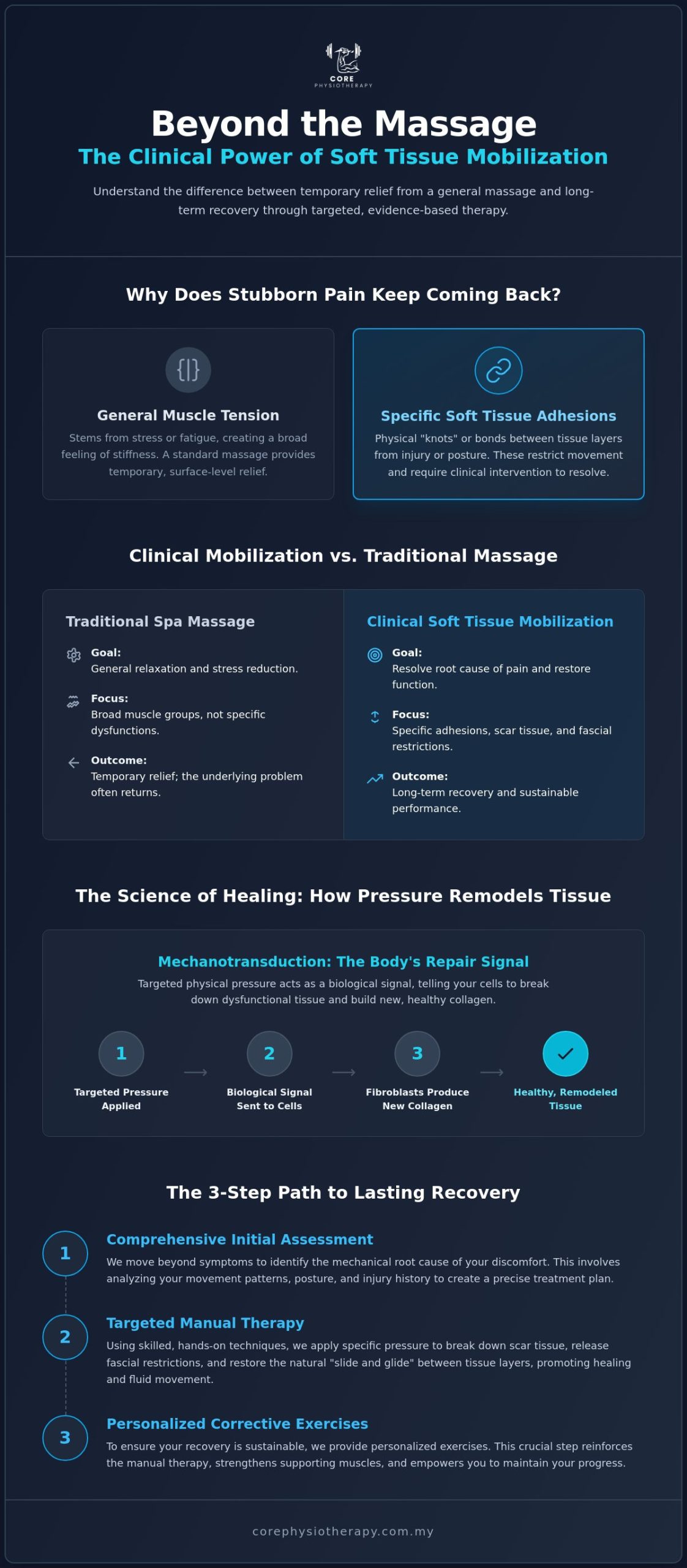
There is a fundamental difference between generalized muscle tension and specific soft tissue adhesions. Generalized tension often stems from stress or fatigue, resulting in a broad feeling of stiffness. Adhesions, however, are physical bonds that develop between tissue layers, often due to injury or chronic postural strain. These “stuck” areas prevent muscles from contracting and lengthening correctly. When you visit us for soft tissue mobilization jb, our therapists use advanced palpation skills to identify these specific areas of densification. We look for trigger points and restricted fascial planes that a standard wellness massage might overlook.
By treating STM as a medical intervention rather than a lifestyle service, we prioritize clinical reasoning. Every session begins with an understanding of your unique movement patterns. We don’t just rub where it hurts. We trace the pain back to the restrictive tissue that is causing the dysfunction. This precision is what allows for long-term recovery instead of temporary relief.
The Components of the Soft Tissue System
Your body is held together by fascia, a sophisticated connective “web” that provides structure and support. Fascia surrounds every muscle fiber and organ, ensuring everything stays in place. However, when fascia becomes restricted, it acts like a tight suit, pulling on muscles and tendons. This interaction is critical; if the soft tissue is tight, the joint it supports cannot move efficiently. Over time, restricted soft tissue can lead to premature joint wear and decreased mobility in your daily life. Patients who also experience that characteristic “rusty” sensation in their joints alongside soft tissue restrictions often benefit from concurrent physiotherapy for joint stiffness JB to address both the surrounding tissue and the joint mechanics simultaneously.
The Goals of Clinical Mobilization
The ultimate aim of clinical mobilization is to return your body to its optimal state of movement. We achieve this through several specific therapeutic goals:
- Breaking down scar tissue: We target internal adhesions that limit your range of motion and cause “catching” sensations.
- Accelerating circulation: Targeted pressure increases local blood flow, which delivers the nutrients required for cellular repair.
- Restoring “slide and glide”: We help different tissue layers move independently of one another, which is essential for fluid, pain-free movement.
By focusing on these mechanical outcomes, we help you transition from a state of restriction to one of physical freedom.
The Science of Healing: How STM Remodels Your Body
Clinical healing is a biological process that requires the right environment to succeed. While many people view manual therapy as a way to simply relax, the underlying reality is far more scientific. Through a process known as mechanotransduction, the physical pressure applied during therapy acts as a biological signal to your cells. This signal tells your body to restart the repair process, specifically targeting fibroblasts to produce new, healthy collagen. Understanding The Science of Healing: How STM Remodels Your Body allows you to see your recovery as a physical restructuring rather than just a temporary reduction in discomfort.
Targeted pressure also plays a vital role in breaking the cycle of chronic inflammation. When an injury doesn’t resolve properly, the tissue can become stuck in a low-grade inflammatory state that causes persistent stiffness. By applying specific mechanical loads, we can stimulate a controlled, localized response that flushes out metabolic waste and introduces fresh, nutrient-rich blood to the area. This reset is essential for anyone seeking soft tissue mobilization jb to address long-standing physical limitations that haven’t responded to rest alone.
From Adhesions to Alignment
Tissue adhesions are essentially internal tangles of collagen fibers that form after surgery, injury, or long periods of immobility. Instead of lying in neat, parallel lines that allow for easy movement, these fibers become a disorganized “bird’s nest” that restricts your range of motion. During a session, we use “micro-trauma” to gently disrupt these faulty bonds. This intentional stimulus encourages your body to realign those fibers into a more functional, load-bearing pattern. Identifying these specific restrictions through an initial assessment ensures that we’re remodeling the tissue that actually causes your stiffness.
Neuromuscular Re-education
Soft tissue health is deeply connected to how your brain perceives your body. When tissues are chronically tight, your muscle spindle cells send constant signals to the brain to maintain a high level of resting tension, a behavior known as “pain guarding.” Clinical mobilization helps reset these sensors, effectively lowering the “volume” of those tension signals. This process improves your proprioception, which is your body’s innate awareness of its position in space. The gate control theory of pain suggests that non-painful tactile input, such as clinical manual pressure, can effectively “close the gate” to pain signals traveling to the brain. By improving the health of your soft tissues, you’re not just moving better; you’re teaching your nervous system that it’s safe to move again.
Common Conditions Managed with Soft Tissue Mobilization in Johor Bahru
Johor Bahru’s unique lifestyle, from the high-pressure corporate environments in hubs like Eco Palladium to the grueling daily commute across the Causeway, places specific demands on the human body. These repetitive physical stressors often manifest as chronic pain that simple rest cannot resolve. Using soft tissue mobilization jb allows us to address these regional challenges by targeting the specific tissues that have adapted poorly to your daily routine. Clinical intervention ensures that we aren’t just treating a surface-level symptom, but rather the underlying structural changes caused by your lifestyle.
Beyond daily habits, many patients seek our expertise for post-surgical recovery. After a procedure, the body’s natural healing process often produces dense scar tissue that can limit your functional range of motion. Specialized manual therapy helps manage this tissue, ensuring it remains flexible and doesn’t interfere with your recovery timeline. We also frequently treat repetitive strain injuries (RSI) that develop from the constant micro-movements of professional work or long hours of driving, helping you return to your activities with confidence.
Addressing the “Commuter Back” and Desk Stiffness
The “Commuter Back” is a growing concern for those traveling between JB and Singapore. Hours spent in static, seated positions lead to fascial thickening, particularly in the iliopsoas and the lower back fascia. When these connective tissues lose their elasticity, they pull on the spine and hips, causing deep, persistent aches. Our therapists focus on releasing these specific restrictions to restore your postural alignment and comfort. For those spending long hours at a workstation, our physiotherapy for office workers in JB provides a structured path to pain-free performance by addressing these exact mechanical issues.
Sports Recovery and Performance Optimization
Active individuals in the local community, especially those frequenting badminton courts or running trails, often struggle with the “tightness-injury-rest” cycle. We see a high volume of plantar fasciitis and Achilles tendonitis cases among JB athletes. Utilizing soft tissue mobilization jb helps break this cycle by maintaining the health of your tendons and muscles before they reach a breaking point. If you’ve already experienced an acute injury, such as a rolled ankle during a football match, our ankle sprain physiotherapy in JB integrates targeted manual therapy with progressive loading exercises. This comprehensive approach ensures you don’t just recover, but return to your sport stronger and more resilient than before.
Clinical STM vs. Traditional Massage: Why Precision Matters
Choosing between a weekend spa visit and a clinical session involves more than just a difference in environment. While a traditional massage focuses on systemic relaxation and stress reduction, clinical soft tissue mobilization is a targeted intervention aimed at functional restoration. When you book soft tissue mobilization jb, the objective isn’t merely to feel relaxed for an hour. It’s to resolve specific structural impediments that limit your movement. This distinction is critical because applying general pressure to a complex injury can sometimes mask symptoms without addressing the underlying mechanical cause.
Precision is the hallmark of clinical therapy. A wellness massage typically follows a set routine, applying similar techniques to every client. In contrast, our approach is entirely assessment-driven. We use our anatomical knowledge to identify exactly which muscle, tendon, or fascial plane is restricted. We also challenge the common myth that “deeper is always better.” In a clinical setting, the depth of pressure is calibrated to the specific tissue layer we’re targeting. Excessive force can actually trigger more “pain guarding” and inflammation, whereas precise, moderate pressure can facilitate the tissue remodeling required for true healing.
Assessment vs. Application
Effective treatment never starts with the hands; it starts with the eyes and clinical reasoning. A professional movement assessment must precede any manual intervention. This allows us to identify “referred pain” patterns where the source of your discomfort is actually far from where you feel the ache. For example, a knot in your shoulder might be a compensation for a restriction in your mid-back. By using STM as a diagnostic tool, we can feel for subtle changes in tissue density that indicate deeper musculoskeletal issues, ensuring our therapy is as efficient as possible.
Integration with Other Therapies
Soft tissue mobilization rarely exists in a vacuum at our clinic. It often serves as a foundational step that prepares your body for more intensive interventions. For instance, releasing superficial fascial tension through STM can significantly improve the effectiveness of dry needling by allowing the needles to reach deeper trigger points with less resistance. However, manual therapy is only half of the equation. To ensure lasting change, we follow these sessions with personalized corrective exercises. This transitions you from passive treatment to active recovery, reinforcing the new range of motion you’ve gained. If you’re ready to experience the difference that clinical precision makes, book your initial assessment with us today.
The Core Physiotherapy Approach: Root-Cause Soft Tissue Recovery
Core Physiotherapy PLT operates on a foundation of clinical excellence and patient-centered care. We believe that effective recovery is only possible when we understand the structural “why” behind your physical limitations. Our commitment to evidence-based manual therapy means that every session of soft tissue mobilization jb is backed by scientific reasoning and a deep understanding of human anatomy. We don’t just treat the symptoms that brought you through our doors. We investigate the mechanical imbalances and lifestyle factors that created the problem in the first place.
This “Assessment-First” philosophy ensures that your treatment is never generic. Your body has a unique history of movement, injury, and adaptation. Therefore, we customize our pressure levels and techniques based on your specific tissue tolerance and the depth of the restriction. By combining this hands-on precision with a focus on long-term health, we empower you to take an active role in your own recovery. We provide the tools and corrective movement strategies you need to maintain your progress long after you leave the clinic. Seeking professional soft tissue mobilization jb means choosing a partner who is genuinely invested in your long-term vitality.
What to Expect During Your Session
Your clinical journey begins with a thorough evaluation of your tissue texture, temperature, and mobility. This isn’t a passive process. We actively feel for areas of densification and restricted fascial glide that interfere with your natural movement. Once identified, we apply specific STM techniques tailored to your needs. This might involve sustained pressure to release a deep trigger point, cross-friction to address stubborn scar tissue, or movement-based mobilization where we guide your limbs through a range of motion while applying manual pressure. After the treatment, we provide clear guidance on how to maintain these gains through specific stretches or postural adjustments.
Start Your Recovery in Eco Palladium
Our clinic in Eco Palladium is designed to be a professional and supportive environment where your health is the primary focus. We’ve moved away from the cold, institutional feel of traditional healthcare toward a more personalized and attentive experience. If you’re ready to find a permanent solution for your stiffness, you can book an initial assessment for pain management in Johor Bahru. Our team is dedicated to guiding you through a safe, effective, and evidence-based rehabilitation process. We’re confident in the efficacy of our methods and look forward to being your partner in restoring your mobility and confidence.
Reclaiming Your Physical Freedom
Restoring fluid movement is a journey that begins with understanding the mechanical nature of your pain. By shifting the focus from temporary relaxation to clinical tissue remodeling, you address the underlying causes of persistent stiffness. We’ve explored how evidence-based manual therapy breaks down internal adhesions and resets the nervous system. This approach provides a sustainable alternative to generalized wellness treatments and ensures your body is prepared for the demands of daily life.
Professional soft tissue mobilization jb offers a structured path toward functional recovery for those managing sports injuries or office-related tension. At Core Physiotherapy PLT, our expert therapists specialize in meticulous root-cause analysis and personalized care within our supportive clinic in Eco Palladium. We invite you to Book Your Clinical Assessment at Core Physiotherapy JB to begin your rehabilitation journey. Your recovery is a realistic goal, and we’re dedicated to helping you achieve lasting physical improvement and confidence in your movement.
Frequently Asked Questions
Is soft tissue mobilization painful?
Soft tissue mobilization shouldn’t be an agonizing experience, though you’ll likely feel some therapeutic discomfort as we address deep-seated adhesions. Our therapists maintain constant communication with you to ensure the pressure remains within your specific tolerance levels. While some “good pain” is common when remodeling restricted tissue, the goal is always functional restoration without causing unnecessary trauma to your body.
How many sessions of STM will I need to see results?
The number of sessions required depends on the chronicity of your condition and your body’s specific response to manual therapy. Many patients seeking soft tissue mobilization jb notice meaningful improvements in mobility within three to six sessions. During your initial assessment, we define a clear clinical pathway that includes both in-clinic treatment and home-based movement strategies to accelerate your recovery timeline.
What is the difference between STM and myofascial release?
Myofascial release is actually a specific technique categorized under the broader umbrella of soft tissue mobilization. While STM includes various methods like trigger point therapy and transverse friction, myofascial release focuses specifically on the connective tissue “web” that surrounds your muscles. We use a combination of these approaches based on whether your restriction resides within the muscle fibers themselves or the surrounding fascial layers.
Can STM help with old injuries and scar tissue?
Clinical mobilization is highly effective for remodeling old scar tissue and chronic adhesions that have persisted for years. Even if an injury occurred long ago, the disorganized collagen fibers can still be influenced through targeted mechanical pressure. By introducing specific loads to these tissues, we help realign the fibers into a more functional pattern, which reduces the “tugging” sensation often associated with old surgical sites.
Is soft tissue mobilization safe for seniors?
Soft tissue mobilization is remarkably safe and beneficial for seniors when performed by a registered physiotherapist. We adjust our techniques to account for changes in skin integrity and bone density, focusing on the gentle restoration of joint mobility and circulation. This specialized care helps manage age-related stiffness and improves balance by enhancing proprioception, allowing older adults to maintain their independence and daily activity levels. Seniors experiencing significant joint stiffness alongside soft tissue restrictions may also benefit from dedicated physiotherapy for joint stiffness in JB to comprehensively restore their range of motion and quality of life.
Should I do STM before or after my workout?
Performing STM before a workout can be an excellent way to improve your range of motion and “prime” your muscles for activity. However, if the therapy session is intensive, you might prefer to schedule it afterward to focus on recovery and metabolic waste removal. We generally recommend light movement following a clinical session to help your nervous system integrate the new mobility gained during therapy.
What should I wear for a soft tissue mobilization session?
We recommend wearing loose, comfortable athletic clothing that allows our therapists to easily access the affected area. T-shirts and flexible shorts are usually the best choice, as we often combine manual therapy with movement assessments. If we’re treating your lower back or hips, please ensure your clothing doesn’t restrict your ability to perform basic stretches or squats during the session.
How is STM different from IASTM (Graston Technique)?
Instrument Assisted Soft Tissue Mobilization (IASTM) is a specialized subset of STM that utilizes ergonomic tools instead of just hands. These tools allow us to detect and treat fascial restrictions with high sensitivity. In our clinical practice, we often integrate both hands-on manual therapy and IASTM to provide the most comprehensive approach to soft tissue mobilization jb, ensuring we address every layer of dysfunction.