
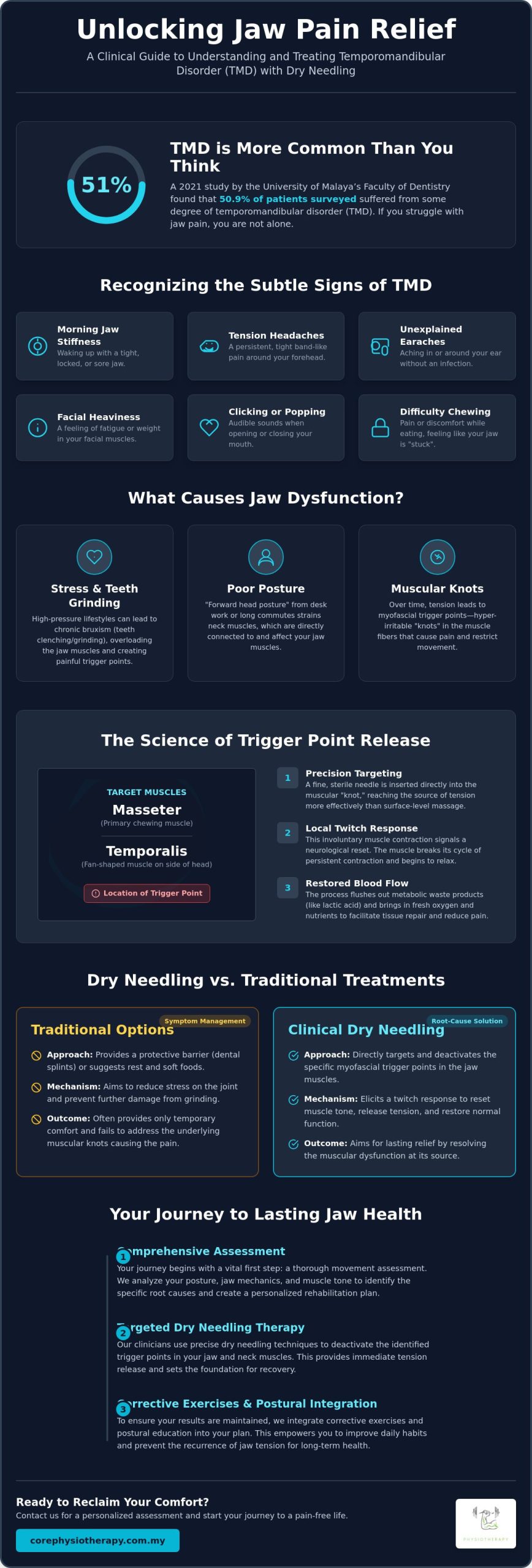
Did you know that a 2021 study by the University of Malaya’s Faculty of Dentistry found that 50.9% of patients surveyed suffered from some degree of temporomandibular disorder (TMD)? If you spend your mornings struggling with a stiff jaw or your afternoons managing a tension headache, you’re certainly not alone in this experience. It’s exhausting to navigate the day when eating or speaking feels like a chore, and it’s natural to feel anxious about the possibility of invasive dental procedures or lifelong medication.
We believe that recovery starts with a clear, clinical understanding of the underlying problem. You deserve to know why your jaw feels locked and how to regain your natural, fluid movement. This guide explores how specialized dry needling for jaw pain jb can deactivate specific trigger points and restore your comfort through a precise, root-cause approach. We’ll walk you through the science of neuromuscular relief, the value of a thorough initial assessment, and how targeted therapy can finally eliminate those clicking sensations so you can live without the constant shadow of jaw tension.
Key Takeaways
- Identify the subtle symptoms of TMD, including earaches and facial heaviness, that often persist even after standard dental checkups.
- Learn how clinical dry needling for jaw pain jb deactivates trigger points in the Masseter and Temporalis muscles to unlock restricted movement.
- Compare the efficacy of dry needling against traditional options like dental splints to find the most direct path toward lasting relief.
- Understand why a comprehensive movement assessment is a vital first step in creating a personalized rehabilitation plan for your jaw.
- Discover how integrating corrective exercises ensures the results of your treatment are maintained through improved postural habits.
The Silent Struggle of Jaw Pain in JB: Why Your TMJ Won’t Settle
Many residents in Johor Bahru experience a persistent tightness in their jaw that simply won’t go away. This condition, often referred to as Temporomandibular joint dysfunction (TMD), isn’t just a minor inconvenience. It affects your ability to eat, communicate, and enjoy your day. While many people believe jaw pain is strictly a dental issue, it’s frequently rooted in the complex muscular system surrounding the joint. In a high-pressure urban environment like JB, stress-induced bruxism, or teeth grinding, is a common catalyst for these issues. Traditional advice like resting the jaw or sticking to a soft-food diet might provide temporary comfort, but these methods often fail to address the underlying muscular knots that have formed over months of clenching. You need a solution that targets the root cause.
Identifying TMD Symptoms: More Than Just a Clicking Sound
Realizing that your jaw pain is more than a “click” is the first step toward recovery. We often see patients who describe a sense of “heaviness” in their face or persistent earaches that have no clear medical cause. It’s vital to distinguish between joint-related issues and muscle-related dysfunction. When the muscles are the primary source of pain, it often presents as chronic muscle tension relief jb. This tension doesn’t stay isolated. It frequently radiates upward, manifesting as tension-type headaches that feel like a tight band around your forehead. You might find that your teeth are healthy, yet your jaw feels perpetually exhausted. This muscular fatigue is a hallmark of TMD that requires a specialized clinical approach rather than just a dental guard.
The JB Lifestyle Factor: Stress, Posture, and Jaw Clenching
Your daily routine in JB significantly impacts your jaw health. Long commutes across the causeway or hours spent at a desk can lead to “forward head posture.” This misalignment places immense strain on the neck muscles, which are physiologically linked to your jaw. When your neck is strained, your jaw muscles overwork to compensate. This leads to the formation of painful trigger points. Simply telling yourself to “just relax” isn’t effective once these physiological “knots” have set in. This is where clinical interventions like dry needling for jaw pain jb become essential. We focus on deactivating these stubborn points to reset the muscle’s resting tone. This allows for a return to natural, pain-free movement. It’s about more than just temporary relief; it’s about reclaiming your quality of life through a steady, methodical recovery process.
How Dry Needling Targets the Root Cause of Jaw Dysfunction
The jaw is a marvel of biomechanical engineering, yet it’s highly susceptible to muscular dysfunction. Your jaw’s movement is controlled by a specialized group of muscles, including the powerful Masseter, the broad Temporalis, and the deep-seated Pterygoids. When these muscles are subjected to chronic stress or postural strain, they develop myofascial trigger points. These are tight “knots” of muscle fibers that remain in a constant state of contraction. By utilizing dry needling for jaw pain jb, our clinicians can precisely target these points to restore normal function.
When a fine, sterile needle enters a trigger point, it often elicits a “Local Twitch Response.” This involuntary contraction is a signal that the muscle is resetting its resting tone. This mechanical stimulation breaks the cycle of persistent contraction and allows the muscle fibers to lengthen. Additionally, the process encourages local vasodilation. This increase in blood flow is crucial; it flushes out accumulated metabolic waste products like lactic acid while bringing in fresh oxygen and nutrients to facilitate tissue repair.
The Science of Trigger Point Release in the Masseter and Temporalis
The Masseter is widely recognized as the strongest muscle in the human body relative to its size. Because of its strength, it’s prone to hypertonicity, a state of excessive muscle tone that makes the jaw feel “heavy” or stuck. A clinical approach to muscle trigger point release jb allows us to penetrate these dense tissues more effectively than surface-level massage. The needle has an immediate mechanical effect on shortened muscle spindles, forcing them to relax and easing the pressure on your temporomandibular joint.
Neurological Benefits: Calming the Jaw’s Pain Signal
The benefits of this therapy extend far beyond the physical muscle fibers. Dry needling interacts directly with the nervous system by disrupting the pain-gate mechanism within the trigeminal nerve, which is responsible for sensation in the face. This process stimulates the body’s natural pharmacy, triggering the release of endogenous opioids that provide a sense of calm and systemic relief. Dry needling for the jaw is a specialized clinical intervention that utilizes fine-filament needles to provide a neurological “reset” for overactive facial muscles and sensitive nerve pathways. If you’re ready to address these symptoms at their source, a professional initial assessment can help determine the right path for your recovery.
Dry Needling vs. Traditional Jaw Pain Treatments: A Comparative Look
Choosing the right path for TMD recovery can often feel overwhelming. Many people begin their journey with over-the-counter painkillers or topical gels. While these options provide temporary comfort, they primarily mask the pain signal rather than fixing the underlying muscle dysfunction. When you rely on medication, the metabolic waste and trigger points remain trapped within the tissue. Dry needling for jaw pain jb offers a sophisticated middle ground. It’s a clinical intervention that provides deeper, more targeted results than surface treatments while remaining far less invasive than surgical procedures. By integrating this technique with hands-on manual therapy, we address both the joint’s mobility and the muscle’s resting state for a more comprehensive recovery.
Dry Needling vs. Mouth Guards: Active vs. Passive Therapy
Dental splints and night guards are standard recommendations for those who grind their teeth. These devices are excellent for protecting your tooth enamel from the mechanical force of bruxism, but they’re essentially passive tools. They don’t always stop the brain from sending the signal to clench; they simply provide a buffer. In contrast, dry needling is an active therapy. It physically deactivates the overactive trigger points, teaching the muscle to return to a relaxed state. For many, a multi-modal approach is the most effective. You might continue using a guard to protect your teeth while utilizing dry needling for jaw pain jb to treat the underlying muscular cause. This dual strategy ensures both immediate protection and long-term rehabilitation.
Why Clinical Dry Needling Surpasses General Massage
While a general facial massage feels pleasant, it often lacks the precision required to resolve chronic jaw tension. Certain muscles, such as the lateral pterygoid, are located deep within the jaw structure. These areas are virtually impossible to reach with manual pressure alone. A fine-filament needle allows for pinpoint accuracy, reaching these deep-seated knots with minimal discomfort. This level of anatomical precision is the primary difference between a relaxation-focused spa treatment and an evidence-based pain management clinic johor bahru. Our focus is on clinical outcomes and functional improvement. We don’t just aim to make you feel better for an hour. We aim to restore your jaw’s full range of motion and eliminate the persistent clicking that disrupts your daily life.
What to Expect During Your Jaw Pain Session in Johor Bahru
Walking into a clinical environment for the first time can feel intimidating, especially when you’re already dealing with the discomfort of a locked or painful jaw. At Core Physiotherapy, we prioritize your comfort by explaining every step of our process with clarity and empathy. Your journey toward relief doesn’t begin with a needle; it starts with a conversation and a thorough physical examination. This methodical approach ensures that dry needling for jaw pain jb is applied exactly where it will be most effective for your specific condition, rather than following a generic protocol.
The Initial Assessment: Why We Look Beyond the Jaw
Many patients are surprised when we begin by examining their neck and shoulders during their first visit. Your jaw doesn’t exist in isolation. Its position is often dictated by the alignment of your cervical spine and the tension in your upper trapezius muscles. By conducting a professional movement assessment in Johor Bahru, we can identify postural imbalances that contribute to your TMJ dysfunction. We also look for “referred pain” patterns. Sometimes, what feels like a localized toothache is actually a trigger point in the masseter muscle sending pain signals elsewhere. Understanding these interconnected patterns is key to achieving a root-cause resolution rather than just a temporary fix.
Safety, Comfort, and Post-Session Care
Safety is our highest priority. We use only single-use, sterile, fine-filament needles in a strictly hygienic clinical setting. If you’re nervous about needles, you’ll be pleased to know that jaw needling is remarkably comfortable. Most patients report a tiny “pinch” followed by a deep, dull ache. This ache is a positive sign; it indicates that we’ve successfully engaged the trigger point to initiate a release. We never aim for sharp or radiating pain, and we’ll communicate with you throughout the procedure to ensure you feel secure.
Following your session for dry needling for jaw pain jb, it’s normal to feel some mild soreness, similar to the feeling after a good workout. We recommend staying well-hydrated to help your body flush out metabolic waste and facilitate healing. Within the first 24 hours, you should avoid heavy jaw usage, like chewing gum or eating very hard foods. Many of our patients notice an immediate improvement in their range of motion, finding they can open their mouths wider and with less “catching” than before. If you’re ready to experience this clinical approach for yourself, we invite you to book an initial assessment with our dedicated team today.
Beyond the Needle: Integrating Movement Therapy for Lasting Jaw Health
The immediate relief experienced after a clinical session is often profound, but for many patients, the ultimate goal is ensuring that the pain doesn’t return. We often describe the therapeutic process in two distinct phases: the “reset” and the “reprogram.” While the needle acts as a powerful reset for overactive muscles, movement therapy is the essential reprogramming required for your nervous system. Clinical dry needling for jaw pain jb creates a window of opportunity where your muscles are relaxed and receptive to change. Our role as your dedicated recovery guides is to help you use that window to build better habits and stronger support structures.
Addressing the postural habits that lead to jaw tension is a vital part of this journey. If you spend your day leaning toward a computer screen or tensing your shoulders during a long commute, your jaw will naturally compensate for that forward head position. Without addressing these systemic patterns, the trigger points we deactivate may eventually reform. By focusing on the coordination of your cervical spine and the stability of your temporomandibular joint, we help you build a physical foundation that resists future tension. This holistic approach ensures that your recovery isn’t just a temporary break from pain but a permanent shift in how your body moves.
Personalized Corrective Exercises for TMJ Stability
Lasting jaw health requires more than just relaxation; it requires control. We design personalized routines that fit into the busy lives of JB professionals, focusing on efficiency and clinical effectiveness. Your program may include:
- Jaw Tracking Drills: Gentle exercises that improve opening symmetry and prevent the “zigzag” motion often seen in TMD.
- Deep Neck Flexor Strengthening: Exercises to support your cervical spine, which reduces the workload on your jaw muscles.
- Postural Awareness Drills: Simple, desk-friendly movements that reset your shoulder and head alignment throughout the day.
Why Core Physiotherapy JB is Your Partner in Recovery
At our Eco Palladium center, we’ve created a supportive, clinical environment where your long-term well-being is the primary focus. We don’t believe in superficial fixes or temporary patches. Our commitment to root-cause analysis means we’re invested in understanding the unique stressors and physical demands of your life. Integrating specific drills alongside dry needling for jaw pain jb ensures that your recovery is both deep and durable. We’re here to help you move toward a life free from the anxiety of jaw clicking and the exhaustion of chronic tension. You don’t have to manage this struggle alone; let’s work together to restore your natural, pain-free vitality.
Reclaim Your Comfort and Confidence
Living with persistent jaw tension often feels like an endless cycle of discomfort and frustration. We’ve explored how a clinical approach to dry needling for jaw pain jb can effectively deactivate deep-seated trigger points and restore your natural range of motion. By moving beyond temporary fixes and focusing on evidence-based root cause analysis, you can finally address the muscular knots and postural habits that keep your TMJ from settling. Our expert therapists are committed to acting as your dedicated guides, ensuring that every session at our Eco Palladium center moves you closer to a life free from clicking and stiffness.
Recovery is a progressive journey, and it begins with understanding exactly why your pain started in the first place. Whether you’re struggling with chronic headaches or difficulty eating, there’s a clear path toward physical improvement and lasting relief. We invite you to take the first step toward a more vibrant, pain-free lifestyle today. Book Your Comprehensive Jaw Assessment at Core Physiotherapy JB and discover the difference that specialized, patient-centered care can make in your daily well-being. Your recovery is possible, and we’re here to support you every step of the way.
Frequently Asked Questions
Is dry needling for jaw pain safe?
Dry needling for the jaw is highly safe when administered by a qualified professional. In Malaysia, practitioners are registered under the Allied Health Professions Act 2016 to ensure they meet strict clinical standards. We use single-use, sterile needles and follow rigorous hygiene protocols to protect your health. Our therapists are trained to navigate the delicate facial anatomy with precision, ensuring a safe and supportive environment for your recovery.
How many sessions of dry needling will I need for my TMJ?
The number of sessions required depends on the duration and severity of your symptoms. Most patients begin to feel a noticeable improvement in their jaw mobility within 3 to 5 sessions. While some individuals experience immediate relief, chronic cases often require a more structured plan to ensure the muscular “reset” becomes permanent. We’ll outline a specific timeline tailored to your needs during your initial assessment.
What is the difference between dry needling and acupuncture for jaw pain?
Dry needling and acupuncture use similar needles but follow entirely different clinical philosophies. Acupuncture is based on Traditional Chinese Medicine (TCM) and focuses on restoring energy flow along traditional meridians. In contrast, dry needling for jaw pain jb is an evidence-based Western intervention. It targets specific myofascial trigger points and neuroanatomical structures to resolve muscular dysfunction and pain signals directly. For a deeper understanding of how these two approaches compare, our dry needling vs acupuncture Johor Bahru clinical comparison guide outlines the key evidence-based differences to help you make an informed choice.
Will dry needling help if my jaw is clicking or popping?
Yes, dry needling can be very effective for reducing or eliminating clicking and popping sounds. These noises often occur when tight muscles pull the jaw joint or its protective disc out of optimal alignment. By deactivating knots in the lateral pterygoid and masseter muscles, we help the joint move more smoothly. This reduces the mechanical friction and imbalance that typically cause audible clicking during mouth opening.
Can dry needling fix my tension headaches?
Many tension headaches are actually referred pain originating from the jaw and neck muscles. Trigger points in the temporalis muscle, located on the side of your head, are a frequent culprit for pain felt around the temples. By releasing these specific points, we can often eliminate the root cause of chronic headaches. This provides a long-term solution that helps you move away from a reliance on daily painkillers.
Does jaw dry needling hurt?
Most patients find the procedure much more comfortable than they initially anticipated. You might feel a brief “pinch” followed by a deep, dull ache or a local twitch response as the muscle relaxes. This sensation is a positive sign that the needle has successfully engaged the trigger point. Our therapists work at your pace to ensure the experience remains manageable and focused on your comfort.
What should I do after my jaw needling session in JB?
Following your session, prioritize hydration and gentle movement to support the healing process. Drinking plenty of water helps your body process the metabolic changes initiated during the treatment. It’s also helpful to perform the gentle jaw-tracking drills provided by your therapist. These movements help “program” your newly relaxed muscles into a healthier, more symmetrical pattern of motion for lasting results.
Can I eat normally after a jaw dry needling treatment?
You can eat after your treatment, though we recommend choosing softer foods for the first 24 hours. Avoiding very crunchy, hard, or chewy foods gives your jaw muscles time to settle after their neurological “reset.” This minor adjustment helps maximize the benefits of your dry needling for jaw pain jb session and prevents unnecessary strain on the treated tissues as they begin to recover.